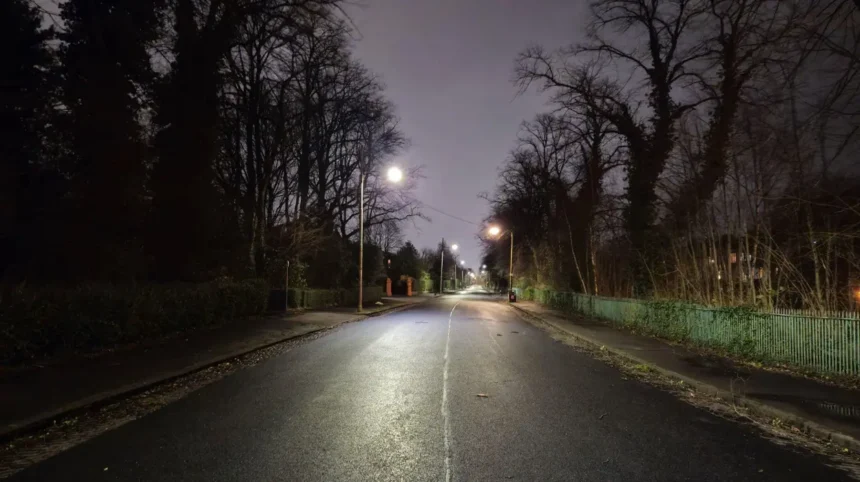
Streetlights play an essential role in maintaining road safety, pedestrian visibility and public security across Glasgow. A faulty streetlight creates poor visibility for drivers, cyclists and pedestrians, particularly during winter evenings when daylight hours are limited. Damaged lighting columns, exposed electrical cables and groups of unlit streetlights also create potential hazards in residential streets and public spaces.
- Why Is Street Lighting Important in Glasgow?
- Road and pedestrian safety
- Visibility around residential neighbourhoods
- Public accessibility
- Crime prevention and public confidence
- Who Is Responsible for Streetlight Maintenance in Glasgow?
- How Can You Report a Streetlight Problem in Glasgow?
- Report a streetlight fault online
- Report a broken streetlight through the MyGlasgow app
- Report an emergency streetlight problem by telephone
- What Types of Streetlight Problems Can You Report in Glasgow?
- 1. Streetlights that are not working
- 2. Streetlights operating during daylight
- 3. Damaged or leaning lighting columns
- 4. Exposed electrical cables
- 5. Multiple streetlights not working
- 6. Damaged lighting equipment
- What Information Should You Provide When Reporting a Streetlight Fault?
- Street name and exact location
- Lighting column reference number
- Description of the problem
- Photographic evidence
- Date and time
- What Happens After You Report a Streetlight Problem?
- Initial assessment of the report
- Inspection of the lighting equipment
- Identification of the fault
- Repair or replacement
- Why some repairs take longer
- How Does Glasgow City Council Maintain Its Streetlighting Network?
- Lighting columns and associated equipment
- Routine inspections
- Investment in lighting infrastructure
- Public lighting asset information
- How Long Does Glasgow City Council Take to Repair a Broken Streetlight?
- Emergency lighting repairs
- Routine lighting repairs
- Electrical supply problems
- What should residents do about prolonged delays?
- What Should You Do If a Streetlight Is Dangerous?
- Report a leaning or unstable column
- Stay away from exposed electrical wiring
- Report fallen lighting columns
- Report dangerous defects near schools
- Does Glasgow City Council Maintain Streetlights on Every Road?
- How Can Residents Help Improve Street Lighting Across Glasgow?
- Report faults when they first appear
- Provide accurate location information
- Encourage community reporting
- Report recurring lighting problems
- What Is the Future of Street Lighting in Glasgow?
Glasgow City Council is responsible for maintaining a substantial streetlighting network across the city. Residents, businesses, commuters and visitors can report defective streetlights through the council’s official reporting service. The reporting process helps the council identify faults, assess potential dangers and arrange appropriate maintenance.
Knowing how to report a streetlight problem in Glasgow helps residents direct complaints to the correct authority. It also ensures that dangerous lighting defects receive appropriate attention.
This guide explains how to report a broken streetlight, which contact details to use, what information to provide, how the council manages lighting faults and what residents should do when a damaged lighting column presents an immediate danger.
Why Is Street Lighting Important in Glasgow?
Street lighting improves visibility, supports road safety and helps pedestrians navigate Glasgow’s public spaces after dark. It illuminates roads, pavements, crossings and residential areas. Properly maintained lighting also helps drivers identify hazards and makes streets more accessible during darker months.
Street lighting is an important part of Glasgow’s public infrastructure. It supports the movement of pedestrians, cyclists, motorists and public transport users throughout the city.
Glasgow experiences substantial seasonal differences in daylight. During winter, darkness arrives earlier and daylight begins later. These conditions increase the importance of functioning streetlights around residential neighbourhoods, busy roads, shopping streets and transport connections.
Streetlights provide several important public benefits.
Road and pedestrian safety
Streetlights help drivers identify pedestrians, road markings, junctions, parked vehicles and potential obstacles. Good visibility supports safer driving conditions, particularly around complex intersections and areas with frequent pedestrian movement.
Pedestrians also depend on street lighting when using pavements, pedestrian crossings and public footpaths.
Visibility around residential neighbourhoods
Residential streets require appropriate illumination to support residents travelling home during evening hours. Streetlights help people identify pavement edges, uneven surfaces, street furniture and other potential obstacles.
Areas around schools, community facilities and public transport stops also benefit from consistent lighting.
Public accessibility
Street lighting supports people with different mobility and accessibility requirements. Adequate illumination helps pedestrians identify kerbs, steps, ramps and changes in pavement surfaces.
Poor lighting creates additional difficulties for people with visual impairments and older residents.
Crime prevention and public confidence
Visible public spaces support natural surveillance. Residents can observe streets, entrances and nearby activity more easily when appropriate lighting is available.
However, street lighting alone does not prevent crime. Its contribution forms part of wider community safety arrangements involving environmental design, policing and neighbourhood management.
Who Is Responsible for Streetlight Maintenance in Glasgow?
Glasgow City Council manages street lighting on roads and public spaces within its maintenance responsibilities. Its Lighting Establishment unit oversees the city’s lighting infrastructure, including lighting columns and associated maintenance activities. Different arrangements apply to motorways and certain trunk roads.
Glasgow City Council is the main local authority responsible for public streetlighting across Glasgow. Its responsibilities include maintaining lighting infrastructure, investigating reported defects and arranging repairs.
The council’s Lighting Establishment unit manages the city’s streetlighting assets.
A sentencing statement published by the Scottish Judiciary on 8 January 2026 identified approximately 74,490 streetlighting columns under the unit’s responsibility. This figure demonstrates the scale of the infrastructure requiring inspection and maintenance. scts_judiciary
Glasgow City Council’s responsibilities
The council’s streetlighting responsibilities include:
- Maintaining public streetlighting columns.
- Investigating reported lighting faults.
- Repairing defective lighting equipment.
- Assessing damaged lighting infrastructure.
- Arranging replacement of deteriorating columns.
- Managing lighting maintenance and improvement programmes.
The council also maintains a public dataset containing the locations of lighting columns managed by its roads operations service. Open Data Scotland identifies this dataset as being refreshed weekly, with the latest listed update on 10 July 2026.
Who maintains motorway and trunk road lighting?
Not every road in Glasgow falls under the same maintenance arrangements.
Motorways and designated trunk roads form part of Scotland’s strategic road network. Transport Scotland manages the trunk road network through its operating companies.
Glasgow City Council generally handles local authority roads, while the relevant trunk road operating company deals with infrastructure on its network.
Residents should identify the road authority before submitting a report. This prevents complaints about strategic road infrastructure from being directed to the wrong organisation.
How Can You Report a Streetlight Problem in Glasgow?
Residents can report non-emergency streetlight faults through Glasgow City Council’s official lighting fault reporting service. The MyGlasgow app also supports broken streetlight reports. For dangerous lighting faults presenting immediate risks, residents should contact the council’s emergency reporting number.
Glasgow residents have access to digital and telephone reporting options. The correct method depends on the seriousness of the problem.
The council’s lighting fault reporting service provides the main route for notifying the authority about defective streetlights.
Report a streetlight fault online
The online reporting service allows residents to provide information about faulty lighting infrastructure.
Visit the Glasgow City Council website and search for its official Report a lighting fault service.
When submitting a report, provide the following information:
- The street name and location.
- The nearest property or landmark.
- The lighting column reference number, if available.
- A description of the fault.
- The approximate date the problem started.
- Photographs, where safe and appropriate.
Accurate location information helps the maintenance team identify the affected lighting equipment.
Report a broken streetlight through the MyGlasgow app
The MyGlasgow app provides another reporting option for residents who prefer using smartphones.
The application supports reports about public infrastructure and environmental issues, including broken streetlights, potholes, graffiti and illegal dumping.
The general reporting process involves selecting the relevant issue category, answering the required questions, adding photographic evidence where appropriate and identifying the location.
The application supports location information and photographic evidence, helping residents communicate infrastructure problems more accurately.
Report an emergency streetlight problem by telephone
Emergency reporting
Residents should telephone 0800 373635 when a streetlighting fault creates an immediate danger to the public.
Emergency examples include a severely damaged lighting column, exposed electrical wiring or equipment presenting an immediate risk of injury.
Do not rely on an ordinary online report when the problem requires urgent attention. Contact the emergency reporting service directly and explain the danger.
The number is also listed in Glasgow council contact information reproduced by local community organisations. nvha.org.uk+1
What Types of Streetlight Problems Can You Report in Glasgow?
Glasgow residents can report different streetlighting defects, including completely unlit lamps, damaged columns, exposed cables, lights operating during daylight and faulty lighting equipment. Reports should describe the visible problem accurately so the council can assess its seriousness and arrange suitable maintenance.
Streetlighting problems do not always involve a completely dark lamp. Electrical faults, structural deterioration and damaged equipment also affect the reliability and safety of public lighting.
Understanding the type of fault helps residents provide useful information when contacting Glasgow City Council.
1. Streetlights that are not working
A completely unlit streetlight is one of the most common problems residents encounter.
The fault can affect an individual lamp or several lights along the same road. Residents should report the location of every affected lighting column when possible.
For example, someone travelling along a residential street in Pollokshields might notice that a streetlight outside a property is no longer operating.
The report should identify the affected road, nearby building number and lighting column reference.
2. Streetlights operating during daylight
Streetlights sometimes remain illuminated during daylight hours.
This problem can result from defective photocells, control equipment or electrical systems. A photocell is a light-sensitive component that helps control when a streetlight switches on and off.
Although a lamp operating during daylight does not always create an immediate safety hazard, it indicates a potential equipment or control fault.
Residents can report persistent daytime operation through the standard lighting fault reporting service.
3. Damaged or leaning lighting columns
A damaged lighting column requires particular attention because structural deterioration affects public safety.
Visible problems include:
- Bent or leaning columns.
- Cracked column bases.
- Severe corrosion.
- Missing access covers.
- Columns damaged by vehicle collisions.
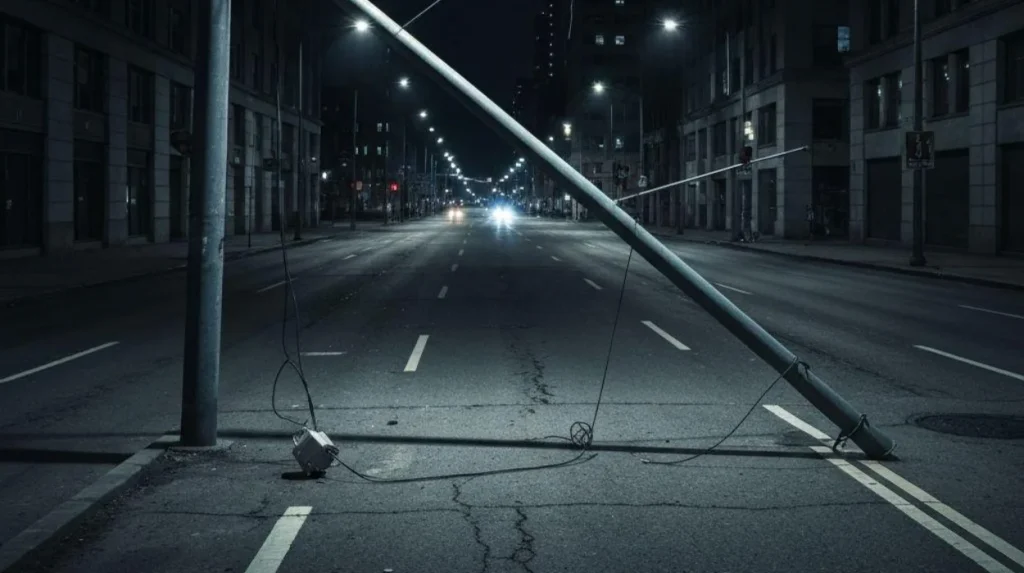
A damaged column should never be approached or touched. Residents should keep away from the structure and report the danger immediately.
4. Exposed electrical cables
Exposed wiring creates a serious electrical hazard.
Residents should report visible electrical cables, damaged electrical enclosures and missing access doors immediately when they present a danger.
Never attempt to repair exposed wiring or inspect electrical equipment yourself.
Keep pedestrians away from the affected area where this can be done safely.
5. Multiple streetlights not working
A group of defective streetlights can indicate a wider electrical or infrastructure problem.
For example, three consecutive streetlights failing along a residential road might indicate a supply fault, damaged underground cable or another shared electrical issue.
Reporting the entire affected section gives maintenance teams a clearer understanding of the problem.
6. Damaged lighting equipment
Streetlighting infrastructure includes more than the lamp itself.
Problems involving lantern fittings, covers, mounting brackets and electrical access panels also require attention.
Residents should describe the visible damage rather than attempting to identify the technical cause.

What Information Should You Provide When Reporting a Streetlight Fault?
A useful streetlight report includes the exact location, lighting column reference, type of fault and supporting photographs where available. Accurate information helps Glasgow City Council identify the correct equipment, understand the potential safety implications and direct the report to the appropriate maintenance team.
Providing detailed information improves the usefulness of a streetlight complaint.
A report stating only that a streetlight is broken does not identify the precise equipment or explain the nature of the problem.
Residents should provide enough information for the council to locate and assess the defect.
Street name and exact location
The street name is the most important starting point.
Include the nearest property number, junction, landmark or public facility.
For example, a report concerning a broken lamp on Great Western Road should identify the approximate position of the light rather than simply naming the entire road.
Useful location details include:
- Street name.
- Nearest building number.
- Nearby road junction.
- Opposite property or business.
- Nearby bus stop or public facility.
Lighting column reference number
Lighting columns often display identification numbers.
This reference helps maintenance teams locate individual lighting assets within the council’s infrastructure records.
Residents should check for a visible identification plate or label when it is safe to do so.
Never climb a column, cross a dangerous road or approach damaged electrical equipment to obtain a reference number.
If the number is unavailable, provide an accurate street address and nearby landmark.
Description of the problem
Explain exactly what is happening.
For example:
A clear report might state that the streetlight outside a particular property has remained completely unlit for three consecutive evenings.
Another report might explain that a lighting column is leaning towards the pavement and has visible damage around its base.
Specific descriptions are more useful than general complaints.
Photographic evidence
Photographs help communicate visible defects.
A photograph showing the affected lighting column, nearby street sign and surrounding location can help identify the correct equipment.
For safety reasons, take photographs from a safe public position. Do not touch the column or approach exposed cables.
Date and time
Include when the fault was first noticed.
Information about whether the problem happens continuously or intermittently is also useful.
For example, a streetlight that switches off repeatedly during the evening presents a different pattern from one that has remained completely unlit for several weeks.
What Happens After You Report a Streetlight Problem?
After receiving a streetlight report, Glasgow City Council can assess the reported location, identify the affected lighting equipment and determine the appropriate maintenance response. The investigation considers the defect, its safety implications and whether specialist electrical work is required.
Reporting a fault is the first stage of the maintenance process. The council then needs to establish what has happened and which work is necessary.
The exact process depends on the type and seriousness of the defect.
Initial assessment of the report
The reported information helps the council understand the nature of the problem.
Location details, photographs and lighting column references support the identification process.
The authority assesses whether the report concerns a routine lighting failure, damaged infrastructure or a potentially dangerous defect.
Inspection of the lighting equipment
A maintenance team or appointed contractor investigates the reported problem.
An inspection can involve checking the lamp, electrical equipment, connections and visible condition of the lighting column.
Where structural deterioration is suspected, further examination is required to assess the condition of the column.
Identification of the fault
Different technical problems require different repair methods.
A defective lamp or electrical component requires a different response from a damaged underground supply cable.
Some faults involve equipment maintained by the council, while others require cooperation with an electricity network operator.
Repair or replacement
Once the problem has been identified, the responsible organisation arranges appropriate remedial work.
Repairs can involve replacing defective lighting components, restoring electrical connections or arranging more extensive infrastructure work.
Where a lighting column is structurally unsafe, replacement or other safety measures become necessary.
Why some repairs take longer
Not every streetlight fault can be repaired during the initial inspection.
Underground cable damage, replacement equipment requirements and coordination with external network operators can extend the repair process.
Residents should therefore distinguish between the time taken to acknowledge a report, investigate a defect and complete the permanent repair.
Glasgow City Council’s published information should be consulted for any applicable service standards. Do not assume that every non-emergency fault has the same repair deadline.
How Does Glasgow City Council Maintain Its Streetlighting Network?
Glasgow City Council maintains streetlighting through infrastructure management, inspection, fault reporting and repair programmes. Its Lighting Establishment unit oversees approximately 74,490 lighting columns, making planned maintenance and accurate defect reporting important parts of managing the city’s public lighting network.
Streetlighting maintenance involves ongoing management rather than simply replacing lamps after they stop working.
Glasgow has an extensive network of lighting infrastructure distributed across residential areas, commercial streets and transport routes.
Lighting columns and associated equipment
A streetlighting column is the supporting structure that holds the lighting equipment above a road or pavement.
Its main components include the structural column, lantern, electrical connections and associated control equipment.
The lantern houses the light source and optical components that distribute illumination.
Electrical systems provide power and control the operation of the lighting equipment.
Each component requires appropriate maintenance to ensure the complete installation operates correctly.
Routine inspections
Inspections help identify deterioration before equipment becomes unsafe.
Inspectors assess the visible condition of columns and associated equipment, looking for defects such as corrosion, damage and deterioration.
The importance of structural inspection became particularly clear following a serious incident on Bellshaugh Road in Glasgow in June 2023.
According to the Scottish Judiciary’s sentencing statement published on 8 January 2026, a lighting column collapsed and seriously injured a pedestrian. The investigation identified severe corrosion near the base of the column.
The court was informed that the council had approximately 9,000 lighting columns categorised as being in poor condition at the time of the incident. The affected column had previously been identified for replacement.
Investment in lighting infrastructure
The same judicial statement recorded that Glasgow City Council had invested more than £13.6 million in lighting infrastructure since 2014.
It also recorded an additional £7.5 million allocation for replacing T4 lighting columns over the following three years.
The council described improvements to its inspection criteria, risk-based assessment and dedicated inspection arrangements.
These developments demonstrate the importance of identifying structural defects and reporting damaged lighting infrastructure promptly.
Public lighting asset information
Glasgow’s lighting column dataset provides another important part of infrastructure management.
Published through Open Data Scotland, the dataset identifies locations of lighting columns maintained by the council’s roads operations service.
The dataset is available in formats including CSV, GeoJSON, KML and shapefile. Its published update frequency is weekly.
This information supports the wider understanding and management of public lighting assets.
How Long Does Glasgow City Council Take to Repair a Broken Streetlight?
The time required to repair a broken streetlight in Glasgow depends on the type of defect, its safety implications and the work required. Emergency hazards receive priority assessment, while routine lighting failures follow the council’s maintenance and repair arrangements.
There is no single repair timeframe that applies to every streetlight fault.
A simple lamp failure generally involves less complex work than a damaged column or underground electrical fault.
Emergency lighting repairs
Emergency faults require prompt attention because they present potential risks to pedestrians, motorists or nearby properties.
Examples include severely damaged columns, exposed electrical wiring and unstable lighting equipment.
Residents should telephone the emergency reporting number rather than rely on a routine online submission.
Routine lighting repairs
Routine faults include individual lamps that have stopped working and streetlights that remain illuminated during daylight.
The council investigates these problems and arranges the necessary repairs.
The actual completion time depends on equipment availability, contractor arrangements and the technical cause.
Electrical supply problems
Some lighting failures originate in the electricity supply network rather than the streetlight itself.
These faults can require additional investigation and coordination with the relevant electricity network operator.
For this reason, residents should not assume that a repair delay means the original report has been ignored.
What should residents do about prolonged delays?
If a reported streetlight remains defective, residents should follow up through the council’s official reporting channels.
Provide the original report details, location and lighting column reference.
Explain whether the problem has worsened or whether additional streetlights have stopped working since the original report.
What Should You Do If a Streetlight Is Dangerous?
A dangerous streetlight requires immediate reporting when damaged equipment presents a risk of electrical injury, structural collapse or harm to road users. Keep away from the affected installation, warn others from a safe position and contact Glasgow City Council’s emergency reporting service.
Not every lighting problem is an ordinary maintenance issue.
Some defects create immediate hazards that require urgent intervention.
Report a leaning or unstable column
A leaning lighting column can indicate structural damage, vehicle impact or deterioration around its base.
Residents should avoid standing underneath or close to the structure.
Do not attempt to straighten, move or inspect the column.
Report its location and visible condition immediately.
Stay away from exposed electrical wiring
Damaged electrical equipment creates a serious risk of electric shock.
Never touch exposed cables, electrical panels or fallen lighting equipment.
Keep other people away from the affected area where it is safe to do so.
If someone is in immediate danger or an electrical emergency requires emergency services, call 999.
Report fallen lighting columns
A fallen column can obstruct pavements, roads and public access routes.
It can also leave electrical cables exposed.
Residents should report the incident immediately and provide information about the road obstruction and visible hazards.
Report dangerous defects near schools
Lighting defects near schools require particular attention because children and pedestrians regularly use surrounding pavements and crossings.
A damaged column near a school entrance, pedestrian crossing or busy footpath should be reported with its exact location.
The report should clearly explain the potential danger to people using the area.
Does Glasgow City Council Maintain Streetlights on Every Road?
Glasgow City Council maintains streetlighting on roads and public infrastructure within its responsibilities. Motorways and designated trunk roads fall under separate strategic road network arrangements, so residents should identify the responsible authority before submitting a lighting complaint.
Understanding road ownership prevents unnecessary delays when reporting streetlight problems.
Glasgow contains different road categories, including local residential roads, distributor roads and strategic transport routes.
Local authority roads
Glasgow City Council manages the maintenance of local public roads and associated streetlighting infrastructure within its responsibilities.
Examples include residential streets, local shopping areas and many neighbourhood roads.
Trunk roads
Trunk roads form part of Scotland’s strategic road network.
Transport Scotland is responsible for the strategic network, with operating companies undertaking maintenance and operational activities.
If a faulty streetlight is located on a trunk road, residents should consult Traffic Scotland to identify the appropriate reporting arrangements.
Motorways
Motorways have separate operational and maintenance arrangements.
Residents should not automatically send motorway lighting complaints through Glasgow City Council’s ordinary streetlight reporting service.
Identifying the road authority helps ensure that the problem reaches the organisation responsible for the infrastructure.
Explore More Area Guide
How to Report a Pothole in Glasgow: Council Guide
How to Report Fly-Tipping in Glasgow: Council Guide
How Can Residents Help Improve Street Lighting Across Glasgow?
Residents support better streetlighting through accurate fault reporting, early identification of damaged infrastructure and appropriate follow-up. Reporting defective lamps and dangerous columns helps Glasgow City Council identify maintenance requirements and understand problems affecting local streets and public spaces.
Community reporting is an important source of information for infrastructure maintenance.
Council inspections provide planned assessments, while residents can identify problems during everyday journeys.
Report faults when they first appear
Residents should report defective streetlights as soon as they notice persistent problems.
Early reporting provides the council with information about the affected location and equipment.
It also creates an opportunity for the authority to investigate before a defect becomes more serious.
Provide accurate location information
A precise location helps maintenance teams identify the correct lighting column.
Include the street name, nearby property number and reference number whenever possible.
Photographs provide additional context when they can be taken safely.
Encourage community reporting
Residents can share information about reporting procedures with neighbours, local community groups and businesses.
For example, a residents’ association in Dennistoun can encourage members to report broken lamps along shared residential streets.
Similarly, businesses in the city centre can notify the council about defective lighting near public entrances and pedestrian routes.
Multiple reports about the same problem should include consistent location information to help identify the affected infrastructure.
Report recurring lighting problems
Some faults return after an initial repair.
A streetlight that repeatedly switches off or a section of road that regularly loses illumination requires further investigation.
Residents should explain the recurring nature of the problem when submitting a follow-up report.
This information helps distinguish an isolated equipment failure from a potentially wider infrastructure issue.
What Is the Future of Street Lighting in Glasgow?
The future of streetlighting in Glasgow involves maintaining existing infrastructure, replacing deteriorating columns and improving lighting technology. Investment in inspections, equipment renewal and efficient lighting systems supports road safety, public accessibility and the long-term management of the city’s streetlighting network.
Streetlighting infrastructure requires continuous maintenance as equipment ages and technology develops.
Glasgow’s existing network includes thousands of lighting columns that require inspection, repair and eventual replacement.
LED lighting technology
Light-emitting diode technology, commonly called LED lighting, provides an alternative to traditional streetlighting systems.
LED lights convert electricity into illumination using semiconductor technology.
Their characteristics include:
- Lower electricity consumption compared with many traditional lighting technologies.
- Longer operating lifespans under suitable conditions.
- Directional light distribution.
- Reduced routine lamp replacement requirements.
LED installations still require maintenance. Electrical faults, damaged fittings and deteriorating columns remain possible.
Infrastructure replacement
Replacing ageing lighting columns is an important part of public infrastructure management.
The January 2026 judicial statement concerning Glasgow’s streetlighting system recorded additional funding for T4 column replacement and improvements to inspection arrangements. scts_judiciary
Continued asset renewal helps address structural deterioration and maintain the reliability of public lighting.
Smarter lighting management
Modern lighting systems support more advanced control and monitoring arrangements.
These technologies include remote fault monitoring, programmable lighting controls and systems that adjust illumination according to operational requirements.
Such systems provide opportunities to identify certain equipment failures more efficiently.
However, technological improvements do not replace the need for physical inspections and public reporting.
Long-term public safety
Streetlighting remains an essential component of Glasgow’s transport and public infrastructure.
Maintaining reliable lighting requires coordination between local authorities, contractors, electricity network operators and residents.
Accurate reporting remains an important part of identifying problems across the city.
Reporting a streetlight problem in Glasgow is an important way for residents to support public safety and infrastructure maintenance.
Glasgow City Council provides an official online lighting fault reporting service and the MyGlasgow app for reporting non-emergency problems.
Residents should use 0800 373635 when a dangerous streetlighting fault requires emergency attention.
Providing the exact location, lighting column reference, description and supporting photographs helps the council investigate reported problems.
Whether a streetlight has stopped working in the city centre, a residential street in Shawlands or a neighbourhood road in Maryhill, reporting the defect helps the responsible authority identify the problem and arrange the appropriate response.
Keeping Glasgow’s public lighting infrastructure safe and functional requires regular maintenance, effective inspections and cooperation between the council and local communities.
How do I report a broken streetlight in Glasgow?
You can report a broken streetlight through Glasgow City Council’s official online lighting fault reporting service. Visit the council website, provide the street location and describe the fault. You can also use the MyGlasgow app.