Key Points
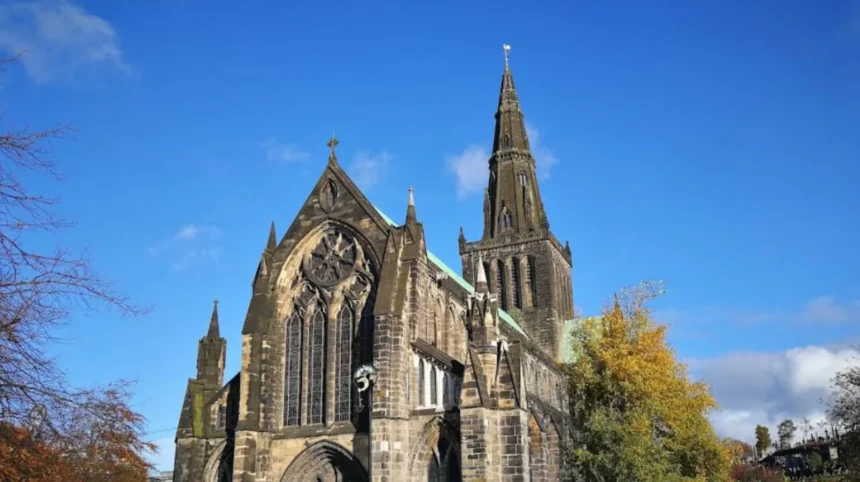
- Historic Environment Scotland (HES) has launched a major three-year conservation programme to protect the medieval spire of Glasgow Cathedral.
- The initiative involves carefully dismantling and rebuilding the head of the iconic 225ft spire to address damaged stonework and secure its long-term future.
- An internal steel frame installed in 1970 has caused structural stress because its bolts have rusted and expanded against the medieval masonry, resulting in cracks and shifting.
- Increased rainfall, linked to climate change, has accelerated stone corrosion and deterioration across historic Scottish architecture.
- HES stonemasons are actively carving replacement stones while striving to preserve and reinstate as much original medieval fabric as possible.
- Authorities have raised concerns over unauthorized access to the site scaffolding, prompting appeals to the public and Police Scotland.
Glasgow (Glasgow Express) September 24, 2026 – Major conservation works have officially commenced to protect the medieval spire of Glasgow Cathedral, introducing a notable visual shift to the city skyline as scaffolding rises around the structure.
- Key Points
- What caused the structural damage to the 225ft spire?
- How are conservation teams tackling the high-altitude engineering challenges?
- What are the official statements regarding the monumental repair works?
- Why have authorities issued warnings regarding cathedral scaffolding?
- Background of the particular development
- Prediction
The extensive three-year Historic Environment Scotland programme centers on the careful dismantling and subsequent rebuilding of the head of the iconic 225ft spire. This intervention is designed to repair acute stonework damage and guarantee the structural integrity of the monument for future generations.
What caused the structural damage to the 225ft spire?
According to technical findings detailed by Historic Environment Scotland, the core issues stem from a steel support framework introduced inside the spire back in 1970. Over decades of exposure, the bolts securing this internal frame have corroded and rusted, expanding outward against the fragile medieval masonry. This relentless pressure has induced visible cracks and structural movement. Furthermore, heritage authorities note that accelerating climate change trends—specifically increased and heavier rainfall—have exacerbated moisture infiltration and hastened the deterioration of historic stone across multiple Scottish landmarks.
How are conservation teams tackling the high-altitude engineering challenges?
To address the complex decay high above the roofline, specialized stonemasons deployed by Historic Environment Scotland have already commenced crafting bespoke replacement stones. Conservation architects and craftspeople are dedicated to retaining, conserving, and reinstating as much of the original medieval fabric as physically possible during the rebuilding phases. The overall project is structured into tightly managed stages, with expert teams coordinating their operations around restrictive seasonal weather windows and rigorous safety protocols mandated for high-level structural engineering.
What are the official statements regarding the monumental repair works?
Emphasizing the architectural significance of the undertaking, David Borthwick, Head of South Region at Historic Environment Scotland, stated that
“Glasgow Cathedral is a defining part of the city’s skyline and one of Scotland’s great medieval buildings.”
Mr Borthwick further noted that while ongoing maintenance had previously taken place, “detailed surveys have confirmed that the upper section of the spire must now be taken down and rebuilt to secure it for the future.”
Elaborating on the technical execution, Mr Borthwick added that
“our teams are combining traditional craft skills with modern conservation expertise to tackle complex damage high above the cathedral roofline,”
describing it as
“challenging work, but it is essential if we are to protect as much historic stone as possible and keep this nationally important monument resilient in a changing climate.”
Why have authorities issued warnings regarding cathedral scaffolding?
Alongside the structural engineering hurdles, project leads have confronted security challenges on site. Historic Environment Scotland has formally urged members of the public to stay clear of the cathedral scaffolding network following a series of unauthorized access incidents.
Addressing these security breaches, Mr Borthwick cautioned that “as well as being extremely dangerous, activity like this disrupts conservation work, diverts our resources, and adds avoidable security costs,” while urging “anyone who witnesses trespassing on the site or has any information about these incidents to contact Police Scotland.”
Background of the particular development
Glasgow Cathedral stands as the oldest building within the city boundaries and holds the distinction of being the sole medieval cathedral on the Scottish mainland to survive the Protestant Reformation of 1560 virtually intact. Originally dedicated to St Kentigern—widely known as St Mungo—the foundations of the present complex trace back to the 12th century, though the bulk of the surviving architecture reflects a comprehensive rebuilding effort executed throughout the 13th century. Over the centuries, the landmark has witnessed significant climatic wear, industrial pollution impacts, and structural modifications, making continuous heritage oversight essential to its survival.
Prediction
This large-scale preservation initiative will likely influence how heritage agencies across the United Kingdom approach climate adaptation for ancient stone structures. For local residents, heritage enthusiasts, and the tourism sector in Glasgow, the temporary alteration of the skyline underscores a growing financial and logistical commitment required to safeguard national antiquities against intensifying weather patterns. While the scaffolding will temporarily alter the visual profile of the East End landmark, the successful execution of these repairs will secure the structural viability of the cathedral for decades, ensuring that regional tourism and historical education programs remain uninterrupted over the long term.