Key Points
- Investment Scale: A £270 million regeneration project will deliver approximately 1,000 new homes in north Glasgow over the next decade.
- Public-Private Tripartite: Glasgow City Council has backed plans to establish an Investment Partnership with the Scottish National Investment Bank (SNIB) and Aviva Capital Partners (ACP).
- Location & Site Specs: The project targets a 30-hectare brownfield site in Cowlairs, situated between Saracen Street and Keppochhill Road, which has laid derelict for 30 years.
- Tenure Mix & Stewardship: The masterplan proposes a multi-tenure mix across social, affordable, private, and build-to-rent sectors, with around one-third designated as social and affordable housing while the council maintains long-term stewardship.
- Engineering Challenges: The site suffers from complex ground constraints, including historic mine workings, a disused mineshaft, steep topography, and major infrastructure deficits requiring remediation.
- Funding Model: Glasgow City Council will transfer land at a nominal value, while ACP and SNIB provide development capital; a £34 million viability gap is currently being negotiated with the Scottish Government for grant funding.
- Masterplan Support: Regeneration specialist Place Capital Group provided design and feasibility frameworks, structuring the development into three main phases.
- Wider Regeneration Context: Cowlairs forms one of five active North Glasgow regeneration hubs (alongside Sighthill, Dundashill, Hamiltonhill, and Possilpark) collectively slated to deliver over 5,500 homes.
Glasgow Council (Glasgow Express) Augustb21, 2026 — Glasgow City Council has officially approved plans to enter into a pioneering £270 million investment partnership alongside the Scottish National Investment Bank and Aviva Capital Partners to construct approximately 1,000 new homes on a long-derelict 30-hectare site in Cowlairs.
- Key Points
- How Will the £270 Million Cowlairs Regeneration Project Be Structured?
- What Type of Housing Will Be Built on the Cowlairs Site?
- Why Is the Cowlairs Brownfield Site Considered Complex to Develop?
- Background of the Cowlairs Site and North Glasgow Regeneration
- Prediction: How This Development Will Affect Key Audiences
How Will the £270 Million Cowlairs Regeneration Project Be Structured?
As reported by Glasgow City Council officials, the local authority’s City Administration Committee backed the proposal to form a joint Investment Partnership designed to revive the massive, disused tract of land situated between Saracen Street and Keppochhill Road in the Possilpark area.
Under the agreed framework, Glasgow City Council will contribute the 30-hectare land holding at a nominal value. This land contribution is set to be matched by cash injections from SNIB and Aviva Capital Partners to capitalise the new corporate vehicle.
Development capital will be driven by institutional investors Aviva Capital Partners alongside the Scottish National Investment Bank, relieving the local authority of any ongoing capital demands. Local authority records indicate that technical and commercial assessments have highlighted a £34 million financial viability gap caused by heavy infrastructure and ground remediation requirements.
The Scottish National Investment Bank is currently leading discussions with the Scottish Government to secure grant funding to bridge this specific gap and unlock the full £270 million gross development value.
Place Capital Group, acting as a specialist urban regeneration consultant, provided initial feasibility studies and technical design frameworks.
The updated masterplan expands upon an earlier 2019 concept that envisioned roughly 600 homes, optimizing land use to yield approximately 1,000 units across three distinct phases. Each phase is planned to deliver roughly one-third of the total housing volume, allowing initial construction to focus on the most easily accessible land while maintaining flexibility across housing tenures.
What Type of Housing Will Be Built on the Cowlairs Site?
As detailed by municipal reports, the scheme aims to create a highly walkable, urban neighborhood that prioritises family-focused housing design.
The mixed-tenure framework encompasses social housing, affordable units, private sale properties, and build-to-rent options. Because Glasgow City Council retains an ongoing measure of long-term stewardship over the site, roughly one-third of all homes built across the development are designated to fall under social and affordable categories.
Architectural designs emphasize higher-density, low-rise homes—including terraced structures—intended to maximize brownfield density without relying entirely on multi-storey tower blocks. The local authority indicated that housing quality and sustainable urban design will serve as core metrics, seeking to reconnect the site seamlessly with existing commercial assets along Saracen Street.
Why Is the Cowlairs Brownfield Site Considered Complex to Develop?
As noted in reporting by Project Scotland, municipal assessments categorise the Cowlairs land as exceptionally complex and technically challenging. Having sat abandoned for three decades, the former post-industrial zone presents severe civil engineering hurdles.
Primary site constraints include:
- Subsurface Mine Workings: Widespread historical underground coal and ironstone workings requiring extensive stabilization.
- Unsealed Shafts: At least one documented disused mine shaft that must be safely capped and remediated.
- Severe Topography: Irregular ground contours requiring extensive re-grading and earthworks.
- Infrastructure Deficits: A complete lack of modern internal utilities, vehicular connectivity, and drainage networks capable of supporting high-density residential use.
Despite these physical obstacles, council leaders view the commercial structure as a scalable template. As stated by Susan Aitken, Leader of Glasgow City Council:
“This is a welcome decision that will lead to one of the most exciting developments I’ve seen over my nine years as council leader. Firstly, 1,000 much-needed family homes of all tenures during a housing emergency is more evidence of Glasgow’s reputation as a city that builds where other prevaricate. But the ambition to create a whole new walkable neighbourhood adjoining one of Glasgow’s most famous thoroughfares in Saracen St, with a commitment to quality, design-led higher-density family housing will create a new standard for modern urban design in Scotland.
“And while it may seem like dry accounting fact, the creation of this Investment Partnership with SNIB and Aviva opens up a whole new world of possibilities for housing-led regeneration in our city, and we are already in discussions with other similar patient capital funders around other large brownfield sites across Glasgow.”
Explore More Local Glasgow News
Graeme Dott Child Abuse Trial: High Court Glasgow Hearing 2026
Glasgow Gang War Re-ignites: Lyons Clan Orders Attacks, Glasgow 2026
Background of the Cowlairs Site and North Glasgow Regeneration
The Cowlairs development sits within a broader historical context of post-industrial decline and ambitious urban renewal in North Glasgow. For over 150 years, Cowlairs was heavily industrialized, famously housing the Cowlairs Railway Works—a massive engineering complex established in 1841 by the Edinburgh and Glasgow Railway.
The works built locomotives, carriages, and wagons, serving as an economic engine for the surrounding Possilpark and Springburn communities. However, following the nationwide decline of heavy industry and rail manufacturing during the mid-20th century, the works were systematically closed and demolished by the late 1960s and 1970s.
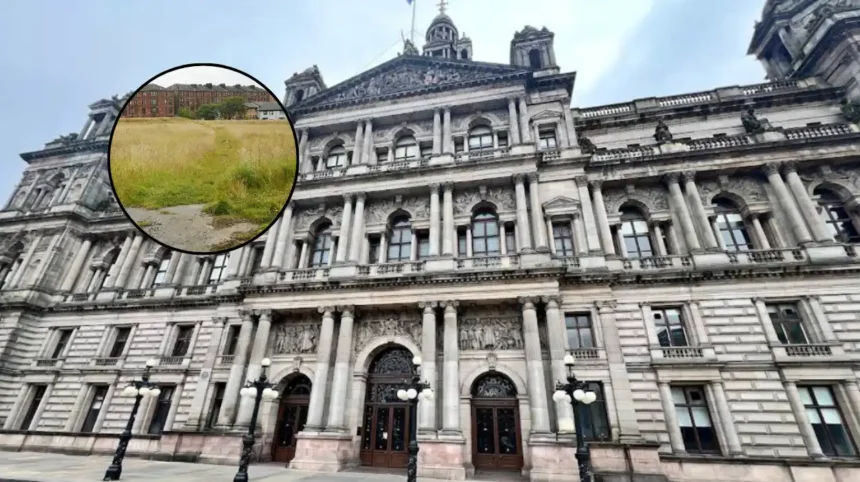
For the past 30 years, the 30-hectare expanse has remained vacant and derelict, slowly rewilding while standing as a physical barrier between nearby communities. Glasgow declared a city-wide Housing Emergency in November 2023 due to severe pressures on temporary accommodation, rising homelessness figures, and an acute shortage of affordable housing across all sectors.
To combat these challenges, Glasgow City Council identified North Glasgow as its primary urban expansion corridor. Cowlairs represents one of five major interconnected regeneration nodes along the Forth & Clyde Canal corridor. These five zones comprise:
- Cowlairs: 1,000 proposed homes.
- Sighthill: Scotland’s largest active urban regeneration project outside London, delivering over 1,000 homes alongside new schools and pedestrian bridge infrastructure.
- Dundashill: A canal-side eco-development focused on low-carbon custom builds.
- Hamiltonhill: Delivering roughly 600 energy-efficient social and private residences.
- Possilpark: Core town centre revitalization tied directly into the Cowlairs footprint.
Together, these five schemes are projected to bring more than 5,500 new residential properties to North Glasgow, reclaiming vast tracts of post-industrial land and targeting long-standing socio-economic inequalities.
Prediction: How This Development Will Affect Key Audiences
The approval and eventual build-out of the Cowlairs Investment Partnership will have distinct, direct consequences across several core groups:
- For Local Residents and the North Glasgow Community:The introduction of 1,000 family homes will significantly increase the local footfall in Possilpark. This population influx is expected to boost commercial vitality along Saracen Street, supporting existing small businesses and attracting new retail and community amenities. Replacing a 30-hectare derelict, blighted landscape with walkable green streets and modern housing will improve local physical connections, reduce anti-social activity associated with abandoned land, and enhance overall public safety and neighbourhood pride.
- For Individuals and Families on Housing Waitlists:With approximately one-third of the development dedicated to social and affordable housing (roughly 330 units), the project directly expands local housing supply during an active housing emergency. It provides modern, energy-efficient choices for low-income families and key workers who are currently priced out of the private rental sector or languishing in temporary council accommodation.
- For the Local Economy, Construction Industry, and Investors:The £270 million capital expenditure will generate substantial local economic activity. Construction firms, subcontractors, and supply chains throughout the West of Scotland will benefit from a decade-long pipeline of infrastructure and build contracts. Furthermore, if this tripartite model combining municipal land with patient institutional capital (Aviva) and state investment banking (SNIB) succeeds, it will establish a repeatable financial blueprint for unlocking contaminated brownfield sites across the United Kingdom.