Key Points
- Demolition Proposal: An application submitted to Glasgow City Council requests the demolition of an A-listed former church hall on Duke Street to enable a new residential development.
- Housing Project: Architectural studio Stallan-Brand has designed a six-storey development featuring 49 apartments, ground floor office space, and a courtyard on the corner of Duke Street and Melbourne Street.
- Applicant Details: The application for planning permission and listed building consent names Mark Feeley as the official applicant.
- Conservation Stance: Planning documents highlight that the proposed demolition is considered a “last resort” following extensive efforts to explore alternative options.
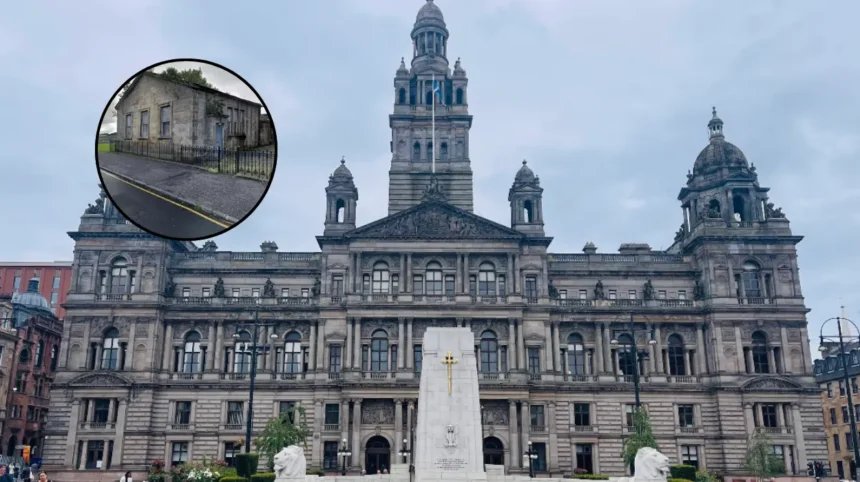
- Structural Deterioration: Unoccupied since a fire in 1985, the hall has suffered nearly 40 years of severe water damage, roof failure, timber decay, and local instability.
- Exhausted Options: At least six previous reuse exercises—including conversion into workspaces, studios, nurseries, and offices—were examined but deemed commercially and physically unviable.
Glasgow (Glasgow Express) October 2026 – An A-listed former church hall located near Tennent’s brewery on Duke Street could be demolished under fresh development proposals submitted to local authorities. Glasgow City Council has received official applications seeking full planning permission and listed building consent to clear the structure to pave the way for almost 50 residential flats.
- Key Points
- Why Is Demolition Being Proposed for the Historic Site?
- What Condition Is the Former United Presbyterian Church Hall Currently In?
- Have Alternative Reuse Schemes Been Explored Prior to Seeking Demolition?
- Background of the Particular Development
- Prediction: How This Development Can Affect the Local Community and Stakeholders
As reported by Local Democracy Reporter Drew Sandelands of Glasgow Live, The Herald, and Glasgow View, architectural studio Stallan-Brand has submitted the detailed plans on behalf of the named applicant, Mark Feeley. The submission outlines intent to erect a six-storey, 49-apartment development complete with ground floor commercial office space and a central courtyard situated at the corner of Duke Street and Melbourne Street.
Why Is Demolition Being Proposed for the Historic Site?
According to formal planning documents submitted to Glasgow City Council, the request to knock down the historic building comes as a “last resort”. As reported by Drew Sandelands of Glasgow Live, the application maintains that “all reasonable conservation, adaptation, funding and marketing options have been exhausted” over an extended period of assessment.
The former United Presbyterian church was originally designed in 1858. While the primary church structure forms part of the modern Wellpark Enterprise Centre, the adjoining hall was constructed at a later stage. Official planning filings state that the hall has now been “deemed unusable commercially and physically”.
Furthermore, planning documents emphasize that the hall is “no longer physically connected to the church, and its removal would not prevent the principal building or its architectural composition from being understood and appreciated”.
What Condition Is the Former United Presbyterian Church Hall Currently In?
As reported by Drew Sandelands of Glasgow Live, the hall structure has remained completely unoccupied since sustaining severe fire damage in 1985. Over the intervening decades, the condition of the listed hall has steadily and critically declined.
Planning documents submitted to the council detail the extent of the deterioration:
“Almost four decades of water penetration, roof failure, timber decay, vegetation growth and further unauthorised access have left it in an extremely poor and locally unstable condition. Its original plaster ceiling has been lost, its remaining timbers are rotten, and successive holding repairs have failed to arrest deterioration.”
Have Alternative Reuse Schemes Been Explored Prior to Seeking Demolition?
Before determining that demolition was required, developers and architectural teams carried out multiple feasibility assessments. As reported by Drew Sandelands of The Herald, at least six substantive reuse exercises were formally examined to evaluate whether the church hall could be adapted for alternative uses.
These evaluated reuses included:
- Conversion into light commercial workspace units
- Dedicated creative studios
- Education and vocational training facilities
- Professional architectural office suites
- A community children’s nursery facility
Following financial and structural appraisals, each option was determined to be unfeasible due to the extreme structural damage and prohibitive restoration costs required to return the hall to a usable standard.
Glasgow City Council planners are currently reviewing the planning application and listed building consent requests. A decision from the council’s planning committee is expected following standard public consultation and statutory heritage assessments.
Background of the Particular Development
The former United Presbyterian Church on Duke Street represents a notable example of mid-19th-century religious architecture in Glasgow’s East End. Designed in 1858, the original church served the local parish community for decades before shifting social demographics in the 20th century led to changes in its function. The main body of the church was subsequently integrated into the Wellpark Enterprise Centre, providing commercial space for small businesses and local enterprises.
However, the supplementary hall built behind the main church structure experienced a very different trajectory. Following a devastating fire in 1985, the hall was vacated and left disused. Over the subsequent 41 years, lack of active occupation coupled with harsh Scottish weather conditions accelerated structural decay. The building gained A-listed protection status due to its historic association with the primary church complex. In Glasgow, A-listed status signifies buildings of national or international architectural or historic importance, creating a exceptionally high legal threshold for permission to demolish. As a consequence, any proposal for demolition requires comprehensive justification proving that retention, repair, or conversion is structurally and economically unviable.
Prediction: How This Development Can Affect the Local Community and Stakeholders
If Glasgow City Council grants planning permission and listed building consent for the demolition and new build, the project will directly impact several key stakeholder groups across the area:
- Local Residents and Community: The introduction of 49 modern residential apartments will increase density on Duke Street and Melbourne Street. This influx of new residents could boost footfall for local shops, cafes, and amenities along the Duke Street corridor, while potentially increasing demand for local services and street parking.
- Heritage Advocates and Preservation Groups: The removal of an A-listed structure may draw criticism or formal objections from heritage bodies concerned about the loss of Glasgow’s 19th-century built environment. Conversely, resolving a derelict site that has stood as an eyesore and safety hazard since 1985 may be viewed as a practical resolution to long-term urban blight.
- Local Economy and Businesses: The inclusion of ground-floor commercial office space will provide fresh premises for local businesses, complementing the neighboring Wellpark Enterprise Centre and supporting employment in the East End.
- Planning Precedent: The decision will establish an important precedent regarding how Glasgow City Council balances strict statutory heritage protection against the economic realities of severely degraded, long-term vacant listed structures.