Key Points
- Police Scotland have arrested four additional men following the disorder at Glasgow’s Trongate during Celtic’s Scottish Premiership title celebrations.
- The total number of arrests connected to the event has now risen to seven following three initial detentions at the scene.
- The disturbances resulted in injuries to two police officers and the hospitalisation of three members of the public.
- Authorities spent several hours managing crowds, clearing litter, and addressing public order breaches in Glasgow city centre.
- Police Scotland have confirmed that dedicated investigations remain ongoing to identify further individuals involved in the disturbance.
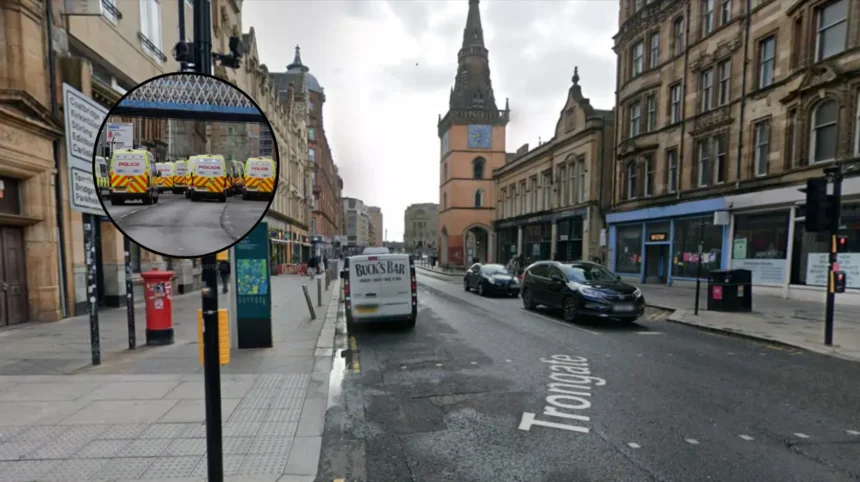
Glasgow (Glasgow Express) August 12, 2026 – Four more men have been arrested by Police Scotland in connection with widespread public order offences and violence during Celtic Football Club’s Scottish Premiership title celebrations in Glasgow city centre. The latest law enforcement action follows the gathering of thousands of football supporters at the Trongate area on Saturday afternoon after the team secured the league championship with a victory over Heart of Midlothian at Parkhead.
- Key Points
- What casualties and damage were reported during the Trongate disturbance?
- How did law enforcement respond to the situation?
- What actions are local authorities taking moving forward?
- Background of the particular development
- Prediction: How will this development affect Glasgow residents, businesses, and football supporters?
The gathering, which began as an impromptu celebration following the final whistle of the Scottish Premiership season, rapidly escalated into scene-wide disturbances. Police officers deployed to the area encountered significant levels of anti-social behaviour, violent conduct, and public intoxication, which ultimately led to multiple injuries and broad structural disruption across the immediate vicinity.
What casualties and damage were reported during the Trongate disturbance?
The disorder resulted in injuries to emergency service personnel and members of the public. Two Police Scotland officers sustained injuries while attempting to manage the crowd and enforce public order. Furthermore, three members of the public required emergency medical transport to local hospital facilities due to injuries sustained during the chaos.
In addition to personal injuries, substantial physical damage and public inconvenience were recorded across the historic Trongate district. Street furniture was damaged, commercial shopfronts were impacted, and vast quantities of glass bottles, pyrotechnic debris, and general rubbish were left scattered across roads and footpaths.
Local transport services were thrown into disarray, forcing First Bus to divert multiple services away from the city centre for several hours while cleanup crews and public order units cleared the thoroughfare.
How did law enforcement respond to the situation?
Police Scotland implemented a tailored policing strategy to manage the multi-thousand-strong crowd, deploying both uniformed officers and specialized units to maintain safety lines. Initial efforts focused on containment and mitigating immediate physical hazards, particularly around high-density zones near public transport nodes.
During the immediate event, officers arrested three individuals on site for various public order violations. Following the dispersal of the main crowd late into Saturday evening, detectives opened a comprehensive review using local CCTV footage, body-worn video recordings, and social media media uploads to track down further participants involved in acts of violence or vandalism.
This secondary phase of the investigation yielded four additional arrests of men aged between 18 and 32 years old, bringing the total number of individuals formally charged or detained to seven.
What actions are local authorities taking moving forward?
Glasgow City Council clean-up teams worked through the night and into the following morning to restore access to the Trongate and surrounding streets. The financial cost of the emergency sanitation effort, alongside repairs to municipal infrastructure, is expected to be collated by council authorities in the coming days.
Police leadership emphasized that the investigative work remains far from complete. Dedicated officers are continuing to examine hours of surveillance footage to identify remaining offenders, with officials indicating that further arrests are anticipated as identification procedures progress.
Explore More Celtic FC News
Will Farès Ghedjemis Join Celtic or Rangers in Glasgow 2026?
Kasper Høgh Becomes Celtic Top Earner Following Record Transfer Glasgow 2026
Background of the particular development
The practice of Celtic supporters assembling at the Trongate to celebrate major trophy victories has become an established tradition in recent years, though one that has drawn increasing scrutiny from local business owners, council leaders, and emergency services.
Similar unofficial gatherings occurred following championship wins in 2022 and 2023, both of which resulted in significant logistical challenges, clean-up costs, and reports of minor street violence.
Unlike official club-sanctioned victory parades, these gatherings are spontaneous and lack planned infrastructure such as designated sanitary facilities, organized stewarding, security checkpoints, or formal traffic management plans.
Glasgow City Council and Police Scotland have repeatedly held discussions regarding the management of these non-permitted celebrations, seeking ways to balance public safety with fan celebration. However, the absence of an official organizer makes pre-event safety coordination exceptionally difficult for municipal authorities.
Prediction: How will this development affect Glasgow residents, businesses, and football supporters?
The ongoing police crackdown and rising arrest numbers following this latest incident are likely to trigger stricter municipal and policing strategies for future football celebrations in Glasgow.
For local residents and business owners in the merchant city and Trongate areas, these developments will probably lead to heightened pressure on Glasgow City Council to implement preventive measures. Communities can expect stricter road closures, dynamic alcohol exclusion enforcement, and a heavier preemptive police presence during end-of-season fixture dates in future years to prevent unsanctioned gatherings before they gain momentum.
Business owners may also seek formal discussions on commercial compensation or enhanced council-funded security protocols to protect property during high-risk weekends.
For Celtic supporters and the broader football fan community, these high-profile arrests signal a shift toward zero-tolerance post-event enforcement using digital surveillance. Fans gathering spontaneously in public spaces without formal authorization will face an increased risk of identification and prosecution long after the event concludes.
This trend may accelerate calls from fan groups for official, organized, and properly stewarded fanzones or victory events hosted directly by the football club or civic authorities, providing a controlled environment that ensures public safety while preserving traditional title celebrations.