

Key Points
- Contractors are moving on-site today to begin physical construction on the Stockwell Street Avenues scheme in Glasgow city centre.
- Comprehensive structural works include resurfacing carriageways, fitting upgraded traffic signals, and expanding footpaths using high-specification Caithness stone paving.
- Sustainable urban drainage systems (SuDS) will be installed, incorporating new tree plantings and active raingardens positioned between Bridgegate and Howard Street.
- A segregated two-way cycleway will be introduced on the west side of Stockwell Street between Bridgegate and Howard Street, extending northbound towards Stockwell Place.
- The new cycling path establishes direct active travel connectivity, linking the established South City Way at its southern tip with the upcoming Argyle Street East Avenue project at the northern terminus.
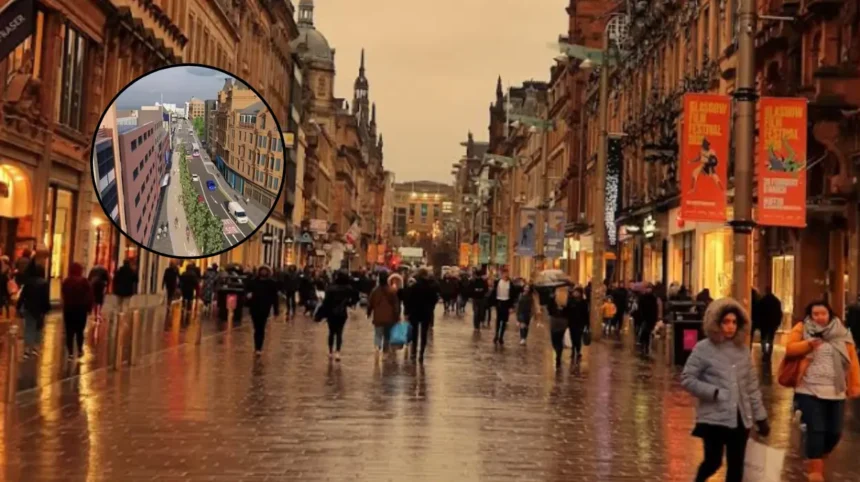
Glasgow (Glasgow Express) August 10, 2026 – Works have officially commenced today on Stockwell Street as appointed contractors enter the site to undertake the complete physical transformation of the corridor under the city centre Avenues Programme. The infrastructure project is designed to deliver immediate physical and environmental improvements for local residents, commercial enterprises, and city centre visitors. The scope of work encompasses total road surface renewal, extensive pedestrian footway widening paved with Caithness stone, green drainage infrastructure, upgraded signalised junctions, and dedicated, fully segregated active travel corridors.
What Physical Changes Are Being Made to Stockwell Street?
The engineering operations starting today comprise a comprehensive redesign of the existing public realm along Stockwell Street to balance vehicular traffic, pedestrian movement, and active travel routes. Central to the site works is the structural replacement and expansion of existing footpaths using Caithness stone paving, selected for its durability and aesthetic integration into the historic urban streetscape. Pedestrian pathways are slated for widening wherever spatial constraints permit, alongside complete carriageway resurfacing.
The vehicular infrastructure will see the installation of modernised traffic signal systems at key intersections to regulate traffic flow and integrate dedicated crossing phases for non-motorised road users.
Environmental engineering measures form a key pillar of the on-site developments between Bridgegate and Howard Street. Contractors will install integrated raingardens and plant new street trees. These green interventions serve as a sustainable urban drainage framework designed to alleviate pressure on the municipal drainage network during heavy rainfall events by intercepting and filtering surface run-off before it enters stormwater channels.
How Does the Stockwell Street Infrastructure Connect to the Wider Cycling Network?
A primary mechanical element of the Stockwell Street project is the construction of a dedicated, two-way segregated cycleway along the western side of the street between Bridgegate and Howard Street. For northbound cyclists, the segregated lane will continue onwards to Stockwell Place, isolating active travel users from heavy commercial and public transport vehicles.
This specific stretch of infrastructure bridges a vital gap in the city’s overarching transport strategy. At its southern boundary, the newly laid Stockwell Street cycle route links directly with the South City Way, a primary arterial cycling corridor connecting southern neighbourhoods directly into the city core. At its northern boundary, the infrastructure will merge seamlessly with the planned Argyle Street East Avenue active travel corridor. Once fully realized, these dual connections will form an uninterrupted, physically protected route through the core of the city centre.
What Is the Background of the Development?
The Stockwell Street initiative forms part of the broader Glasgow City Centre Avenues Programme, a citywide urban redesign scheme funded through the Glasgow City Region City Deal. Supported by combined investment from the UK Government and the Scottish Government, the Avenues Programme aims to redesign core street networks throughout Glasgow’s central business and retail districts.
Historically dominated by high vehicular volumes and narrow, aging pedestrian paths, streets such as Stockwell Street have been identified as key arteries requiring modernization to meet current accessibility, active travel, and climate resilience targets. The overarching scheme aims to reallocate street space away from private motor vehicles toward pedestrians, cyclists, and sustainable transport modes while simultaneously increasing biodiversity and climate resilience through green infrastructure installation. The start of physical construction on Stockwell Street represents the latest phase in this multi-year city centre transformation.
Explore More City Centre News
Glasgow Transport After 6pm Fails Night Economy – Glasgow 2026
Anti-Racism Groups Clash With Far-Right Protesters in Glasgow 2026
What Is the Prediction for How This Development Will Affect Local Stakeholders?
The commencement of physical works on Stockwell Street will deliver distinct short-term disruptions and long-term structural impacts across primary target audiences:
Local Businesses and Retailers
In the short term, commercial enterprises situated along Stockwell Street, Howard Street, and Bridgegate may face temporary logistical challenges due to footway re-paving, lane closures, and altered loading access during the construction phase. However, upon completion, the widening of footways with high-quality Caithness stone and the overall visual enhancement of the streetscape are predicted to increase local footfall, improve outdoor amenity space, and boost street-level commercial vitality.
Commuters and Cyclists
Commuters who rely on active travel modes will experience immediate safety and accessibility benefits once the project is finished. By physically separating bicycles from general traffic lanes on the western side of Stockwell Street, the route eliminates dangerous mixing points between cyclists, heavy goods vehicles, and buses. The seamless connectivity established between the South City Way and Argyle Street East will shorten transit times for cross-city cyclists and encourage a higher modal shift toward non-motorised commuting.
Pedestrians and Residents
For local residents and city centre visitors, the expanded pavements and upgraded signal crossings will significantly enhance pedestrian safety and accessibility, particularly for individuals with mobility challenges. The installation of new street trees and raingardens will improve local microclimate conditions, attenuate surface noise, and reduce urban heat island effects, transforming Stockwell Street from a transit-heavy thoroughfare into a greener, more attractive urban space.