

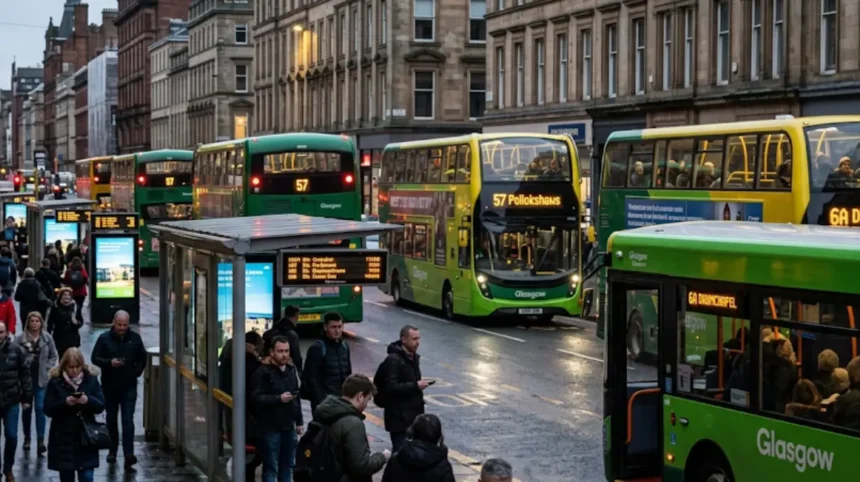
Glasgow’s bus network is a practical daily commuting option in 2025. It offers wide coverage, frequent services on major corridors, and improving punctuality on several routes. It still faces delays from traffic, roadworks, and peak-hour congestion, so reliability varies by route and time of day.
- What does Glasgow’s bus network cover?
- How reliable are Glasgow buses in 2025?
- Why do buses run late in Glasgow?
- How does the bus network compare with the Subway?
- What role do fares and tickets play?
- Which routes suit daily commuting best?
- How important is frequency for commuters?
- How do roadworks affect commuters?
- What does accessibility look like?
- Is the network improving long term?
- What should commuters expect day to day?
- What is the final assessment?
What does Glasgow’s bus network cover?
Glasgow’s bus network covers the city centre, inner suburbs, outer residential areas, and many key commuter corridors. It connects places that are not served directly by the Subway or rail stations, which gives it a major role in daily travel.
The network supports trips to work, education, retail, healthcare, and leisure destinations. For many residents, buses are the main option when a direct, single-seat journey is needed.
How reliable are Glasgow buses in 2025?
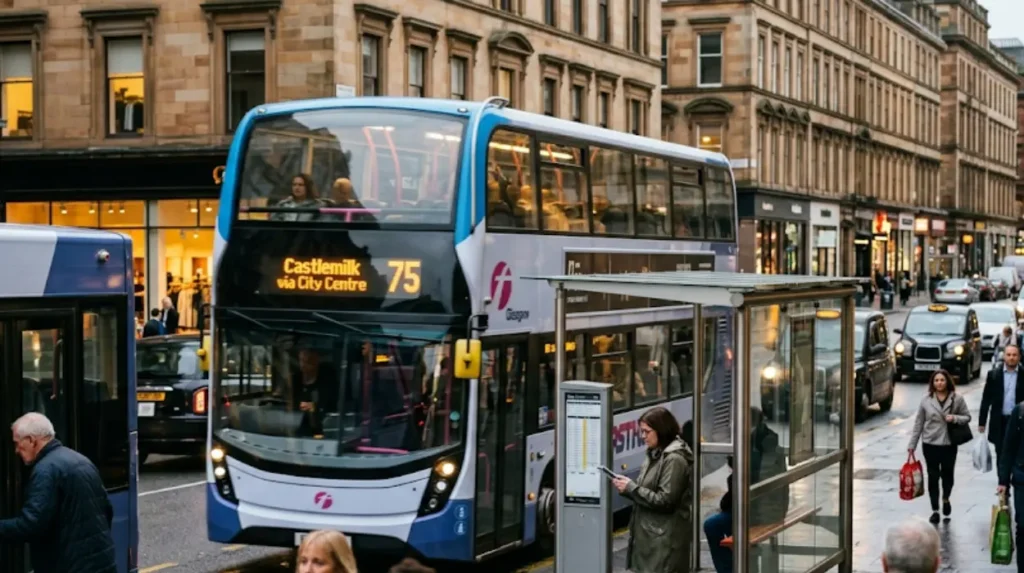
Glasgow buses are more reliable in 2025 than they were in earlier periods, especially on routes where timetables have been adjusted to better match road conditions. Some operators have reported noticeable improvements in punctuality after schedule changes.
Even with those gains, reliability is not uniform across the city. Some routes perform well most of the day, while others lose time during rush hour or when city-centre traffic builds up.
Why do buses run late in Glasgow?
Buses in Glasgow run late mainly because they share the road with general traffic. Congestion, roadworks, signal delays, and traffic incidents all slow services down.
This means the timetable can be accurate on paper but still slip in real conditions. Routes that pass through busy corridors usually face the biggest delays.
How does the bus network compare with the Subway?
The Subway is faster for short journeys in the central area, while buses are better for coverage. The Subway works well when both the start and end points are close to stations.
Buses are stronger for door-to-door commuting because they reach more neighbourhoods. For many workers, the bus is the more practical one-mode option even if it takes longer.
What role do fares and tickets play?
Affordable and simple fares make buses easier to use every day. Ticket options for day and regular travel reduce the hassle of paying for each individual journey.
For commuters, this matters because a reliable service is not just about timing. It also has to be convenient and economical enough to use repeatedly.
Which routes suit daily commuting best?
The best commuting routes are usually the ones with high frequency, direct links to the city centre, and fewer traffic bottlenecks. Direct corridors are more dependable than routes that make many detours.
Routes with stronger service patterns are easier to plan around. That makes them more useful for workers, students, and shift-based commuters.
How important is frequency for commuters?
Frequency is one of the biggest factors in practical reliability. When buses arrive often, a delay on one service does not cause a long wait.
That is especially important in a city like Glasgow, where many people travel during busy peak periods. Frequent services give commuters more flexibility and less risk.
How do roadworks affect commuters?
Roadworks can reduce bus reliability by causing diversions, slower journeys, and stop changes. In a city with active infrastructure work, even well-run routes can become less predictable for a period of time.
This is why commuters often need extra travel time. A route that works well one month can become slower the next if a major road is disrupted.
What does accessibility look like?
Accessibility is part of reliability because a service must be usable for a wide range of passengers. Glasgow buses support many daily trips because they provide street-level access across a large area.
That helps passengers with mobility needs, prams, shopping, or luggage. A network with broad stop access is more useful than one that only serves a few major stations.
Explore More Area Guide
Full Cast Announced for The Silence of the Lambs Glasgow 2026
Comprehensive Guide to the Best Weekly Farmers Markets for Local Produce in Glasgow
Is the network improving long term?
Glasgow’s bus network is improving through timetable changes, route adjustments, and better scheduling. Those changes show that reliability is being managed more actively than before.
Long-term improvement depends on traffic management, infrastructure investment, and service planning. If those areas keep improving, bus performance should become steadier for commuters.
What should commuters expect day to day?
Commuters should expect a network that is useful, broad, and generally workable for daily travel. They should also expect variation between routes, especially during busy traffic periods.
The safest approach is to build in a small time buffer. That is especially important for work start times and cross-city journeys.
What is the final assessment?
Glasgow’s bus network in 2025 is reliable enough for daily commuting for many people, especially on frequent and well-used routes. It is strongest where coverage and convenience matter most.
Its main weakness is exposure to traffic and roadworks, which makes punctuality less consistent than fully separated transport. For most city travel, though, it remains one of Glasgow’s most important commuting options.
Is Glasgow’s bus network reliable for daily commuting in 2025?
Yes. Glasgow’s bus network is generally reliable for daily commuting, particularly on frequent routes with regular services. However, delays can occur during peak traffic, roadworks, or major incidents.