The Glasgow rail network forms the largest urban rail system in the United Kingdom outside of London, operating 186 stations across the metropolitan area. This heavy rail infrastructure is divided into distinct high-level terminal and low-level subterranean lines.
- Why is Glasgow Central Station critical for residents?
- How does Glasgow Queen Street Station serve the city?
- Infrastructure and Recent Redevelopment
- The High-Level Express Lines
- The Low-Level Subterranean Integration
- Which suburban interchange stations are most vital?
- How do the Low Level lines connect the city?
- What future transit developments impact these stations?
The metropolitan rail network across the City of Glasgow is managed primarily by Network Rail, which maintains the physical track and station structures, and ScotRail, the national train operating company that provides the passenger services. The geographic layout features two primary city-centre terminal stations: Glasgow Central Station and Glasgow Queen Street Station. These two hubs are not physically connected by operational passenger tracks on the surface, creating a distinct dual-terminus setup that splits regional and national traffic.
Beyond the terminal buildings, the infrastructure includes extensive subterranean lines known locally as the Low Level lines. The North Clyde Line and the Argyle Line run beneath the city centre, providing east-west transit through the urban core. This layout connects suburban residential districts in Dunbartonshire, Lanarkshire, and Renfrewshire directly to the commercial center. The system integrates with the Glasgow Subway, a separate circular underground light rail system, at several key interchange points to create a multimodal transport network.
Why is Glasgow Central Station critical for residents?
Glasgow Central Station is the busiest railway station in Scotland, handling over 25 million passenger entries and exits annually. It serves as the definitive terminus for all cross-border routes to England and domestic lines heading south and west.
Historical Development and Scale
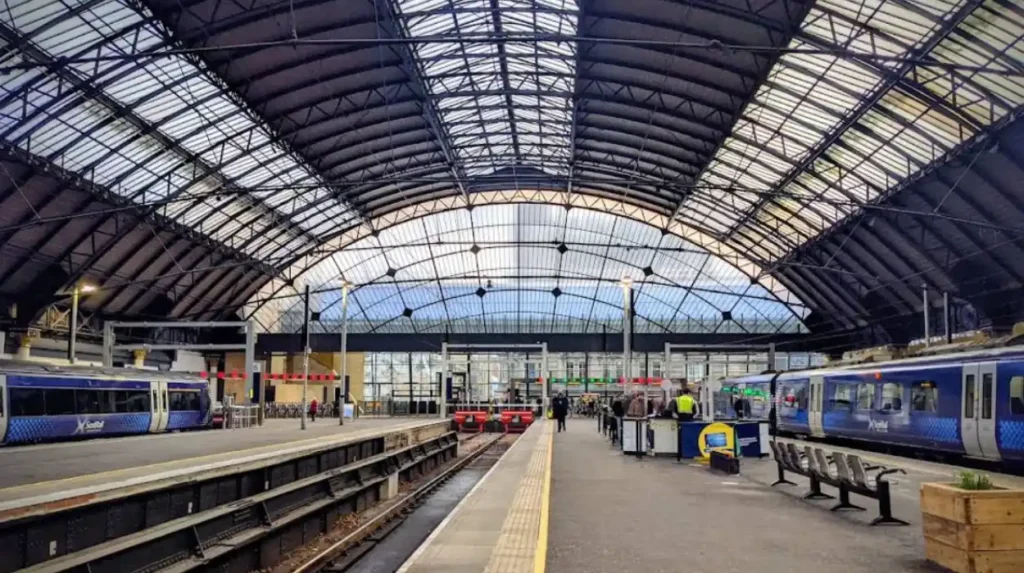
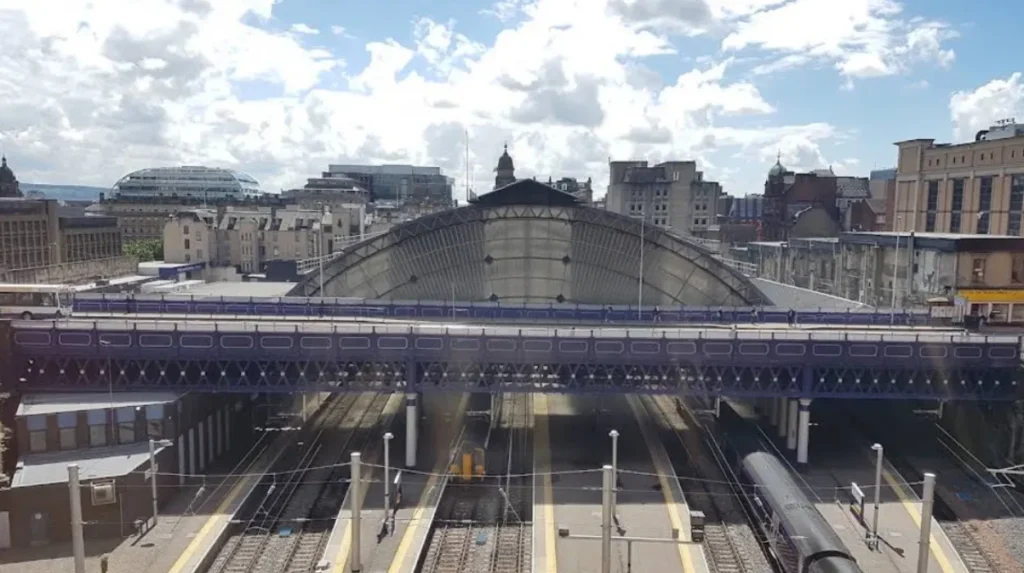
Opened by the Caledonian Railway Company on August 1, 1879, Glasgow Central Station was built to consolidate rail traffic entering the city from the south. The station underwent a massive expansion between 1901 and 1906, which included the construction of the iconic sandstone bridge over Argyle Street, known colloquially as the Heilanman’s Umbrella. This Grade A listed architectural structure features a massive 15-platform high-level concourse covered by a vast glazed roof, alongside a two-platform low-level station beneath the main building.
Operational Routes and Destinations
The high-level platforms (Platforms 1 to 15) accommodate long-distance national operators including Avanti West Coast, CrossCountry, TransPennine Express, and the Caledonian Sleeper. These lines link Glasgow directly to major English cities, including London Euston, Manchester Piccadilly, and Birmingham New Street. Domestically, the high-level lines carry commuter trains to the coastal towns of Ayrshire and Inverclyde, alongside suburban loops such as the Cathcart Circle Lines and the Paisley Canal Line. Examples of key destination stations include Ayr, Gourock, Neilston, and East Kilbride.
Low-Level Commuter Connectivity
The low-level section (Platforms 16 and 17) forms a core component of the Argyle Line. This electrified subterranean passage allows continuous through-services from southeast Lanarkshire to western suburbs. Residents utilize the low-level platforms for high-frequency travel across the city without transferring at the main concourse. Examples of destinations served by this specific line include Motherwell, Hamilton Central, Lanark, and Milngavie.
How does Glasgow Queen Street Station serve the city?
Glasgow Queen Street Station is the third busiest railway station in Scotland, facilitating roughly 15 million passenger journeys per year. It functions as the primary gateway for all rail services departing northward to the Scottish Highlands and eastward to Edinburgh.
Infrastructure and Recent Redevelopment
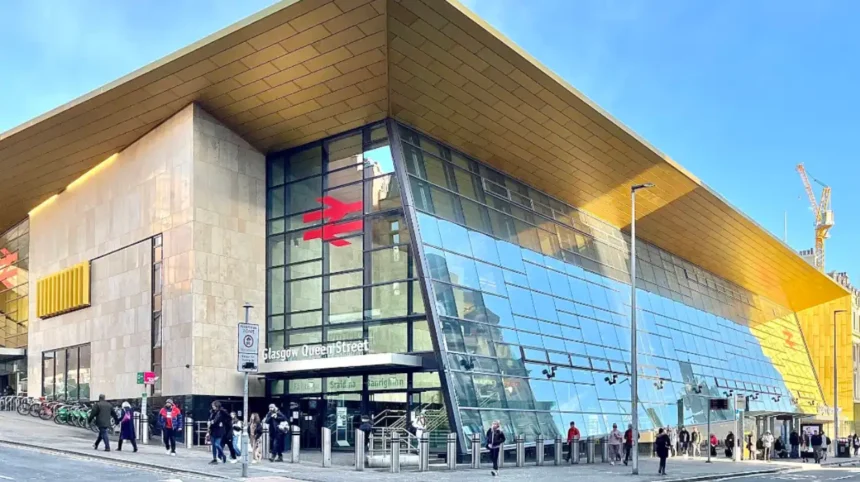
Inaugurated by the Edinburgh and Glasgow Railway in 1842, Queen Street Station occupies a position at the northern edge of George Square. The station completed a comprehensive £120 million redevelopment project part of the Edinburgh to Glasgow Improvement Programme (EGIP). This modernization expanded the main concourse by removing obsolete 1970s extensions, lengthened the high-level platforms to accommodate longer eight-carriage electric trains, and installed a dramatic gold-colored glass façade. The upgrades increased the station’s maximum passenger capacity to safely handle a projected 28 million users by 2030.
The High-Level Express Lines
The high-level platforms handle express intercity routes that connect Glasgow to the other major urban centers of Scotland. The most critical route is the premium shuttle service between Glasgow Queen Street and Edinburgh Waverley via Falkirk High, which delivers an average journey time of 42 minutes with departures every 15 minutes. Additionally, the high-level tracks serve northern routes operating out of Glasgow. Examples of northern destinations include Aberdeen, Dundee, Perth, Inverness, and the scenic West Highland Line toward Oban and Mallaig.
The Low-Level Subterranean Integration
The low-level platforms at Queen Street form a vital intersection on the North Clyde Line. This double-track underground line passes beneath the city centre, facilitating continuous electric transit from West Dunbartonshire through to West Lothian. It provides a direct link for city residents traveling to suburban commercial centres and university campuses. Examples of direct stops on this specific route include Helensburgh Central, Balloch, Partick, Airdrie, and Edinburgh Waverley via Bathgate.
Which suburban interchange stations are most vital?
Suburban interchange stations allow passengers to transfer between different rail lines, the Glasgow Subway, and local bus networks without entering the central termini. These multi-modal hubs prevent congestion in the city center and streamline cross-city commutes.
Partick Station
Situated in the West End of Glasgow, Partick is a major tri-modal transport interchange that combines a national rail station, an underground subway station, and a bus terminal into a single complex. It ranks as one of the busiest non-terminus stations in Scotland, recording over 3 million rail entries and exits annually. Partick connects the North Clyde Line directly to the Glasgow Subway circle. This link allows commuters from external regions to transfer rapidly to university districts and residential areas in the West End. Examples of key institutions served by this connection include the University of Glasgow and the Queen Elizabeth University Hospital.
Hyndland Station
Hyndland Station operates strictly as a rail-to-rail interchange hub located deeper within the West End residential zone. It serves as the critical convergence point where the lines from Milngavie and the lines from Helensburgh and Balloch merge into the main North Clyde underground corridor. Because all westbound trains heading toward Dunbartonshire funnel through this station, it provides residents with high-frequency departures toward the city centre. The high volume of connecting trains makes Hyndland a strategic boarding point for passengers trying to access both Glasgow Queen Street Low Level and Glasgow Central Low Level.
Rutherglen Station
Located immediately east of the Glasgow city boundary, Rutherglen Station acts as the eastern counterpart to the western interchange hubs. It sits on the Argyle Line and serves as a major dividing point where rail tracks branch out into multiple separate directions across South Lanarkshire. Commuters residing in the eastern suburbs utilize Rutherglen to switch between local inner-city stopping services and faster regional lines. Examples of routes diverging at this junction include the lines toward Whifflet, Motherwell, and the Larkhall branch corridor.
Explore More Area Guide
Comprehensive Guide to the Best Weekly Farmers Markets for Local Produce in Glasgow
Best Outdoor Eating and Drinking Spots Across Glasgow for Every Occasion
How do the Low Level lines connect the city?
The Low Level lines utilize historic Victorian railway tunnels to run high-frequency, metro-style train services directly underneath the central business district. These underground passages bypass surface-level traffic entirely, providing direct east-west transit across the urban geography.
The Mechanics of the Subterranean Network
The Low Level system operates on two parallel, independent underground rail lines that slice through the foundations of Glasgow. These structures are the Argyle Line, which passes underneath Glasgow Central Station, and the North Clyde Line, which transits through Glasgow Queen Street Station. Both systems are fully electrified via 25-kilovolt overhead lines, allowing emission-free operation inside the enclosed tunnels. Trains run at frequencies resembling rapid transit systems, with multiple services per hour passing through the central subterranean platforms during peak commuting windows.
Key Subterranean Stations
Aside from the low-level platforms situated directly beneath the two main termini, several dedicated underground stations serve specific commercial, cultural, and residential zones within the absolute city centre. Examples of these crucial underground stops include:
- Argyle Street Station: Positioned on the Argyle Line, this station provides direct exit access to the bustling St Enoch Centre and the primary retail districts of the city centre.
- Charing Cross Station: Located on the North Clyde Line at the western edge of the city centre, this hub serves the central financial district and the nightlife venues around Sauchiehall Street.
- Anderston Station: Situated near the River Clyde, this stop provides direct transit proximity to major corporate offices, residential developments in the international financial services district (IFSD), and the Kingston Bridge approaches.
- Exhibition Centre Station: Located on the Argyle Line, this facility serves as the primary transport link for the Scottish Event Campus (SEC), the OVO Hydro arena, and the Finnieston entertainment zone.
What future transit developments impact these stations?
Future transit developments focus on expanding electrification, improving cross-city connectivity, and integrating the heavy rail network with proposed light rail systems. These structural initiatives aim to achieve net-zero carbon emissions across the transport sector by 2035.
Electrification Initiatives
Transport Scotland and Network Rail continue to execute systemic electrification projects across the wider Strathclyde rail geography. Converting older diesel-operated lines to modern electric power improves acceleration, lowers transit times, and eliminates tailpipe emissions within suburban communities. A prime example of this ongoing work is the comprehensive electrification of the East Kilbride and Barrhead rail corridors, which routes directly into Glasgow Central Station. This conversion allows the deployment of modern electric rolling stock fleets to replace older diesel multiple units.
The Glasgow Metro Project
The most significant long-term infrastructure strategy impacting local rail selection is the Glasgow Metro proposal. Championed by the Strategic Transport Projects Review 2 (STPR2) published by the Scottish Government, this multi-billion-pound initiative plans to introduce a comprehensive tram-train and light rail network across the Greater Glasgow region. The Glasgow Metro is designed to complement existing heavy rail stations by filling explicit transport gaps in areas lacking direct rail access. The planned network will create new interchange points at existing stations, linking heavy rail hubs directly to the Glasgow Airport rail link corridor and peripheral hospital sites.
Inter-Terminus Link Solutions
The historical lack of a direct rail link between Glasgow Central and Glasgow Queen Street remains a focus for urban planners. While passengers currently walk or utilize the dedicated bus links connecting the two termini, long-term regional plans continue to evaluate structural options to unify the networks. Proposed solutions include the construction of the Glasgow Cross Rail initiative, a plan to utilize forgotten rail alignments to link the northern and southern rail networks permanently. This integration would allow passenger trains to travel directly from the north of Scotland to the south without requiring passengers to change stations within the Glasgow city center.
How many railway stations are there in Glasgow?
Glasgow’s metropolitan rail network has 186 railway stations, making it the largest urban rail system in the UK outside London.