The evening economy of major metropolitan areas relies heavily on post-midnight food availability. In Glasgow City Centre, a combination of shifting employment patterns, student populations, and a robust weekend entertainment sector maintains consistent demand for twenty-four-hour and late-night food establishments. Navigating this sector requires an understanding of primary geography, logistical delivery hubs, and regional culinary classifications.
- What Defines the Late Night Food Infrastructure in Glasgow City Centre?
- Licensing Laws and Municipal Regulations
- Geographic Distribution Hubs
- Economic and Demographic Drivers
- Which Independent Outlets Offer the Best Late Night Savoury Takeaway?
- Cookies Takeaway (Hope Street)
- Specialized Kebab Houses and Grill Outlets
- Culturally Diverse Late-Night Kitchens
- Where Can You Find Traditional Scottish Fish and Chips After Midnight?
- The Blue Lagoon Franchise Infrastructure
- Technical Aspects of the Scottish Chippy Menu
- Regional Condiment Preferences
- What 24 Hour Fast Food Chains Operate in the Centre of Glasgow?
- McDonald’s Footprint and Access Management
- Alternative Global Chain Availability
- Digital Infrastructure and Kiosk Ordering
- How Do Late Night Delivery Services Change Food Availability?
- Dark Kitchen Networks and Ghost Kitchens
- The Logistics Cycle of Courier Networks
- Spatial and Temporal Expansion
- Where Can You Purchase Late Night Desserts and Sweet Food?
- The Evolution of the Late-Night Dessert Parlor
- Core Product Chemistry and Offerings
- Customization and Build Your Own Models
- What Are the Historical and Cultural Influences on Glasgow’s Late Night Scran?
- Italian Immigration and the Fish and Chip Tradition
- The South Asian Contribution and the Invention of Chicken Tikka Masala
- The Shift from Industrial Fuel to Entertainment Rejuvenation
- What Future Trends Will Shape Late Night Dining in the City?
What Defines the Late Night Food Infrastructure in Glasgow City Centre?
The late-night food infrastructure in Glasgow City Centre comprises hot-food takeaways, late-licensed chip shops, and twenty-four-hour multinational franchises. These establishments operate under strict municipal licensing hours, specifically serving pedestrians and delivery logistics networks between the hours of 11:00 PM and 5:00 AM.
Licensing Laws and Municipal Regulations
Hot food takeaways operating within the Glasgow City Council boundaries must secure a Late Hours Catering Licence to trade between 11:00 PM and 5:00 AM. The Civic Government (Scotland) Act 1982 dictates the legal framework governing these permissions. Licensing boards evaluate applications based on public order, environmental noise pollution, and waste management protocols. Consequently, specific zones within the city centre have highly concentrated operational windows, while surrounding residential fringes face stricter termination times, usually capping service at midnight or 1:00 AM.
Geographic Distribution Hubs
The highest density of late-night food providers clusters around three core arterial sectors.
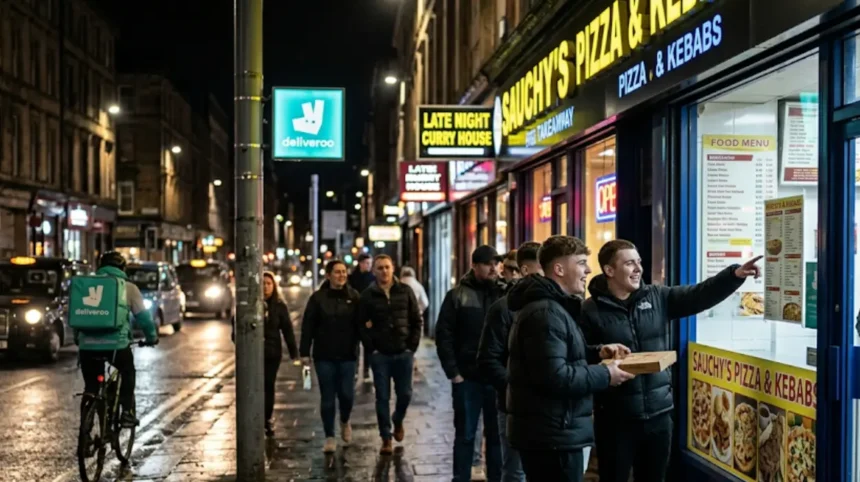
- The Sauchiehall Street Corridor: Traditionally associated with the student nighttime economy, this street hosts numerous independent kebab shops, pizza outlets, and global fast-food chains.
- The Central Station and Hope Street Nexus: Serving commuters, shift workers, and transit users, this zone features high-volume establishments like Cookies Takeaway and local fish and chip shops.
- The Merchant City and Trongate Boundary: This sector caters to a mix of residential occupants and late-night venue attendees, offering more diverse options including Afro-Caribbean food from The Calabash Restaurant and wood-fired pizza providers.
Economic and Demographic Drivers
Data from Glasgow City Council indicators highlights that over 130,000 students reside within the Greater Glasgow area, attending institutions such as the University of Glasgow, Strathclyde University, and Glasgow Caledonian University. This demographic provides a consistent baseline for nighttime revenue. Additionally, hospitality personnel, emergency services staff, and transport operators create a sustained weekday demand for nocturnal food access points, shifting the market away from a purely weekend-peak model.
Which Independent Outlets Offer the Best Late Night Savoury Takeaway?
Independent outlets offering premium late-night savoury takeaway in Glasgow City Centre center around Hope Street, Sauchiehall Street, and the Merchant City. Establishments like Cookies Takeaway, Bistro, and specialized late-licensed kebab houses provide authentic Indian street food, traditional Turkish kebabs, and gourmet burgers.
Cookies Takeaway (Hope Street)
Located near Glasgow Central Station, Cookies Takeaway operates as a prominent culinary anchor for evening commuters and late-night workers. The establishment specializes in authentic Indian street food alongside standard fast-food items. Their core production menu centers on item types including fresh parathas (flatbreads), kathi rolls (skewered meat wrapped in paratha), and traditional curries.
A primary item category driving late-night volume is the Samosa Chaat, which combines broken vegetable samosas with spiced chickpeas, yoghurt, and tamarind chutney. They also produce fresh Aloo Parathas and serve authentic Masala Chai until early morning hours. This menu structure targets customers seeking high-protein, intensely spiced food options that differ from traditional deep-fried late-night fare.
Specialized Kebab Houses and Grill Outlets
High-volume Turkish and Pakistani kebab houses populate the central grid of the city. These kitchens utilize vertical rotisseries to prepare donner meat (seasoned minced lamb or beef) and charcoal grills for shish options (marinated chicken breast or cubed lamb).
The preparation mechanism relies on high-heat searing to preserve moisture. Establishments like Arian Express and various independent operators along Sauchiehall Street provide loaded fries topped with shredded donner meat, spicy house sauces, and fresh salad components. These meals are designed for rapid assembly, fulfilling the high-volume operational demands of peak exit hours from nearby entertainment venues.
Culturally Diverse Late-Night Kitchens
Beyond South Asian and Middle Eastern cuisines, Glasgow City Centre features dedicated Afro-Caribbean and East Asian late-night providers. The Calabash Restaurant on West Regent Street delivers authentic African dishes, including jollof rice, egusi soup, and curried goat, frequently operating until 1:00 AM.
Concurrently, venues like Bibimbap on West Nile Street serve Korean street food staples, including fried chicken and tteokbokki (spiced rice cakes), providing alternative flavor profiles to the traditional post-midnight market.
Where Can You Find Traditional Scottish Fish and Chips After Midnight?
Traditional Scottish fish and chips after midnight are primarily located at the Blue Lagoon outlets situated near Glasgow Central Station and Sauchiehall Street. These licensed chip shops provide deep-fried items, including battered haddock, haggis, and smoked sausage, operating until 3:00 AM or later.
The Blue Lagoon Franchise Infrastructure
The Blue Lagoon has operated across West Central Scotland for over 50 years, establishing multiple high-capacity footprints within Glasgow City Centre. Their primary locations include Gordon Street (adjacent to the Central Station concourse), Argyle Street, and Sauchiehall Street. These units utilize commercial high-efficiency frying ranges designed to maintain exact oil temperatures during periods of continuous product introduction.
Technical Aspects of the Scottish Chippy Menu
The standard late-night menu is anchored by specific regional frying methods. The primary product categories include:
- Battered Haddock: Fresh fish fillets dipped in a flour, water, and raising agent slurry, then flash-fried in beef dripping or vegetable oil at temperatures between 180°C and 190°C.
- The Haggis Supper: A cylindrical pudding made of sheep’s pluck, oats, and spices, encased in batter and deep-fried.
- The Pizza Crunch: A highly localized item consisting of a quarter or half-portion of pizza dipped entirely in batter and fried until crisp.
Regional Condiment Preferences
A distinguishing factor of Glasgow late-night chip shops is the deployment of specific sauces. Unlike the East of Scotland, which favors “chippy sauce” (a mixture of brown sauce and spirit vinegar), Glasgow providers utilize standard salt and malt vinegar as the baseline, complemented by thick, sweet commercial curry sauce or gravy poured directly over chips and cheese portions. This localized preference shapes the flavor profile expected by late-night consumers in the city.
What 24 Hour Fast Food Chains Operate in the Centre of Glasgow?
Twenty-four-hour fast-food chains operating in the centre of Glasgow are led by multinational corporations including McDonald’s, Taco Bell, and Tim Hortons. These entities operate multi-story brick-and-mortar storefronts on Argyle Street, Sauchiehall Street, and Buchanan Street, utilizing dual walk-in and delivery collection structures.
McDonald’s Footprint and Access Management
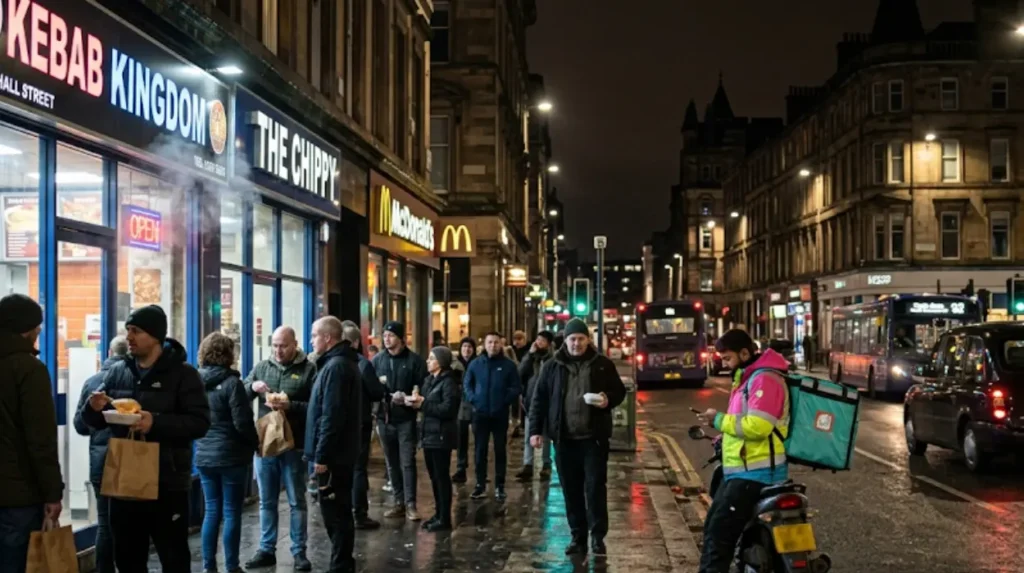
McDonald’s maintains critical twenty-four-hour hubs within the city grid, notably on Argyle Street and Sauchiehall Street. To manage safety and operational flows between 2:00 AM and 5:00 AM, these locations often transition from unrestricted dining areas to restricted counter service or window-only collection. This physical operational change allows staff to process digital orders from delivery drivers and pedestrian queues while minimizing spatial congestion inside the premises.
Alternative Global Chain Availability
Taco Bell and Tim Hortons provide alternative twenty-four-hour or late-close options within the city limits. Taco Bell on Sauchiehall Street services the late-night sector with its value tier menus, offering options like burritos, quesadillas, and seasoned fries.
Tim Hortons on Argyle Street addresses the early morning and late-night overlap, supplying coffee, breakfast wraps, and donuts. These international franchises rely on highly optimized supply chains, ensuring consistent food assembly speeds and identical nutritional profiles across all operational hours.
Digital Infrastructure and Kiosk Ordering
The deployment of self-service digital kiosks within these corporate spaces has fundamentally transformed the late-night ordering process. By removing the necessity for direct vocal ordering at a counter, these machines reduce transaction times and eliminate human processing errors during peak crowds.
Furthermore, integrated point-of-sale systems automatically update menu availability based on real-time inventory levels, preventing the sale of depleted food stocks during the late-night shift.
Explore More Area Guide
Best Outdoor Eating and Drinking Spots Across Glasgow for Every Occasion
Best Cheap Eats in Glasgow: Local Daily Budget Food Guide
How Do Late Night Delivery Services Change Food Availability?
Late-night delivery services change food availability by expanding the logistical reach of city centre kitchens to surrounding residential zones via apps like Uber Eats, Deliveroo, and Just Eat. This network allows non-central dark kitchens and traditional restaurants to serve consumers throughout the night.
Dark Kitchen Networks and Ghost Kitchens
The rise of aggregator apps has stimulated the growth of dark kitchens—centralized food preparation facilities that do not feature a physical storefront or dine-in space. These entities operate solely to fulfill delivery requests generated via mobile applications. In Glasgow, dark kitchen complexes situated on the periphery of the city centre prepare diverse menus including smash burgers, loaded fries, and gourmet desserts. This operational model reduces overhead costs like rent and front-of-house staffing while maximizing culinary output during late-night hours.
The Logistics Cycle of Courier Networks
The execution of a late-night delivery order follows a strict digital and logistical sequence:
1.Order Ingestion:User App.
The customer submits an order through an application interface, initiating real-time payment processing and digital receipt generation.
2.Kitchen Preparation:Restaurant Terminal.
The restaurant terminal receives the order metrics, and kitchen staff assemble the hot food items using thermal-retentive packaging materials.
3.Courier Matching:Algorithmic Dispatch.
The logistics platform algorithm assigns a nearby courier based on proximity, transit mode, and historical route data.
4.Transit and Drop-off:Thermal Delivery.
The courier collects the package from the city centre vendor and transports it via bicycle, scooter, or car inside an insulated thermal backpack directly to the destination coordinates.
Spatial and Temporal Expansion
Prior to the integration of app-based couriers, late-night food availability was restricted to the physical distance an individual could walk from a venue or transit hub. Modern courier networks expand this radius significantly, enabling residents in urban neighborhoods such as Finnieston, Dennistoun, and the Southside to access central city takeaways until 4:00 AM. This spatial expansion has effectively shifted consumption habits, turning late-night dining into a home-delivery standard rather than a purely pedestrian post-pub activity.
Where Can You Purchase Late Night Desserts and Sweet Food?
Late-night desserts and sweet food can be purchased at specialized dessert parlors and dedicated confectionary shops situated on Sauchiehall Street and within the Merchant City perimeter. These shops specialize in hot cookie dough, Belgian waffles, churros, and premium milkshakes, operating until midnight or 1:00 AM.
The Evolution of the Late-Night Dessert Parlor
Over the past decade, a distinct shift in the nighttime economy has occurred with the rise of alcohol-free social spaces. Late-night dessert parlors have populated core retail zones to service this market. These venues cater to student demographics, religious communities that eschew alcohol-focused spaces, and consumers seeking a premium sweet food experience after standard restaurant closing times.
Core Product Chemistry and Offerings
The menus of these dessert venues rely heavily on customizable, high-calorie sweet items. The core offerings are categorized by specific baking and assembly techniques:
- Hot Cookie Dough: Soft-baked chocolate chip cookie paste served warm in cast-iron skillets, topped with Italian gelato and flavored syrups.
- Belgian Waffles: Freshly baked leavened batter rounds featuring deep grids designed to hold heavy toppings like crushed biscuits, fresh fruit, and melted chocolate.
- Gourmet Milkshakes: High-butterfat vanilla ice cream blended with branded confectionary items, whole milk, and whipped creams to achieve a dense emulsion.
Customization and Build Your Own Models
Many late-night dessert locations utilize a “Build Your Own” service model. Customers select a structural base item—such as a waffle, crepe, or pancake stack—and systematically add sauces, crumbles, and ice cream varieties. This operational strategy enhances consumer engagement, drives higher average transaction values, and enables shops to efficiently manage their ingredient inventories through standardized ingredient portions.
What Are the Historical and Cultural Influences on Glasgow’s Late Night Scran?
The historical and cultural influences on Glasgow’s late-night food scene stem from mid-twentieth-century immigration patterns, the industrial heritage of the River Clyde, and the evolution of the city’s music venues. Italian, South Asian, and Turkish communities systematically introduced diverse culinary techniques to the local population.
Italian Immigration and the Fish and Chip Tradition
During the late nineteenth and early twentieth centuries, a substantial influx of Italian immigrants arrived in the West of Scotland from regions such as Tuscany and Frosinone. These families established cafes, ice cream parlors, and fish and chip shops across Glasgow. They introduced industrial deep-frying methods and established the traditional “chippy” as a fundamental component of the urban working-class diet, providing high-calorie, affordable meals to factory workers, dockers, and shipyard personnel.
The South Asian Contribution and the Invention of Chicken Tikka Masala
In the post-World War II era, immigrants from Pakistan, India, and Bangladesh transformed Glasgow’s culinary landscape. Family-run restaurants in the city centre and West End adapted traditional subcontinental spice profiles to suit local preferences.
According to culinary lore, the iconic Chicken Tikka Masala was invented in Glasgow during the 1970s at the Shish Mahal restaurant by combining spiced chicken tikka with a creamy tomato soup base. This innovation laid the groundwork for contemporary late-night street food outlets like Cookies Takeaway, which continue to merge traditional South Asian methods with fast-casual delivery formats.
The Shift from Industrial Fuel to Entertainment Rejuvenation
Historically, Glasgow’s late-night food options served the night shifts of heavy engineering and shipping industries along the River Clyde. As the city transitioned into a cultural and musical hub during the late 1980s and 1990s—culminating in its designation as the European City of Culture in 1990—the nighttime economy pivoted toward leisure, live music, and clubbing. This cultural shift altered the temporal demand for food, moving the operational peaks of central takeaways to match the closing times of music venues, bars, and nightclubs.
What Future Trends Will Shape Late Night Dining in the City?
Future trends shaping late-night dining in Glasgow City Centre involve the adoption of advanced automation, the integration of sustainable packaging materials, and the expansion of plant-based culinary offerings. These developments respond directly to changing environmental legislation and shifting consumer dietary profiles.
Automation and Contactless Kitchen Operations
As labor costs and operating expenses increase, late-night takeaways are increasingly adopting automated food preparation systems. Automated pizza assembly lines, computerized deep-fryer baskets with automatic lift mechanisms, and smart vending lockers are transitioning from experimental concepts to practical applications. These technologies minimize human error, optimize ingredient utilization, and maintain swift processing speeds during high-volume periods when staff retention is challenging.
Legislative Shifts and Sustainable Practices
The Scottish Government’s ongoing environmental directives mandate a systematic reduction in single-use plastics across the hospitality sector. Late-night takeaways must transition away from expanded polystyrene boxes and plastic cutlery toward compostable cardboard containers, wooden utensils, and bagasse (sugar cane residue) packaging. Establishments must also integrate advanced grease-trapping systems and emission-filtration hoods to comply with strict urban clean air and waste management standards.
The Expansion of Vegan and Plant-Based Options
The demand for high-quality meat alternatives during late-night hours is growing. Modern takeaways must look beyond basic chips or side salads to offer sophisticated plant-based items. Chains and independent outlets now regularly feature vegan donner meat, seitan-based chicken wings, and dairy-free cheeses. This expansion ensures that groups with varied dietary requirements can find suitable options at a single food outlet, broadening the market reach of late-night kitchens.
What are the best late-night food places in Glasgow City Centre?
Popular late-night food spots in Glasgow City Centre include Cookies Takeaway, Blue Lagoon, McDonald’s, Taco Bell, Tim Hortons, and independent kebab shops around Sauchiehall Street, Hope Street, and Merchant City.