Key Points
- Demolition Approval Granted: South Lanarkshire Council has officially granted planning permission in principle for the absolute demolition of the historic Shawfield Stadium in Rutherglen.
- Massive Housing Redirection: The 4.75-hectare triangular site will be repurposed by Shawfield Regeneration Limited to construct a 450-home residential development consisting of flats of various sizes and tenures.
- Comprehensive Mixed-Use Masterplan: Alongside residential housing, the approved regeneration framework includes a 150-bed hotel with ground-floor amenities and approximately 700 square meters of commercial, retail, leisure, and office space.
- Loss of Historic Sporting Asset: The decision permanently extinguishes the structure that served as the iconic home of Clyde Football Club for nearly 90 years (1898–1986) and later operated as Scotland’s final licensed greyhound racing venue until its closure in 2020.
- Strategic Regional Regeneration: Backed by South Lanarkshire Council, Glasgow City Council, and Scottish Enterprise, the project represents a major phase within the £500 million Clyde Gateway initiative targeting advanced manufacturing, decarbonized technology, and community infrastructure across the Glasgow and Lanarkshire borders.
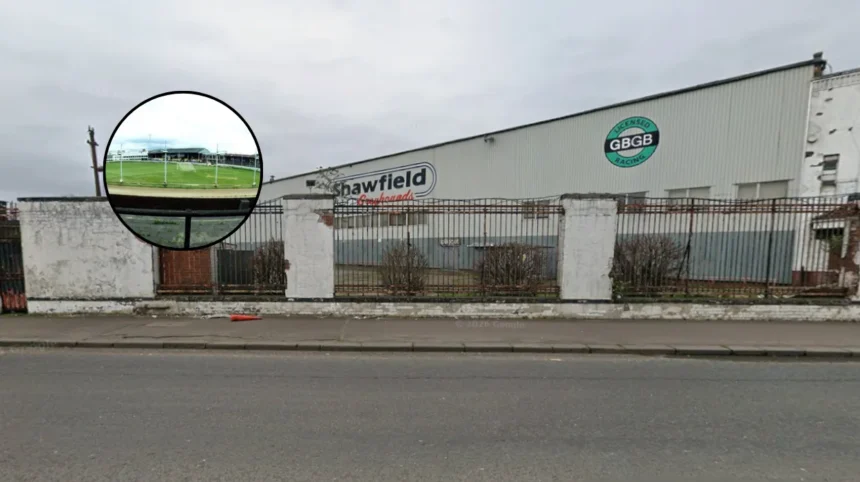
Rutherglen (Glasgow Express) May 25, 2026 — Scotland is officially set to lose an integral monument of its sporting heritage following the formal confirmation that one of its most storied and long-standing stadiums will be entirely leveled. South Lanarkshire Council has granted planning permission in principle to developers Shawfield Regeneration Limited, legalizing the total demolition of the historic Shawfield Stadium in Rutherglen. The sprawling, 4.75-hectare triangular site—bound by Rutherglen Road, Glasgow Road, and Shawfield Drive—is slated to be completely transformed into a modern, highly sustainable mixed-use urban neighborhood anchored by a 450-home residential development.
- Key Points
- What Specific Plans Are Included in the Approved Shawfield Regeneration Masterplan?
- How Will the Land Be Repurposed for Residential and Commercial Use?
- How Does the Scheme Align with the Broader Clyde Gateway Initiative?
- What Historic Sporting Legacy Disappears With the Loss of Shawfield Stadium?
- How Did Clyde FC Shape the Legendary Status of the Ground?
- What Other Diverse Sports Found a Home at the Rutherglen Venue?
- Background of the Shawfield Stadium Redevelopment
- Prediction: How the Demolition and Rehousing Scheme Will Affect Local Residents and Football Communities
As reported by Douglas Dickie of Glasgow Live, the arena once regularly attracted vast crowds, historically hosting over 50,000 passionate football enthusiasts during its athletic zenith. The venue remains profoundly etched into the annals of Scottish sport as the home ground for Clyde Football Club for nearly nine decades, spanning from 1898 until the club’s eviction in 1986. Following the departure of football, the multi-purpose arena successfully maintained its civic relevance by hosting high-speed motorcycle speedway events and acting as the premier hub for Scottish greyhound racing. However, the stadium permanently padlocked its turnstiles in March 2020 due to the global Covid-19 pandemic and has since descended into an accelerating state of severe architectural disrepair, which local planning officials now classify as an unsustainable urban eyesore.
What Specific Plans Are Included in the Approved Shawfield Regeneration Masterplan?
How Will the Land Be Repurposed for Residential and Commercial Use?
According to public planning documents finalized by South Lanarkshire Council, the comprehensive demolition process will clear the way for a dense architectural layout designed to address urgent regional housing shortages. The residential component is confirmed to comprise 450 contemporary flats, featuring a diverse array of layouts, bedroom sizes, and property tenures to ensure accessibility for varying socioeconomic demographics. To inject long-term economic viability into the Rutherglen border region, the masterplan does not rely solely on residential housing; it also incorporates a major commercial footprint.
As documented within the statutory notices published via the Public Notice Portal and outlined by reporters at the Glasgow Times, the development includes explicit authorization for a new 150-bed commercial hotel. This hospitality asset will feature specialized ground-floor amenities tailored for both travelers and local residents. Furthermore, developers have designated approximately 700 square meters of ground-floor commercial real estate across the site. This space is legally earmarked to accommodate localized retail outlets, professional office suites, food and drink establishments, and public leisure services designed to integrate seamlessly into the surrounding communities.
How Does the Scheme Align with the Broader Clyde Gateway Initiative?
The impending leveling of Shawfield Stadium represents a pivotal geographic phase within the far-reaching, £500 million Clyde Gateway regeneration project. This multi-agency masterplan has spent years systematically revitalizing economically challenged communities straddling the urban border between South Lanarkshire and the East End of Glasgow. The local planning departments of both Glasgow City Council and South Lanarkshire Council, alongside national development agency Scottish Enterprise, have offered unified institutional backing to the project, recognizing that the stadium’s current dereliction hinders regional growth.
In corporate statements addressing the strategic expansion of the masterplan, Martin Mackay, the Chief Executive of Clyde Gateway, explained that the overarching regional vision aims to blend commercial innovation directly with community living. With a specific economic focus directed toward high-growth industrial sectors, including advanced manufacturing, life sciences, and clean energy production, Mackay emphasized that the masterplan explicitly reflects a civic ambition to establish an urban territory where commercial progress and local community well-being operate hand in hand. The chief executive stated that the agencies are actively constructing a sustainable, scalable ecosystem capable of supporting everything from early-stage commercial start-ups and university spin-outs to major multinational employers, while consistently delivering modern homes, stable jobs, and distinct upward opportunities for local citizens. To minimize carbon footprints, the developers at Shawfield Regeneration Limited have committed to implementing net-zero and low-carbon technologies across all 450 residential units.
What Historic Sporting Legacy Disappears With the Loss of Shawfield Stadium?
How Did Clyde FC Shape the Legendary Status of the Ground?
The physical erasure of Shawfield Stadium directly severs a tangible link to the golden era of nineteenth and twentieth-century Scottish football. Established on open, agricultural land leased in 1898 from local landowner Mrs. Mary Morgan for an initial annual sum of £75, the stadium was funded through public incorporation and the issuance of dedicated club shares under the banner of “The Clyde Football Club Limited.” The ground famously straddled the historic boundary separating Lanarkshire from the city of Glasgow, creating an enduring piece of Scottish sporting trivia: an attacker could legally strike a football within one county and watch it cross the goal line into another.
Records compiled by football archivists show that Clyde’s local rivals, Celtic Football Club, provided the inaugural opposition at the ground on August 27, 1898, drawing a capacity crowd of 10,000 spectators to witness a hard-fought 0-0 stalemate. Over the subsequent decades, the stadium’s terracing was progressively expanded to handle massive crowds, establishing an official capacity of 40,000 by the 1920s and frequently packing in over 50,000 fans for high-stakes cup ties. It was upon this turf that Clyde FC forged its status as a powerhouse of the domestic game, securing prestigious Glasgow Cup victories and lifting the historic Scottish Cup in 1939, 1955, and 1958. Images preserved by the Daily Record capture club icons such as Joe Walters conducting intense training sessions across the Shawfield pitch during the 1950s, an era when the stadium routinely hosted some of the most formidable squads in Great Britain.
What Other Diverse Sports Found a Home at the Rutherglen Venue?
Beyond the realms of traditional men’s football, Shawfield Stadium consistently operated as a pioneering venue for a broad spectrum of alternative sporting disciplines. In 1923, the stadium achieved international historic significance when it hosted a monumental women’s football match. The pioneering Rutherglen Ladies Football Club defeated the world-renowned Dick Kerr Ladies of Preston on the Shawfield turf, earning the unofficial title of ‘world champions’ at a time when women’s sports faced severe institutional opposition from traditional football governing bodies.
In 1932, the stadium introduced greyhound racing tracks around the perimeter of the pitch, an addition that would ultimately sustain the stadium financially long after football departed. Shawfield grew to host the highly prestigious Scottish Greyhound Derby and the St Mungo Cup, drawing thousands of working-class spectators every week. Furthermore, the venue accommodated professional motorcycle speedway racing, establishing itself as a multi-tiered athletic hub for the population of the Greater Glasgow area.
Background of the Shawfield Stadium Redevelopment
The structural decline of Shawfield Stadium is a complex narrative spanning forty years of financial hardship, ownership changes, and legislative shifts. The stadium’s long-term instability initially intensified during the mid-1980s when the venue came onto the open commercial market under the ownership of the Greyhound Racing Association (GRA). In 1986, Clyde Football Club was formally handed an eviction notice, ending their 88-year residency and forcing the club into an unsettled, multi-decade era of ground-sharing “nomadism” across Scotland, moving between Partick Thistle’s Firhill, Hamilton Academical, and Broadwood Stadium in Cumbernauld.
Following football’s exit, the stadium was saved from immediate closure by the Shawfield Action Group, led by local racing manager and bookmaker Billy McAllister. The track was subsequently acquired by sports businessman Billy King, who successfully operated the site as Scotland’s premier greyhound racing track for over three decades. However, structural elements steadily degraded; the iconic, towering totalisator board that dominated the southern end of the stadium was demolished due to safety concerns in 2004, and the main Art Deco grandstand began falling into substantial disrepair.
The definitive turning point occurred on March 14, 2020, when all racing activities were abruptly suspended in compliance with emergency public health lockdowns mandated during the COVID-19 pandemic. The track never reopened. The prospects of an athletic revival were permanently extinguished in October 2022 following the sudden death of owner Billy King. With the site left entirely vacant and heavily neglected, local residents increasingly labeled the decaying stands an unsafe neighborhood eyesore.
In July 2023, sports historians and preservationists submitted a formal request to Historic Environment Scotland to have the remaining infrastructure assessed for listed building status to shield it from developers. However, following formal reviews, the designation was denied due to the advanced state of structural rot and prior alterations. This architectural vulnerability was further compounded by a definitive political shift in March 2026, when Members of the Scottish Parliament (MSPs) voted overwhelmingly to pass legislation outlawing greyhound racing across Scotland, rendering the stadium legally obsolete for its primary twentieth-century purpose and paving the way for the current mixed-use housing approval.
Prediction: How the Demolition and Rehousing Scheme Will Affect Local Residents and Football Communities
The execution of the Shawfield Regeneration Masterplan will profoundly alter both the socioeconomic landscape of the Rutherglen population and the structural future of regional football supporters. For the local residents of Rutherglen and the adjacent Oatlands neighborhood, the transition from a derelict, 19th-century industrial-era stadium to a high-density residential zone will directly impact local property dynamics, civic infrastructure, and economic opportunities.
The influx of 450 new households alongside a 150-bed hotel will sharply increase demand on local public utilities, traffic corridors, and educational facilities along Rutherglen Road and Glasgow Road. However, the inclusion of 700 square meters of commercial space and the proximity to the Magenta Business Park are highly likely to stimulate localized economic spending, creating construction and service-sector jobs that will partially offset the loss of the historic venue. Furthermore, the deployment of net-zero and low-carbon housing technologies at the site will accelerate local municipal environmental targets, transforming a polluted, heavily contaminated brownfield site into a benchmark for modern sustainable living.
For the wider Scottish football community, and specifically the displaced supporters of Clyde FC, the physical demolition of Shawfield eliminates any lingering, nostalgic hopes of a spiritual return to their traditional geographic home. As Clyde FC approaches its landmark 150th anniversary, club executives have publicly stated that securing a permanent move back toward their historic Glasgow roots remains an absolute necessity for the financial survival of the club.
With Shawfield permanently transitioning into a residential zone, the club’s nomadic existence across Lanarkshire will force directors and supporters to seek entirely new, modern facility solutions elsewhere in the city. Ultimately, while football purists will mourn the irreversible loss of a unique landmark where players could score goals across county lines, the local community will undergo a complete transformation, exchanging a decaying monument of sporting history for vital modern housing and economic infrastructure.