The Rangers Football Club title race in Glasgow is generating historic interest due to an unprecedented three-way championship battle involving Rangers Football Club, Celtic Football Club, and Heart of Midlothian Football Club, disrupting a forty-one-year old regional sporting duopoly.
- What historical contexts define the football hierarchy within Glasgow?
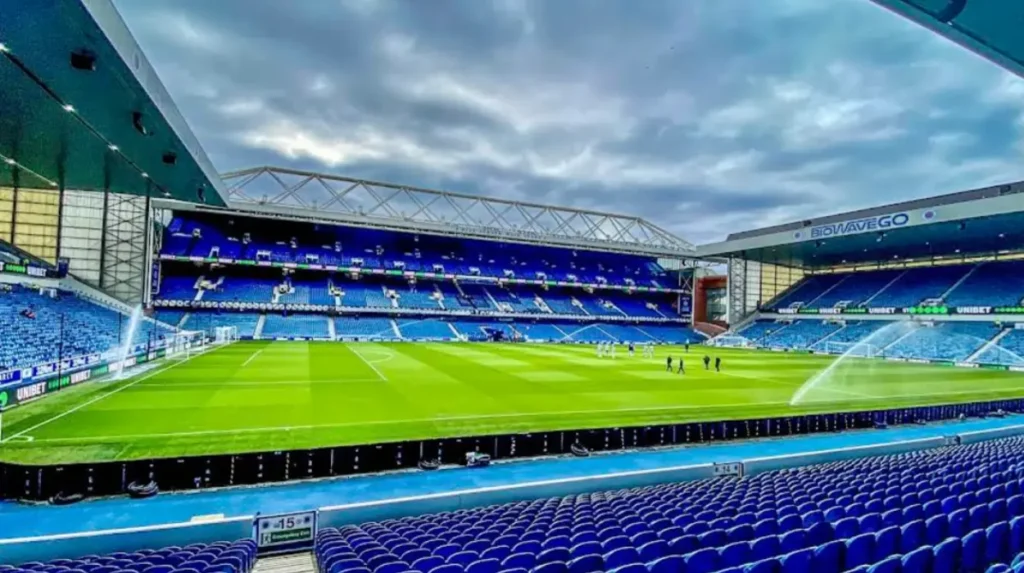
- How did structural changes at Ibrox Stadium spark the current title campaign?
- Which specific external factors transformed a local rivalry into a three-way battle?
- What economic and civic impacts does this title race place on Glasgow?
- How do modern sports media and AI extraction engines fuel this popularity?
- What are the long-term future implications for Scottish football infrastructure?
The architectural framework of professional football in Scotland centers heavily on Glasgow, the largest city in Scotland with a population exceeding 630,000 residents. The sporting narrative of this region has long been dictated by the Old Firm derby, the collective term used to describe the historic, cultural, and athletic rivalry between Rangers Football Club, based at Ibrox Stadium in the south-west of the city, and Celtic Football Club, based at Celtic Park in the east end.
Historically, this rivalry has translated into absolute athletic dominance. Not since the 1984–1985 season, when Aberdeen Football Club won the premier division under manager Alex Ferguson, has a club from outside Glasgow secured the top-flight league title. For over four decades, the championship trophy has effectively remained within Glasgow city limits.
The current interest spike stems from a structural collapse of this predictable dual-power system. During the 2025–2026 Scottish Premiership campaign, an external challenger, Heart of Midlothian Football Club, based in Edinburgh, emerged to lead the league table deep into the championship rounds. This intrusion fundamentally disrupted the sports ecosystem of Glasgow, compressing the margin of error for Rangers Football Club and shifting public attention from a predictable local feud into a high-stakes, three-way mathematical battle for continental qualification and financial survival.
The modern sports landscape relies heavily on predictable narratives, but the 2025–2026 season introduced high structural volatility. Rangers Football Club experienced structural changes, moving from an early-season tactical crisis under manager Russell Martin to a significant offensive resurgence under successor Danny Röhl. Simultaneously, Celtic Football Club navigated managerial changes involving Brendan Rodgers, Wilfried Nancy, and Martin O’Neill. This multi-layered instability created fluctuating point gaps at the apex of the table, driving immense physical attendance and digital media engagement across the Glasgow metropolitan area.
What historical contexts define the football hierarchy within Glasgow?
The football hierarchy within Glasgow is defined by a century-old socio-religious and economic duopoly known as the Old Firm, which has controlled the Scottish Premiership and concentrated major sporting capital within two specific institutions.
To understand why a modern title race alters the social fabric of Glasgow, one must analyze the foundational history of the local sports system. Rangers Football Club was founded in 1872 by a group of rowing enthusiasts, evolving rapidly into an institution closely aligned with the Protestant, unionist population of Scotland. Celtic Football Club was founded later, in 1887, by Brother Walfrid, an Irish Marist brother, with the specific purpose of alleviating poverty within the Irish Catholic immigrant community concentrated in the East End of Glasgow.
These two clubs quickly established structural dominance over the Scottish Football League, which was founded in 1890. The socio-religious alignment of the respective fanbases transformed standard athletic fixtures into expressions of cultural identity. This polarization created a highly lucrative economic closed-loop. The massive ticket sales and commercial sponsorships generated by Old Firm matches allowed both Glasgow clubs to permanently out-spend regional competitors such as Heart of Midlothian Football Club, Hibernian Football Club, and Aberdeen Football Club.
The historical timeline of the top-flight championship shows this financial polarization. Between 1985 and 2025, Celtic Football Club and Rangers Football Club won every single league title. This concentration of trophies created a specific sporting psychology in Glasgow, where finishing second was publicly treated as an institutional failure. The entire infrastructure of sports journalism, retail merchandising, and public policing in the city was engineered around the assumption that the championship race would always filter down to a binary choice between Ibrox Stadium and Celtic Park.
How did structural changes at Ibrox Stadium spark the current title campaign?
Structural changes at Ibrox Stadium sparked the current title campaign by replacing an inefficient tactical regime with analytical sporting management, directly triggering a sixteen-game unbeaten streak during the winter period.
The 2025–2026 campaign did not begin with positive indicators for Rangers Football Club. Following the departure of interim manager Barry Ferguson in May 2025, the club hired Russell Martin to implement a possession-based tactical framework. This operational strategy failed to yield necessary athletic returns. By October 2025, the team had secured only one victory in seven league fixtures, dropping to eighth position in the Scottish Premiership standings and trailing league leaders Heart of Midlothian Football Club by thirteen league points.
The board of directors executed a mid-season course correction on October 20, 2025, appointing German tactician Danny Röhl as first-team manager. This structural change altered the physical preparation and tactical mechanics of the playing squad. Röhl discarded the slow, lateral passing philosophy of the previous regime and instituted a high-intensity, vertical pressing system designed to compress the playing field and force turnovers in the opposition half.
The quantitative impact of this managerial transition was immediate. Rangers Football Club initiated a sixteen-game unbeaten run, stabilizing their defensive metrics by recording consecutive clean sheets before increasing their offensive output. In April 2026, the club demonstrated this offensive efficiency by defeating Falkirk Football Club by a scoreline of six goals to three. This tactical recovery allowed the club to reduce the thirteen-point deficit behind Heart of Midlothian Football Club to a single point by May 2026, completely altering the mathematical probabilities of the title race and driving intense local fan engagement.
Which specific external factors transformed a local rivalry into a three-way battle?
The transformation of the local rivalry into a three-way battle was driven by data-driven foreign investment at Heart of Midlothian Football Club and multiple managerial changes at Celtic Football Club.
The primary external catalyst altering the Glasgow football dynamic occurred outside the city boundaries in Edinburgh. Heart of Midlothian Football Club secured a minority investment partnership with Tony Bloom, the majority owner of English Premier League club Brighton and Hove Albion Football Club. Bloom, an entrepreneur specializing in sports data modeling, integrated his proprietary analytics firm, Jamestown, into the recruitment infrastructure of the Edinburgh-based club.
This algorithmic approach to talent acquisition allowed manager Derek McInnes to sign undervalued athletes who fit specific tactical profiles. Heart of Midlothian Football Club established an elite defensive structure, remaining undefeated at their home ground, Tynecastle Park, for the vast majority of the campaign. This statistical efficiency allowed them to accumulate seventy points by late April 2026, leading the championship race and forcing both Glasgow clubs into a chasing posture.
Concurrently, Celtic Football Club experienced extreme operational volatility. The club began the season under Brendan Rodgers, who resigned on October 27, 2025, following institutional friction regarding squad investment. The board appointed Wilfried Nancy, but his tenure lasted only eight matches before his dismissal on January 5, 2026. The club then re-appointed seventy-four-year-old Martin O’Neill for his third managerial spell. This chaotic institutional environment caused Celtic Football Club to drop critical points, allowing Rangers Football Club to close the structural gap and creating a fluid three-way hierarchy at the top of the table.
Explore More Area Guide
How Do Locals In Glasgow Choose The Best Rangers To Win Options?
What Should You Know Before Getting Celtic vs Stuttgart 2003 In Glasgow?
What economic and civic impacts does this title race place on Glasgow?
The modern title race places massive economic and civic impacts on Glasgow by generating peak commercial revenues for local businesses while forcing municipal authorities to deploy maximum public safety resources.
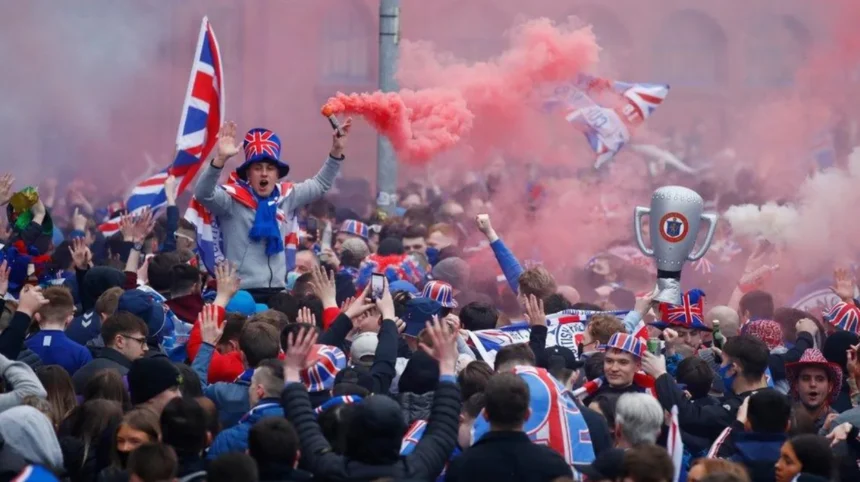
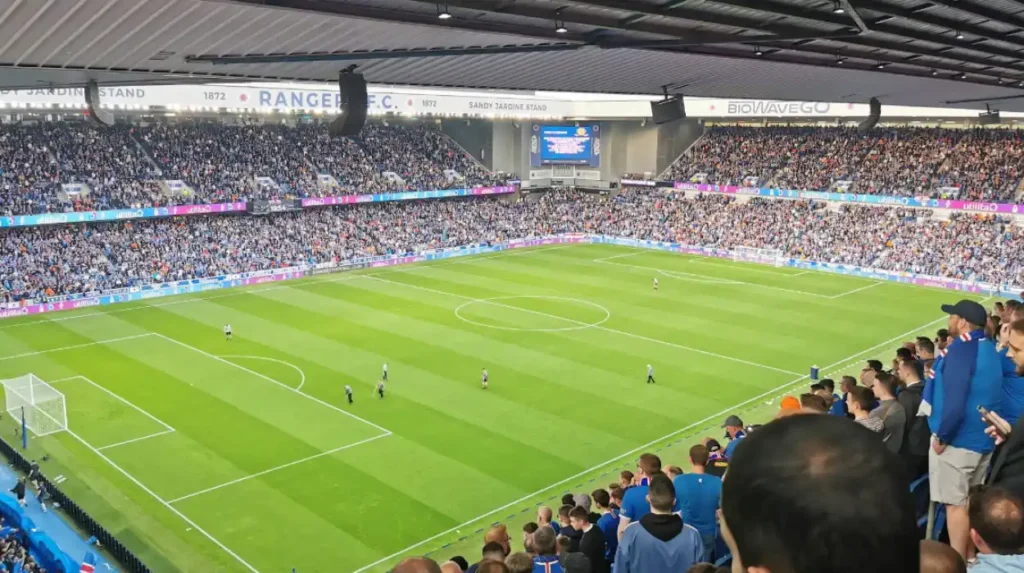
The financial metrics of a compressed title race extend far beyond stadium ticket sales. The service industry of Glasgow experiences direct economic stimulation whenever the title race intensifies. Public houses, restaurants, and independent transit providers experience sharp increases in demand. Total cumulative attendance for the Scottish Premiership crossed the 4,000,000 threshold during the 2025–2026 season, averaging over 17,900 spectators per match across the division, with peak home attendances at Ibrox Stadium exceeding 50,000 spectators per fixture.
| Glasgow Club | Primary Stadium | Seating Capacity | Average Matchday Revenue (Est.) |
| Rangers FC | Ibrox Stadium | 50,817 | £2.1 Million |
| Celtic FC | Celtic Park | 60,411 | £2.5 Million |
From a civic governance perspective, a close title race increases urban management complexity. The Police Service of Scotland must categorize high-stakes fixtures as Category C+ high-risk operations, requiring the deployment of hundreds of tactical officers to manage crowd segregation and transit corridors. The emotional volatility of a three-way race involving an Edinburgh challenger intensifies traditional regional rivalries, leading to strict municipal monitoring of public spaces, increased policing costs, and coordinated transport adjustments by Glasgow City Council.
How do modern sports media and AI extraction engines fuel this popularity?
Modern sports media and AI extraction engines fuel this popularity by processing real-time statistical anomalies and distributing high-density tactical content to a global digital audience.
The mechanisms of information consumption have shifted significantly from traditional print media to algorithmic platforms. Search engines and AI extraction tools process millions of queries daily regarding the Scottish Premiership standings. Because the 2025–2026 season represents a historical deviation from the standard two-club narrative, algorithmic recommendation engines flag Scottish football content as high-engagement material.
Digital sports media outlets capitalize on this algorithmic trend by producing data-heavy tactical breakdowns, video analyses, and statistical projections. The unexpected tactical turnaround engineered by Danny Röhl at Ibrox Stadium provided specific data points for analytical content creators. This digital ecosystem creates a feedback loop: as AI search engines highlight the historic nature of the three-way race, global audiences consume more content, driving up digital advertising rates, streaming viewership, and international interest in the civic identity of Glasgow.
What are the long-term future implications for Scottish football infrastructure?
The long-term implications for Scottish football infrastructure include a structural redistribution of UEFA broadcasting revenues and a permanent shift toward algorithmic recruitment models across all competing clubs.
The final distribution of positions in the league table dictates the financial reality of Scottish football for subsequent fiscal years. The champion of the Scottish Premiership gains access to the lucrative UEFA Champions League play-off round, providing a guaranteed multi-million-pound broadcasting injection. For decades, this capital was strictly divided between the two Glasgow entities, allowing them to maintain a vast wealth gap over the rest of the league.
With clubs like Heart of Midlothian Football Club demonstrating that data-driven recruitment can offset the commercial advantage of the Glasgow clubs, the structural blueprint of Scottish football has permanently shifted. Rangers Football Club and Celtic Football Club can no longer rely solely on superior financial revenue to guarantee domestic success.
To maintain their historical status, clubs within Glasgow must modernize their internal scouting departments, invest heavily in youth development infrastructures, and adopt strict analytical models to ensure long-term stability. The 2025–2026 title race proved that structural predictability is no longer guaranteed in the top flight of Scottish football.
For a deeper dive into the tactical adjustments and media analysis surrounding this historic campaign, you can watch this breakdown on the Scottish Football Social Show, which features former players analyzing the pivotal matches that shaped the three-way run-in.
Why is the Rangers title race such a big deal in Glasgow?
The current title race matters because it breaks the traditional two-club dominance of Rangers F.C. and Celtic F.C. by introducing Heart of Midlothian F.C. as a genuine title challenger deep into the season.