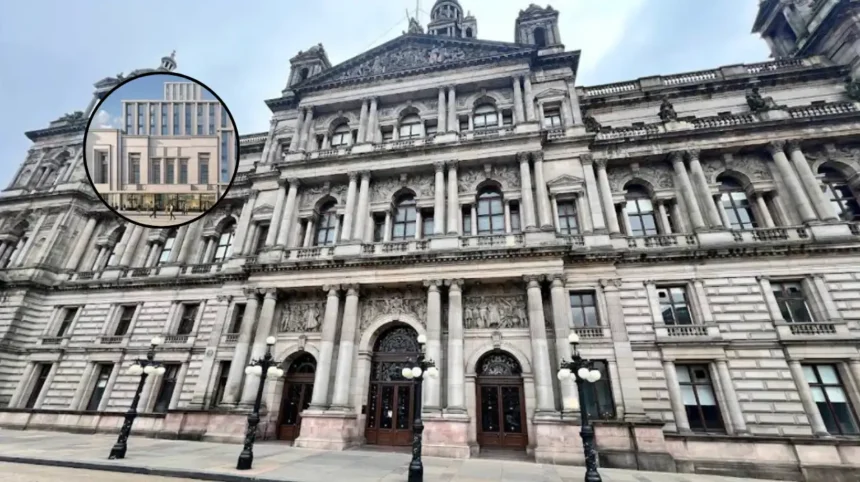
Key Points
- Approval Granted: Glasgow City Council’s planning applications committee has officially granted full planning permission and conservation area consent for the complete demolition of Berkley House.
- The Development: The five-storey redundant 1970s office building at 285 Bath Street will be replaced by a 16-storey mixed-use block featuring 208 purpose-built student accommodation (PBSA) beds.
- The Developers: The application was brought forward jointly by McLaren (Bath Street) Ltd and BIA Murray Ltd.
- Financial Obligations: The approval is subject to conditions and a Section 75 legal agreement requiring a financial contribution of approximately £140,000 from the developers.
- Internal Features: The high-rise complex will feature studios ranging from 13.8 to 18 square metres, alongside 1,047 square metres of student amenity facilities including a gym, cinema room, karaoke room, coffee bar, and social media room.
- Political Division: The proposal sparked mixed reactions locally, receiving nine formal objections—including one from city councillor Angus Millar citing scale and design concerns—alongside two letters of support highlighting brownfield revitalisation.
Glasgow (Glasgow Express) May 20, 2026—A major structural transformation is set to alter the skyline of Glasgow’s uk/local/city-centre/">city centre after municipal authorities granted formal approval for the total demolition of a prominent five-storey commercial office building to make way for a modern 16-storey purpose-built student accommodation (PBSA) complex. The local planning applications committee has sanctioned the redevelopment of Berkley House, situated on Bath Street, allowing joint developers McLaren (Bath Street) Ltd and BIA Murray Ltd to construct a high-rise block capable of housing 208 student beds. The decision, reached following intense local debate regarding municipal density and architectural aesthetics, is legally tethered to a Section 75 developer contribution of roughly £140,000 intended to offset local infrastructure pressures.
- Key Points
- Why Is Berkley House Being Demolished For Student Housing?
- What Arguments Were Raised For And Against The High-Rise Development?
- How Did Glasgow City Councillors React To The Committee Approval?
- Background Of The Student Housing Transition In Glasgow
- Prediction: How This Development Will Affect Local Private Renters And Students
Why Is Berkley House Being Demolished For Student Housing?
The decision to raze the five-storey 1970s office block stems from structural obsolescence and an ongoing shift in city centre real estate demands.
According to technical assessments submitted within the planning application, the existing structure at 285 Bath Street had become redundant, falling foul of modern workplace expectations and flexible working patterns that have reduced the demand for traditional commercial office footprints.
As detailed in the comprehensive reporting by Sarah Hilley, a local democracy reporter published across regional titles including Glasgow Live and The National, the replacement building will scale up significantly to 16 storeys.
The new building will provide micro-living spaces for academic tenants, with individual studio apartments planned to range in size between 13.8 and 18 square metres.
To compensate for the compact nature of the individual living spaces, the architectural plans incorporate 1,047 square metres of dedicated student amenity zones spread throughout the property. On the lower ground level, the development will feature specialized recreational facilities, including a private gym, an internal cinema room, and a karaoke room.
The ground floor layout is designed to interact directly with the streetscape, incorporating a commercial business unit alongside a residents’ coffee bar, an expansive games area, and a specialized social media room tailored for modern content creation and digital study.
What Arguments Were Raised For And Against The High-Rise Development?
The planning application generated measurable friction within the local community and municipal government, resulting in a divided file of public feedback that ultimately landed on the desks of the committee members.
In total, the local authority recorded nine formal objections against the project alongside two formal letters of support, laying bare the clashing priorities governing urban regeneration in post-pandemic Glasgow.
As reported by Sarah Hilley of The National, the opposition to the project was spearheaded internally by City Councillor Angus Millar, who submitted a formal objection.
The collective concerns raised by objectors pointed heavily toward the physical and structural impact of the tower block on its immediate surroundings. Objectors argued that the sheer 16-storey scale of the proposed building was entirely inappropriate for the historic streetscape.
Furthermore, community critics levied complaints against the aesthetics of the tower, characterizing the architectural drawings as following a “repetitive design” that failed to add distinct character to the central district. A broader, systemic concern highlighted by objectors was the belief that the city centre is experiencing an unhealthy overconcentration of purpose-built student accommodation at the expense of traditional, balanced residential spaces.
Conversely, the two letters of support lodged with Glasgow City Council highlighted the immediate economic and structural upside of the development.
Proponents argued that clearing an obsolete, vacant commercial asset would effectively revitalise a brownfield site that had outlived its economic utility.
Supporters also emphasised that introducing more than 200 permanent residents to the block would significantly boost footfall for nearby retail, hospitality, and service businesses, aiding the wider recovery of the city centre.
How Did Glasgow City Councillors React To The Committee Approval?
Despite the community friction, the Glasgow City Council Planning Applications Committee manifested strong political backing for the project during its final cross-examination and voting session.
Committee members repeatedly frames the decision around the twin issues of macroeconomic investment and the ongoing municipal housing shortage.
As reported by Sarah Hilley of Glasgow Live, Ken Andrew, the Chair of the Planning Applications Committee, expressed clear alignment with the proposal, confirming to the chamber that he was entirely “happy to grant” the permission at the morning meeting.
This sentiment was explicitly echoed by other committee members who viewed the private investment as a net positive for the city’s financial standing. As noted in the coverage by The Herald, Councillor Hanif Raja threw his full support behind the initiative, stating:
“We need this sort of development and I think we should encourage people to come to Glasgow and invest. This is an excellent opportunity for us to support these types of projects.”
The debate also focused heavily on how specialized student blocks intersect with the wider regional housing market.
Councillor Saqib Ahmed defended the approval by linking it directly to the broader domestic accommodation shortfall. As recorded by Glasgow Live, Councillor Ahmed explained:
“Building the flats would free up other residential properties as we are going through the housing crisis. It is a welcome development. This could be converted into a hotel in the future if we need to.”
Councillor Ahmed further rationalized the location choice by highlighting its geographic advantages for student populations, pointing out that the site sits directly in the “heart of the city centre.” He noted that the region’s major higher education institutions are within comfortable
“walking distance in both directions left and right,”
while vital municipal public transport links are located within immediate proximity to the Bath Street doors. In his concluding remarks to the chamber, Ahmed stated that “certainly this development will boost our city’s economy and the city centre itself.”
Background Of The Student Housing Transition In Glasgow
The redevelopment of Berkley House at 285 Bath Street is part of a decade-long macroeconomic shift away from traditional commercial office space toward institutional residential real estate in Scotland’s largest city. For decades, the western corridor of the city centre, particularly around Charing Cross and the financial district, relied on mid-rise corporate blocks built during the mid-to-late 20th century.
However, changing corporate tenancy models, accelerated significantly by the post-2020 pivot to remote and hybrid working arrangements, have left many 1970s office blocks structurally obsolete, plagued by low energy efficiency, and economically unviable for modern office retrofits.
Simultaneously, Glasgow has faced an acute, well-documented structural shortage of student accommodation.
Figures published by Glasgow City Council in its Student Accommodation: Briefing Note indicated that by early 2025, the city possessed just over 20,200 dedicated PBSA beds, balanced against an active university and college population that vastly outstrips that figure.
This structural imbalance has historically forced tens of thousands of students into the traditional private rented sector (PRS), driving up rental prices and creating friction within residential communities in the West End and Southside.
The site at 285 Bath Street is highly sought after due to its position within the Principal Office Area and the City Centre Strategic Economic Investment Location (SEIL). Under the council’s modern spatial planning frameworks, developers are actively encouraged to repurpose obsolete commercial floorspace.
The joint venture by McLaren Property and BIA Murray follows several similar high-profile acquisitions in the immediate vicinity, including the nearby multi-million-pound sale of 225 Bath Street for similar demolition and residential transformation, cementing Bath Street as a core transition zone connecting the commercial core with the academic sectors.
Prediction: How This Development Will Affect Local Private Renters And Students
The approval of the 16-storey tower at 285 Bath Street is expected to exert a direct, quantifiable stabilization effect on local private renters and the student demographic navigating Glasgow’s competitive housing market over the next three to five years.
For the student population, the addition of 208 premium studio beds will offer highly integrated, pedestrian-accessible housing situated within a nine-minute cycle of the University of Glasgow and a five-minute walk from the Glasgow School of Art. This custom-built infrastructure reduces the logistical burdens of commuting and provides modern, specialized study and social amenities designed to absorb students who would otherwise compete for scarce institutional housing.
For traditional private renters in Glasgow—particularly young professionals, working families, and long-term tenants currently squeezed by low vacancy rates—the creation of this specialized block will act as a pressure-valve. By shifting 208 student academic tenants out of the standard tenement flats and multi-bedroom Houses in Multiple Occupation (HMOs) in areas like Hillhead, Partick, and Dennistoun, the development will actively reintroduce traditional housing stock back into the broader public rental pool. This transition is predicted to temper the aggressive rental price inflation seen across Glasgow’s broader residential sub-markets, reducing the systemic competition that has characterized the city’s ongoing housing crisis.