Key Points
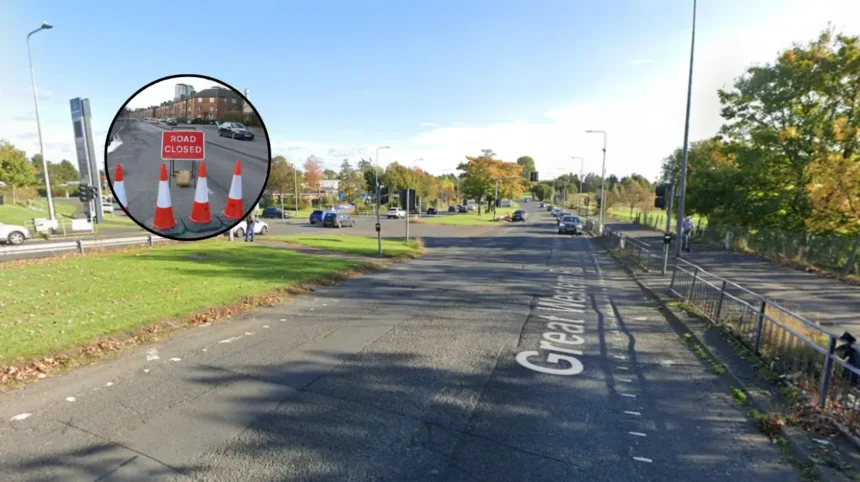
- Lane closures have been enforced at a busy Glasgow junction on Great Western Road to allow for guardrail repairs.
- The Glasgow Times published the report on 9 April 2026, and the story was shared on social media the same day.
- The closures are affecting a section of a key route in Glasgow’s west end, with traffic disruption likely for motorists using the area.
- First Bus also issued a closure notice for Great Western Road between Park Road and Napiershall Street from 13 April to 18 April 2026 for resurfacing works, showing further disruption on the same corridor.
- Glasgow City Council and related roadworks notices indicate that Great Western Road has been subject to repeated maintenance and traffic management measures in April 2026.
Glasgow (Glasgow Express) April 21, 2026
What happened at the junction?
The closures were introduced to support guardrail repairs at a busy junction on Great Western Road. The available report confirms that the disruption was caused by planned roadworks rather than an emergency incident.
Great Western Road is one of Glasgow’s main arterial routes, so even partial restrictions can affect vehicle flow, side-street access and bus reliability. The timing also matters because the same stretch was subject to further road closure notices later in April for resurfacing work.
Why was traffic restricted?
According to the Glasgow Times report, lane closures were put in place to allow guardrail repairs to be carried out safely. Traffic management of this kind is common when workers need space beside live lanes, especially on roads carrying heavy daily traffic.
Roadwork notices from other local transport sources show that Great Western Road was already part of an active maintenance programme in April 2026. First Bus said Great Western Road between Park Road and Napiershall Street would be closed from 13 April to 18 April 2026 for resurfacing, with diversions in place for services 6 and 6A.
How was the road affected?
The source material confirms that lane closures were in force, but it does not provide a full lane-by-lane traffic management plan. That means the clearest verified point is that motorists faced restrictions at the junction while repair work took place.
Separate transport updates show that bus routes in the same corridor were diverted during the road closure period later in the month, suggesting wider knock-on effects for public transport users. On roads of this type, even short-term closures can slow traffic and change journey times for people travelling through the west end.
What did the Glasgow Times report say?
The Glasgow Times headline identified the issue as
“Lane closures affecting busy Great Western Road junction.”
Its social media post summarised the story as
“Drive on Great Western Road? A busy stretch is set to close next week.”
That publication detail is important because it shows the restriction was being presented as a scheduled roadworks update rather than a major incident. No additional named quote from the article was available in the accessible source material, so only the confirmed facts can be reported here.
What other roadworks were taking place nearby?
Great Western Road was not the only Glasgow road affected by maintenance in April 2026. First Bus listed a Great Western Road closure between Park Road and Napiershall Street from 13 April to 18 April 2026, with a full diversion in place for services 6 and 6A.
Traffic Scotland’s roadworks listings also show multiple ongoing lane closures and maintenance works across the wider Glasgow area in April 2026. This suggests the city’s transport network was dealing with several overlapping infrastructure jobs at the same time.
How might drivers and passengers be affected?
Drivers using Great Western Road can expect slower journeys, short diversions and possible congestion near the affected junction while repair work is under way. Bus passengers may also face timetable changes or rerouted services when closures affect major bus corridors such as this one.
For local residents and businesses, repeated roadworks can create short-term inconvenience, but the work is usually carried out to maintain safety and keep roads in serviceable condition. In this case, the immediate effect is traffic disruption, while the longer-term aim is to restore the junction and surrounding road infrastructure.
Background of the development
Great Western Road is one of Glasgow’s most important urban roads, linking several busy districts and carrying high volumes of traffic throughout the day. Because of that, maintenance work on this corridor often requires lane closures, bus diversions or temporary full closures.
The April 2026 notices show that the route was already undergoing resurfacing and related works, which helps explain why the junction repair sat within a broader programme of road maintenance. Similar traffic control measures are standard practice during guardrail repairs, resurfacing and barrier upgrades when crews need to work close to live traffic.
Prediction
For motorists, the most likely short-term effect is continued slow traffic, temporary diversions and localised delays while the repair work is completed. For bus users, the main impact is likely to be route adjustments, stop changes or longer journey times when works overlap with scheduled services.
For people living or working near Great Western Road, the disruption should ease once the repairs and resurfacing are finished, but similar maintenance activity may continue from time to time because the route is heavily used. In practical terms, the development is more likely to cause inconvenience in the short run than lasting change in how the road functions.