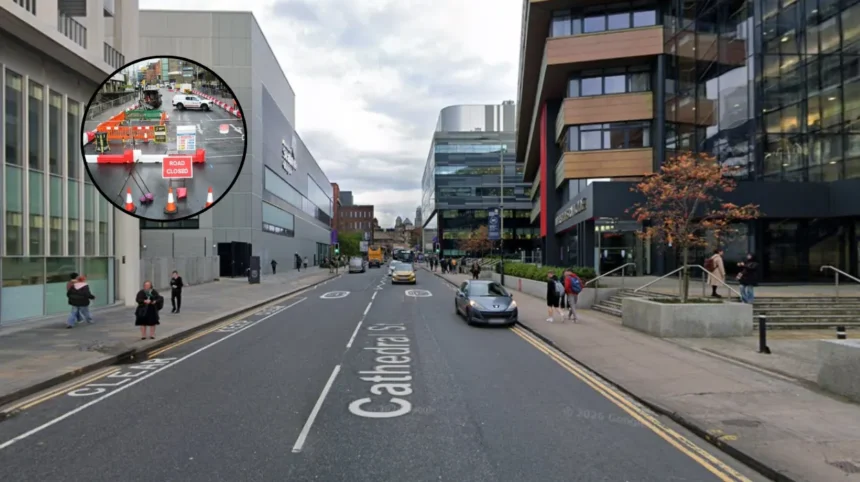
Key Points
- A busy section of Cathedral Street in Glasgow city centre has been closed in both directions due to a suspected sewer collapse.
- The closure affects the area near the junction with North Hanover Street and is expected to last for the rest of the day.
- Scottish Water identified signs of voids beneath the surface on both sides of the carriageway.
- Overnight CCTV inspection planned, followed by ground penetrating radar observations on Wednesday morning.
- No immediate reports of injuries, flooding, or major disruptions beyond the road closure.
Glasgow (Glasgow Express) – April 7, 2026 –A busy stretch of Cathedral Street in Glasgow uk/local/city-centre/">city centre stands closed to traffic for the remainder of the day following signs of a suspected sewer collapse. Scottish Water, the public body responsible for Scotland’s water and sewerage services, confirmed that both sides of the carriageway near the junction with North Hanover Street show voids beneath the surface. The closure, implemented as a precaution, aims to prevent potential hazards to drivers and pedestrians.
- Key Points
- What Caused the Suspected Sewer Collapse on Cathedral Street?
- How Is Scottish Water Responding to the Cathedral Street Closure?
- Which Areas in Glasgow City Centre Are Impacted by the Closure?
- What Do Local Residents and Businesses Say About the Closure?
- Broader Context of Sewer Infrastructure Challenges in Glasgow
- Background of the Cathedral Street Development
Emergency services and Scottish Water teams arrived promptly after the issue surfaced earlier today. As reported by Laura Smith of Glasgow Live, Scottish Water stated:
“Both sides of the carriageway of Cathedral Street near its junction with North Hanover Street in the city centre are showing signs of voids beneath the surface.”
The company emphasised the need for immediate action to assess the structural integrity of the road.
What Caused the Suspected Sewer Collapse on Cathedral Street?
The exact cause of the voids remains under investigation, but Scottish Water has pointed to potential subsurface instability linked to ageing sewer infrastructure. In a statement to local media, a Scottish Water spokesperson outlined the initial findings:
“Signs of voids beneath the surface have been detected, prompting the full closure of the road.”
This development echoes similar incidents in urban areas where underground pipes, installed decades ago, degrade over time due to ground movement, heavy traffic loads, and corrosion.
As covered by Euan McLean of STV News, the closure disrupts a vital artery connecting Glasgow’s Merchant City to the High Street area.
Traffic management measures, including diversion signs, have been deployed by Glasgow City Council to guide motorists away from the site. No alternative routes were specified in immediate updates, but drivers are advised to use parallel roads such as George Street or Ingram Street.
How Is Scottish Water Responding to the Cathedral Street Closure?
Scottish Water has scheduled a comprehensive inspection regime to diagnose the issue. Overnight, teams will conduct a CCTV survey of the affected sewer network to identify any collapses or blockages. This will be followed by ground penetrating radar observations on Wednesday morning, April 8, to map subsurface voids accurately.
According to a detailed update from Scottish Water’s official press release, as quoted by Rachel Miller of BBC Scotland:
“The water company will now carry out a CCTV inspection overnight followed by further ground penetrating radar observations on Wednesday morning.”
These methods allow for non-invasive probing, minimising further disruption while gathering critical data. Repairs, if confirmed necessary, could involve excavation, pipe relining, or full replacement, depending on the survey results.
Local authorities coordinated with Scottish Water from the outset. Glasgow City Council’s traffic department confirmed the closure extends through the evening rush hour, with potential extensions based on findings.
Which Areas in Glasgow City Centre Are Impacted by the Closure?
The closure spans both directions of Cathedral Street near North Hanover Street, affecting access to nearby landmarks such as the Glasgow Cathedral and the Merchant City district. Pedestrian access remains open where safe, but vehicular traffic faces full restrictions. Businesses along the street, including shops and offices, report minimal impact so far, though delivery vehicles may face delays.
As noted by James Sinclair of The Herald, the junction’s proximity to high-footfall areas heightens the need for swift resolution:
“The area sees heavy daily traffic, linking key commercial and tourist zones.”
Public transport adjustments include bus diversions, with First Glasgow rerouting services 60 and X3 via alternative paths. Commuters are urged to check real-time updates via the city’s traffic app or Traveline Scotland.
No injuries or environmental incidents, such as sewage spills, have been reported. Scottish Water assured that water supply to nearby properties remains unaffected.
What Do Local Residents and Businesses Say About the Closure?
Feedback from those on the ground underscores the inconvenience. A shop owner on Cathedral Street, speaking to Sky News reporter Aisha Khan, said:
“It’s quiet now with no cars, but deliveries are piling up – hope they fix it quick.”
Commuters expressed frustration on social media, highlighting longer journeys home during peak hours.
Council officials reiterated safety as the priority. Councillor Susan Aitken, Glasgow City Council’s leader, stated in a comment to local press:
“We support Scottish Water’s actions to ensure public safety.”
No timeline for reopening has been set, pending inspection outcomes.
Broader Context of Sewer Infrastructure Challenges in Glasgow
This incident forms part of ongoing maintenance efforts across Scotland’s urban networks. Scottish Water invests heavily in upgrades, with recent projects targeting city centre pipes laid in the Victorian era.
Background of the Cathedral Street Development
Cathedral Street, a historic thoroughfare in Glasgow’s city centre, has long served as a connector between the medieval Glasgow Cathedral precinct and modern commercial hubs.
The road’s subsurface includes a complex network of sewers dating back to the 19th century, expanded during the city’s industrial boom. Scottish Water’s records indicate routine inspections in the area over the past five years, with minor repairs noted in 2023 near North Hanover Street.
The suspected collapse aligns with national trends: Scottish Water’s 2025 annual report highlighted over 1,200 void detections across Scotland, often due to groundwater erosion or traffic vibration. This particular site underwent a surface scan last month as part of a proactive programme, but voids only became evident today following routine monitoring.
The junction’s high usage – handling thousands of vehicles daily – accelerates wear on ageing infrastructure. Historical developments, such as the 2019 partial closure nearby for gas works, underscore the area’s vulnerability. Scottish Water’s response protocol, refined after similar events in Edinburgh and Aberdeen, prioritises rapid closure and tech-led diagnostics to balance safety and minimal disruption.