Key Points
- Campaigners Win 20-Year Battle: Local community activists and elected representatives have finally secured a commitment to install permanent traffic signals at a notorious intersection in Anniesland.
- “Death-Trap” Junction Identified: The highly dangerous crossroad connecting Temple Road and Bearsden Road has been long condemned by residents due to high-speed traffic, blind corners, and a severe lack of safe pedestrian crossings.
- Political Heavyweights Form Alliance: Glasgow City Council’s Councillor Paul Carey and Member of Parliament for Glasgow West, Patricia Ferguson, successfully lobbied municipal authorities to push the safety scheme through.
- Comprehensive Safety Overhaul Planned: Beyond vehicular traffic signals, the upcoming infrastructure project will feature dedicated pedestrian crossing sensors, high-visibility advance stop boxes, and specialized right-turn filter lanes to structurally separate conflicting traffic streams.
- Decades of Local Inaction Overturned: The operational breakthrough officially resolves two decades of persistent petitioning, community anxiety, and recurring vehicular collisions at the outer edge of Glasgow’s West End.
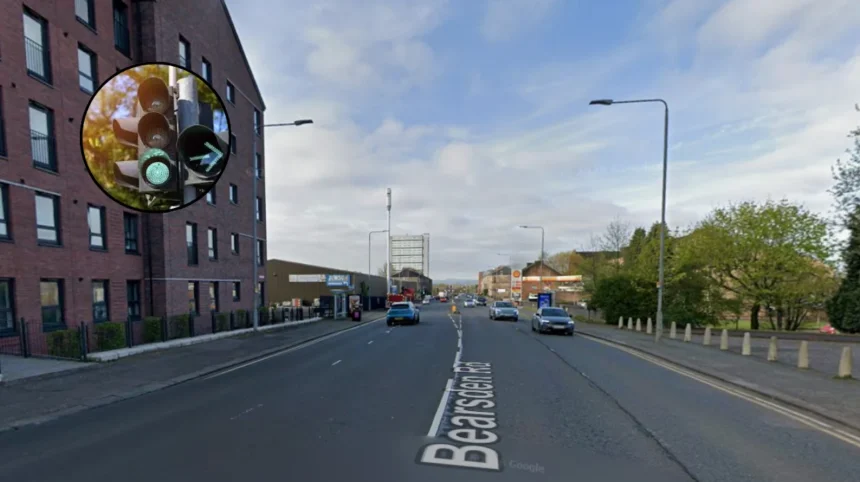
Bearsden (Glasgow Express) June 1, 2026 – A notorious road layout that has sparked local terror for a generation is finally set to undergo a comprehensive engineering intervention after grassroots campaigners secured a historic victory. Glasgow City Council has formally confirmed that permanent, automated traffic control lights will be integrated into the treacherous junction connecting Temple Road and Bearsden Road. The formal infrastructure commitment successfully terminates a grueling, multi-decade advocacy campaign spearheaded by frantic neighbourhood groups, fearful pedestrians, and regional political figures who have collectively condemned the transport bottleneck as an unmitigated “death-trap.”
- Key Points
- Which Local Authorities and Politicians Were Instrumental in Forcing the Infrastructure Breakthrough?
- What Specific Structural Deficiencies Earned the Bearsden and Temple Road Intersection Its Notorious Reputation?
- How Will the Newly Approved Automated Safety Features and Traffic Management Technologies Function?
- Background of the Road Safety Campaign
- Prediction: How This Development Will Affect West End Commuters and Residents
- Impact on Daily Motorized Commuters
- Impact on Commercial Transport and Emergency Services
The hard-fought breakthrough concludes a 20-year cycle of administrative friction, public consultation, and mounting road casualties along one of the principal arterial bypasses linking the northern suburbs of Bearsden and Milngavie to the heart of Glasgow’s West End. For years, the intersection has forced motorists exiting Temple Road to blindly negotiate multiple lanes of high-velocity traffic descending the steep gradient of Bearsden Road, creating structural conflict points that safety experts warn are inherently prone to catastrophic T-bone impacts and high-impact pedestrian strikes.
Which Local Authorities and Politicians Were Instrumental in Forcing the Infrastructure Breakthrough?
The administrative shift required an intensive cross-parliamentary alliance to overcome decades of institutional inertia at the local authority level.
As documented in a series of investigative public interest briefings published by regional transport correspondents, the campaign achieved critical momentum through the combined efforts of veteran ward representatives and newly elevated legislative champions who elevated the safety dispute into a high-visibility municipal priority.
Councillor Paul Carey, a long-serving representative on Glasgow City Council, coordinated closely with Patricia Ferguson, the Labour Member of Parliament (MP) for Glasgow West, to form a united political front at the physical site of the junction. Working in tandem with local action groups, the political duo conducted on-site assessments alongside municipal road engineers to highlight the structural indefensibility of the current layout.
According to official correspondence reviewed by transport specialists, Councillor Paul Carey repeatedly pushed the local authority’s roads and sustainability department to acknowledge that standard warning signage and basic road markings had completely failed to curb the frequency of near-misses.
Meanwhile, Patricia Ferguson MP leveraged her broader parliamentary platform to amplify the safety concerns of hundreds of West End constituents who expressed routine terror regarding the daily school commute across Bearsden Road.
What Specific Structural Deficiencies Earned the Bearsden and Temple Road Intersection Its Notorious Reputation?
To understand the scale of the community’s twenty-year outrage, road safety analysis must look closely at the distinct topographical and architectural flaws that converge at this particular point of the A739 corridor. As localized by geographical surveys of Glasgow’s urban layout, the intersection functions as a high-density merge point where local residential traffic from the Temple district attempts to cross a fast-moving, multi-lane dual carriageway.
The primary hazard stems from a profound visibility deficit. Motorists turning right from Temple Road onto Bearsden Road must peer around dense roadside foliage and navigate a sweeping, blind curve that obscures oncoming vehicles traveling southbound.
This visibility crisis is severely compounded by the topography of the road; vehicles coming from the north travel down a significant incline, frequently exceeding the posted speed limit as they approach the Anniesland Cross peripheral zone.
The danger is equally acute for non-vehicular road users. For two decades, the junction lacked any form of signalized pedestrian infrastructure. Residents walking toward the nearby local amenities, parklands, or the Forth and Clyde Canal pathways were forced to perform dangerous dash maneuvers across multiple lanes of traffic, guessing the speed of oncoming Sports Utility Vehicles (SUVs) descending the hill.
How Will the Newly Approved Automated Safety Features and Traffic Management Technologies Function?
The engineering blueprint sanctioned by municipal planners is designed to replace unpredictable driver human error with tightly regulated, sensor-driven automation. Rather than deploying static, timed traffic lights that can exacerbate gridlock during off-peak hours, the local authority is investing in an advanced, responsive system utilizing intelligent radar and ground-embedded loop detectors.
The technical specifications for the upcoming installation indicate several core enhancements:
LMDX Component Placeholder
- Intelligent Phase Calibration: The primary signal arrays will feature dynamic timing adjustments, rapidly alternating the green phases based on real-time traffic queues detected on Temple Road, preventing long queues from tailing back into residential streets.
- Dedicated Right-Turn Filters: A dedicated signal phase will be added specifically for vehicles turning from Bearsden Road into Temple Road, legally isolating turning cars from oncoming traffic flows and eradicating blind-angle turning risks.
- Automated Pedestrian Sanctuary Zones: Every pedestrian crossing island at the junction will be equipped with high-precision optical sensors. These automated triggers will register the presence of waiting pedestrians without requiring a physical button push, swiftly activating a protected “green man” phase during gaps in traffic.
The twenty-year timeline of community protest is punctuated by a grim log of vehicular collisions, severe injuries, and structural disruptions that have routinely paralyzed Glasgow’s northern transport grid. Police Scotland accident registries reveal that the intersection has seen numerous multi-car pileups, often triggered when a driver, growing impatient due to long delays on Temple Road, attempts to force their way into a microscopic gap on Bearsden Road.
One prominent historical incident that underscores the vulnerability of the site occurred when a westbound Vauxhall Vectra and a southbound Hyundai collided violently directly within the junction’s core.
The impact caused both vehicles to veer wildly off course, careening into the pedestrian pavement and striking a 55-year-old bystander who was standing behind a parked car.
The woman was rushed to the Queen Elizabeth University Hospital in a critical condition with severe injuries, while a 74-year-old driver required emergency treatment at the Glasgow Royal Infirmary.
Beyond passenger vehicle collisions, the junction’s physical proximity to a low railway bridge on Bearsden Road has historically triggered broader transport chaos. Heavy Goods Vehicles (HGVs) and agricultural transports, diverted or misnavigating the tight turning angles from Temple Road, have repeatedly become wedged beneath the low clearance bridge.
One such incident involved a large lorry carrying massive bales of hay, which became structurally pinned under the rail line, spilling cargo across the northbound lanes and forcing emergency services to shut down the entire A739 artery for hours.
Background of the Road Safety Campaign
The realization of the traffic light project marks the culmination of an extraordinarily prolonged grassroots campaign that began in the early 2000s.
For over twenty years, successive waves of community councils, parent-teacher associations, and independent road safety advocates have lobbied Glasgow City Council for a permanent engineering solution.
Historically, municipal transport departments had resisted full signalization of the junction, citing concerns that adding a new set of traffic lights so close to the major junction at Anniesland Cross would cause catastrophic tailbacks across the entire West End network.
During this period of official resistance, the local authority attempted several minor, low-cost modifications, including updating road markings, trimming back obscuring vegetation, and installing static warning signs.
However, as vehicular volumes steadily increased due to housing developments in East Dunbartonshire and the expansion of commuting corridors, these temporary fixes proved entirely inadequate.
The turning point arrived when local residents shifted tactics, gathering dashcam footage of near-misses and coordinating directly with ward politicians to demonstrate that the financial cost of permanent traffic signals was vastly outweighed by the rising human and economic cost of recurring emergency service deployments to the site.
Prediction: How This Development Will Affect West End Commuters and Residents
The installation of permanent, sensor-driven traffic signals at the Temple Road and Bearsden Road junction will trigger immediate, far-reaching shifts in the daily lives, safety profiles, and travel patterns of thousands of individuals across the Glasgow West and East Dunbartonshire regions.
For local residents, particularly school children, elderly citizens, and individuals with limited mobility living in the surrounding Temple and Anniesland housing estates, this development will completely transform their relationship with the local urban environment.
The introduction of high-precision pedestrian sensors and protected crossing phases will eliminate the dangerous, high-stress crossing conditions that have effectively cut off the neighborhood for twenty years. Pedestrians will gain safe, dignified, and reliable access to local retail centers, the Anniesland transport interchange, and nearby scenic walking routes along the Forth and Clyde Canal without risking life and limb.
Impact on Daily Motorized Commuters
For the thousands of motorists who utilize the A739 Bearsden Road daily as a primary commuter artery into the city center, the immediate impact will involve a adjustment in driving patterns.
While the introduction of smart, responsive traffic lights will eliminate the hazardous blind turns and decrease the incidence of high-impact collisions, drivers must prepare for a slight recalibration of travel times during peak morning and evening rush hours.
The advanced loop detectors are designed to minimize delays, but the formal synchronization of this junction means traffic descending the hill will now face controlled stops to allow residential traffic from Temple Road to merge safely.
However, this minor increase in transit time will be heavily offset by a drastic reduction in major, long-term gridlock events previously caused by frequent accidents, police road closures, and emergency vehicle interventions.
Impact on Commercial Transport and Emergency Services
Commercial logistics operators and regional emergency response teams will experience vastly improved route predictability through the northern West End corridor. By establishing clear right-turn filters and structurally separating conflicting traffic movements, the project will drastically lower the probability of multi-vehicle collisions that historically paralyzed the entire local road network.
Furthermore, the implementation of modern, standardized road design will clearly demarcate lanes, reducing the likelihood of large commercial vehicles executing improper maneuvers near the low railway bridge, thereby securing the structural and operational integrity of one of Glasgow’s most critical transport links.