Key Points
- Police Scotland have launched an investigation into “mystery meat” discovered inside a Glasgow business premises.
- The discovery occurred during a three-day multi-agency blitz, designated as part of Operation Machinize.
- Officers forcibly entered 22 commercial establishments across Glasgow, including vape shops, nail bars, barber shops, and car washes.
- More than 15,000 illicit cigarettes were seized during the targeted raids.
- The operation focused on high-density commercial strips, including Dumbarton Road, Maryhill Road, and Hope Street.
- Law enforcement officials suspect cash-rich businesses are being used as fronts for organised crime groups, human exploitation, and customs evasion.
Glasgow (Glasgow Express) November 9, 2026 – Police Scotland have launched a formal investigation into the discovery of an unidentified substance described as “mystery meat” following a series of coordinated raids on commercial establishments across Glasgow. The unusual find occurred during a three-day enforcement initiative designed to disrupt organised crime networks operating within the city. Officers targeted multiple cash-rich venues suspected of serving as covers for illicit finance, human exploitation, and tax evasion.
- Key Points
- What led Police Scotland to raid businesses across Glasgow?
- Why is the discovery of the “mystery meat” significant?
- Which specific areas and trade sectors were targeted?
- Background of the Glasgow illegal business raids
- Prediction: How will this development affect Glasgow residents and local business owners?
During the course of the operation, law enforcement personnel forcibly entered 22 separate business premises located across key high-street corridors. Alongside the unknown meat product—suspected by investigating officers of originating from an unregulated underground trading network—authorities confiscated more than 15,000 illicit cigarettes. The sweeps formed part of Operation Machinize, a nationwide British law enforcement campaign aimed at tackling systemic economic crime, duty evasion, and labor exploitation.
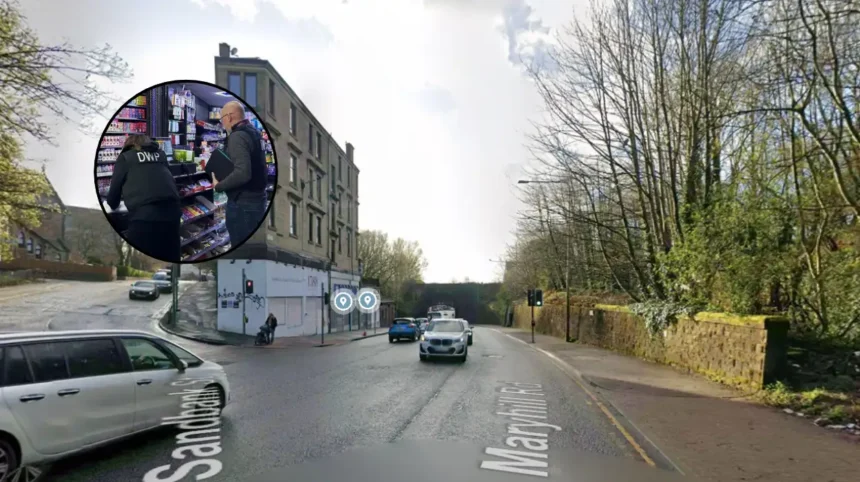
The multi-day operation concentrated on high-footfall thoroughfares, with tactical entries executed on shops along Dumbarton Road in the West End, Maryhill Road in the north of the city, and Hope Street in Glasgow city centre. The targeted establishments encompassed a variety of cash-dominant retail and service businesses, including barbers, vape dispensaries, nail salons, and hand car wash facilities.
What led Police Scotland to raid businesses across Glasgow?
The enforcement action was executed under the framework of Operation Machinize, a UK-wide law enforcement strategy structured to dismantle the infrastructure of serious and organised crime. Investigative authorities identified specific commercial sectors—predominantly cash-handling retail enterprises—as potential conduits for money laundering, human trafficking, and the distribution of contraband goods.
During the three-day operational window, police teams used forcing equipment to gain entry into properties where criminal activity was suspected. The recovery of 15,000 non-duty-paid cigarettes represents a significant financial disruption to the illicit supply chains operating within the West of Scotland. Customs officials and local policing units are currently evaluating the seized inventory to trace the origin of the contraband.
Why is the discovery of the “mystery meat” significant?
The discovery of unlabelled and untraceable meat within a retail setting has introduced a public health and regulatory dimension to the criminal investigation. According to reporting on the operation, police officers uncovered the substance during a search of one of the raided premises, prompting immediate concerns regarding an underground meat market operating out of Glasgow shops.
Environmental health officers and food standards regulators have been alerted to assist Police Scotland with the forensic testing and origin tracing of the product. Unregulated meat distribution networks often bypass mandatory health inspections, slaughterhouse checks, and cold-chain storage regulations, presenting potential bio-hazard risks to consumers and violating UK food safety statutes.
Which specific areas and trade sectors were targeted?
The law enforcement initiative spanned several distinct geographic zones within Glasgow, focusing on commercial arteries known for high densities of independent service shops. The 22 targeted premises included:
- Retail outlets: Vape shops and convenience stores across Hope Street and Dumbarton Road.
- Personal care services: Barber shops and nail bars situated along Maryhill Road.
- Automotive services: Independent car wash facilities operating across the city boundary.
Police Scotland confirmed that these specific trade categories are frequently scrutinised during economic crime operations due to their heavy reliance on cash transactions, which can facilitate the masking of illegal revenue streams and undocumented labor practices.
Background of the Glasgow illegal business raids
The execution of Operation Machinize in Glasgow reflects an ongoing nationwide effort by UK police forces, HM Revenue and Customs (HMRC), and the Home Office to counter the proliferation of illicit trade networks. Over the past decade, law enforcement frameworks have increasingly targeted the physical infrastructure used by organised crime groups (OCGs) to launder cash derived from illegal activities such as drug trafficking, smuggling, and modern slavery.
Cash-rich storefronts—specifically car washes, nail bars, and barber shops—have featured prominently in national intelligence assessments regarding trade-based money laundering. These businesses allow illicit operations to integrate cash directly into the legitimate financial system by overstating revenue or disguising unlawful employment practices. Concurrently, the UK market for illicit tobacco has grown significantly, driven by high tax duties on legitimate products. The seizure of 15,000 cigarettes in Glasgow aligns with broader enforcement trends where counterfeit and smuggled goods are sold below market rates to generate rapid cash returns for criminal enterprises. The emergence of unregulated food supply chains, such as illegal meat processing and trading, represents a expanding facet of illicit trade that intersects with public health governance.
Prediction: How will this development affect Glasgow residents and local business owners?
The outcome of Operation Machinize and the ongoing investigation into the unidentified meat discovery are likely to trigger several operational and social shifts for local communities and commercial operators in Glasgow.
Increased Regulatory Inspection for Independent Retailers
Businesses operating within the high-risk sectors identified by police—particularly barber shops, vape outlets, nail salons, and car washes—will likely face heightened surveillance and more frequent joint inspections from Police Scotland, HMRC, and local council environmental health teams. Legitimate enterprise owners in areas like Dumbarton Road, Maryhill Road, and Hope Street may experience stricter compliance checks, mandatory audit requests, and increased administrative oversight as authorities attempt to eliminate front operations.
Public Health Advisories and Consumer Awareness
Should forensic testing confirm that the “mystery meat” poses a biological hazard or originates from unapproved processing facilities, public health authorities will probably issue widespread warnings to consumers. Residents in Glasgow may be advised to exercise caution when purchasing unlabelled or unusually low-cost food items from non-traditional or non-certified retailers. This could lead to temporary reputational damage and reduced consumer footfall for independent food sellers across the city until supply chain integrity is publicly re-established.
Disruption of Illicit Supply Chains
The seizure of 15,000 illicit cigarettes and the intervention into 22 premises will temporarily disrupt the localized availability of non-duty-paid goods in northern and central Glasgow. However, as law enforcement agencies intensify their crackdowns on cash-based fronts, organised criminal groups are expected to adapt their methods, potentially shifting illicit operations toward online marketplaces or decentralised delivery models to evade physical storefront raids in the future.