Key Points
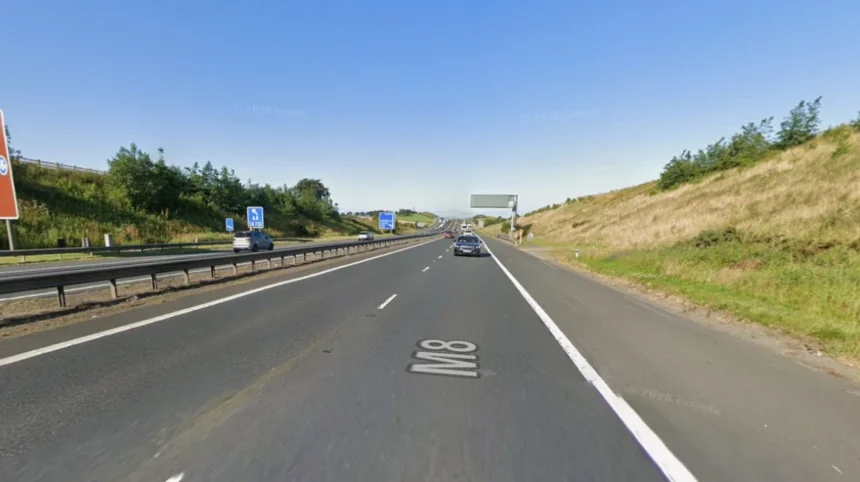
- The M8 motorway between Junction 26 (Hillington) and Junction 27 (Arkleston/Paisley) near Glasgow Airport is currently restricted due to an ongoing incident.
- Transport monitoring agency Traffic Scotland has officially categorised the disruption as a road traffic accident.
- Emergency services have been contacted for comment regarding the situation, with police and recovery teams responding on site.
- Significant traffic congestion is developing along the major arterial route, creating delays for commuters and airport travelers.
Glasgow (Glasgow Express) October 28, 2026 — The M8 motorway between Junction 26 and Junction 27 near Glasgow Airport has been restricted following an ongoing road traffic collision, causing traffic build-up and delays along the busy route. As reported by the news desk of the Glasgow Times, official monitoring agency Traffic Scotland confirmed that the stretch of carriageway adjacent to the airport is subject to lane restrictions while emergency personnel respond to the scene.
- Key Points
- What is the current situation on the M8 near Glasgow Airport?
- How is the M8 restriction affecting traffic and airport passengers?
- What statements have emergency services and transport bodies issued?
- What is the background of this particular transport route development?
- What is the prediction for how this development will affect local motorists and travelers?
What is the current situation on the M8 near Glasgow Airport?
As reported by reporter Standard News Desk of the Glasgow Times, the incident was first flagged by road management authorities after vehicles collided along the westbound section connecting Junction 26 at Hillington to Junction 27 at Arkleston. According to statement details issued by a spokesperson for Traffic Scotland, the agency has formally designated the disruption as a road traffic accident, warning motorists to exercise caution when approaching the affected area. Police Scotland and local emergency service operators have been contacted for further statements regarding any potential injuries or structural damage to the road infrastructure.
How is the M8 restriction affecting traffic and airport passengers?
As documented by the reporting team at The Gazette, traffic flow along the trunk road has slowed down significantly, with queueing vehicles extending back along the M8 corridor towards central Glasgow. Travel updates released by Traffic Scotland indicate that lane availability remains limited while response teams operate. The disruption presents particular challenges for passengers traveling to Glasgow International Airport via Junction 28, as well as general traffic heading towards Paisley, Renfrew, and Greenock. Motorists in the region have been advised by transport officials to factor in extra travel time or seek alternative transport routes where possible.
What statements have emergency services and transport bodies issued?
As stated by a representative from Traffic Scotland via live monitoring updates, operational staff are actively managing the scene alongside emergency service crews. As reported by the news team at the Glasgow Times, police officers were dispatched to secure the carriageway, manage queueing traffic, and facilitate the safe removal of involved vehicles. Official comments from Police Scotland and the Scottish Ambulance Service remain pending following formal requests for statement releases.
What is the background of this particular transport route development?
The M8 motorway serves as Scotland’s busiest and most vital east-west road link, connecting Edinburgh and Glasgow while providing the direct highway link to Glasgow International Airport. The section running between Junction 26 (Hillington) and Junction 28 (Glasgow Airport) routinely carries heavy volumes of regional, commercial, and passenger traffic every day. Due to the high density of vehicles utilizing this stretch—particularly during peak morning and evening travel periods—even minor vehicular collisions or single-lane closures can produce rapid traffic tailbacks that impact the wider arterial road network across Renfrewshire and Greater Glasgow.
Over recent years, recurring incidents and planned infrastructure maintenance along this corridor have prompted Transport Scotland and local authorities to continuously evaluate traffic management procedures and real-time response strategies to minimize travel disruption for regional logistics and air travelers.
What is the prediction for how this development will affect local motorists and travelers?
This development will directly affect several key groups across the west-central belt of Scotland, primarily air passengers, daily commuters, and regional freight operators.
For passengers traveling to Glasgow International Airport, lane restrictions and surrounding congestion introduce a risk of missed flights or security delays if journey planning is not immediately adjusted. Airline passengers approaching via the M8 westbound corridor will likely experience elevated travel times, requiring earlier departures to reach terminals safely.
For daily commuters and local drivers navigating between Glasgow, Paisley, and Renfrew, the tailbacks on the motorway will inevitably displace traffic onto surrounding local roads, including the A737, the A8, and urban residential streets through Hillington and Braehead. This redirection is expected to result in localized urban gridlock during upcoming peak travel hours until the main carriageway is cleared and fully reopened.
For commercial transport operators and freight carriers, prolonged restrictions along the M8 will introduce transit delays across the central belt logistics supply chain, temporarily increasing fuel consumption and operational costs for businesses relying on timely cargo movements throughout western Scotland.