

Key Points
- Local authorities have agreed to introduce traffic mitigation measures on Hamilton Road in Broomhouse, Glasgow.
- The agreed interventions include two flashing speed signs, a new pedestrian crossing, a replacement bus shelter, road resurfacing, an official traffic survey, and enhanced street cleaning routines.
- The developments follow sustained campaigning by local householders and the Broomhouse Community Council over severe heavy goods vehicle (HGV) movements.
- Local residents previously reported structural property damage, including cracked plasterwork, falling ceiling material, window frames detaching from structures, and shifting furniture attributed to severe vehicular vibrations.
- Community members highlight that lorry movements have escalated significantly since the opening of the nearby Patersons Quarries landfill facility in 2013, which recently transitioned to a seven-day operational schedule.
- Campaigners maintain that whilst the new safety and infrastructure measures are welcome, the underlying issue of high-volume heavy freight traffic on a residential thoroughfare remains unresolved.
Glasgow (Glasgow Express) September 5, 2026 – Residents campaigning over the profound structural and environmental impacts of heavy lorry traffic along a primary Glasgow thoroughfare have successfully secured a package of infrastructure improvements from local authorities, though campaigners maintain the primary source of the disruption remains unaddressed.
What Infrastructure Measures Have Been Promised For Hamilton Road?
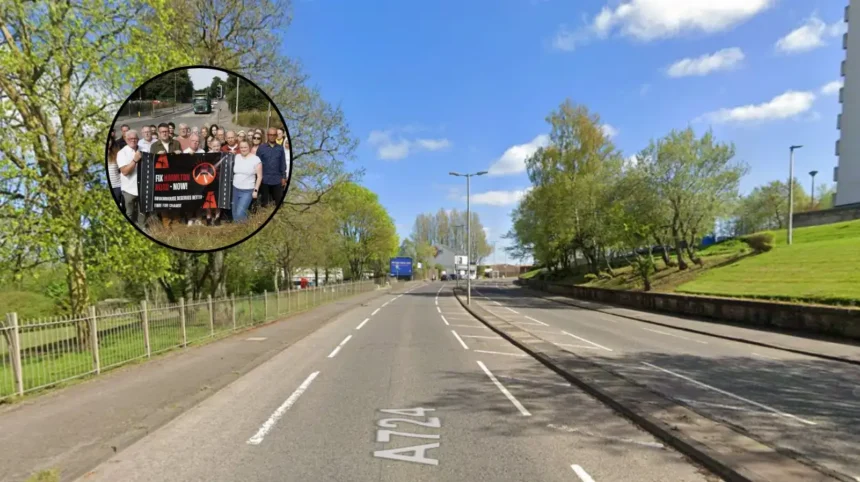
Following formal consultations between area householders, representative group members, and municipal authority representatives, a multi-part intervention scheme has been confirmed for Hamilton Road in the Broomhouse area of East Glasgow. The agreed package comprises the installation of two interactive flashing speed warning signs, the construction of a designated pedestrian crossing point, the erection of a replacement bus shelter, targeted carriageway resurfacing operations, a comprehensive traffic volume survey, and an intensified schedule for street cleaning services.
These municipal commitments were established after extensive representations made by local residents and members of the Broomhouse Community Council (BCC). Campaigners detailed how relentless heavy goods vehicle traffic along the residential corridor generates continuous ground vibrations, leading to structural distress in adjacent properties alongside significant road surface degradation.
How Has Excessive HGV Traffic Affected Broomhouse Residents?
As detailed in earlier reporting by Stacey Mullen of the Glasgow Times, local householders voiced deep concerns regarding the physical impact of heavy transport movements on their homes and daily lives. Residents documented significant internal property damage, reporting that persistent vibrations caused plasterwork to crack, ceiling plaster to collapse, and window frames to pull away from surrounding brickwork. Occupants further stated that ground tremors caused interior furniture to shift across floors during peak traffic hours.
Beyond structural concerns, residents highlighted severe environmental impacts along Hamilton Road, citing pervasive dust generation, elevated noise pollution levels, and hazardous pothole formation caused by heavy axle weights on the carriageway surface.
What Is Driving The Increase In Heavy Lorry Movement?
Community members trace the escalation of heavy vehicular transit directly to commercial industrial operations situated along the route. As reported by Stacey Mullen of the Glasgow Times, residents noted a marked increase in freight movements following the opening of the Patersons Quarries landfill site on Hamilton Road in 2013. The operational pressure on the surrounding road network has reportedly intensified further following the site’s recent expansion to a full seven-day operational timetable, drawing a continuous stream of heavy commercial transport through the residential area.
Background of the Particular Development
The dispute surrounding Hamilton Road sits at the intersection of municipal transport planning, industrial waste logistics, and residential amenity protection in East Glasgow. Hamilton Road functions as a key connective corridor, accommodating both local residential access and heavy industrial traffic heading towards major commercial facilities, including the regional landfill and quarry operations operated by Patersons Quarries.
Over the past decade, the growth of commercial waste management and quarrying operations at the site has altered traffic composition along the thoroughfare. While local roads are designed to standard axle load capacities, persistent heavy transport can accelerate carriageway degradation and transmit ground-borne vibration to vintage and modern residential structures alike.
In response to mounting public concern over road safety, property damage, and environmental degradation, community representatives engaged directly with municipal council officers. The resulting municipal commitment represents a standard local authority traffic mitigation approach, utilising speed management tools, pedestrian safety infrastructure, and physical repairs to manage the immediate symptoms of heavy traffic flows within a residential setting.
Prediction: How This Development Can Affect Broomhouse Residents
The implementation of the agreed traffic interventions will deliver immediate, tangible benefits to the daily lives of Broomhouse residents, particularly regarding pedestrian safety and general road maintenance. The introduction of two interactive flashing speed signs and a dedicated pedestrian crossing will reduce cross-street risks for vulnerable road users, including children and older residents, whilst the new bus shelter and carriageway resurfacing will temporarily improve daily commuting conditions and lower immediate surface noise from passing vehicles. Furthermore, the enhanced street cleaning schedule will help suppress the persistent dust accumulation generated by quarry and landfill haulage.
However, because these measures manage vehicle behavior and road condition rather than heavy transport volume, the core challenge facing property owners is likely to persist. The continuous transit of heavy goods vehicles—compounded by seven-day landfill operations—will continue to generate ground-borne vibrations. As a result, householders may continue to face long-term risks of cosmetic and structural property damage, including recurrent wall cracking and frame misalignment. Until the traffic survey findings lead to structural route re-designations, weight restrictions, or dedicated industrial bypass solutions, residents will remain exposed to the ongoing physical and environmental burdens of heavy industrial transit through their neighborhood.