

Key Points
- Archival Exploration: A new historical column published by Glasgow City Archives examines the origins and early history of Gartnavel Hospital, previously known as the Glasgow Royal Mental Hospital.
- 1842 Foundation Ceremony: On 1 June 1842, a grand civic procession led by Lord Provost Sir James Campbell marched to Gartnavel to lay the foundation stone, though torrential rain disrupted the event.
- Pre-1814 Provisions: Before dedicated facilities existed, Glasgow’s only public provision for individuals with mental illness consisted of a small number of cells inside the Town’s Hospital poorhouse.
- Original Location at Dobbie’s Loan: The institution was first established in 1814 at Dobbie’s Loan after Robert McNair campaigned for a dedicated facility in 1804 and raised £15,000 in public subscriptions.
- Architectural Evolution: Architect William Stark designed the original star-shaped panopticon facility at Dobbie’s Loan, while architect Charles Wilson later designed the Tudor Gothic Gartnavel site in 1843.
- Social and Class Division: The Gartnavel facility was intentionally structured to segregate patients by both gender and social class, dividing accommodation into the West House for paying patients and the East House for pauper patients.
Glasgow (Glasgow Express) August 8, 2026 – A new historical examination based on records held by Glasgow City Archives has revealed the institutional origins and harsh early realities of Gartnavel Hospital, which once served as Glasgow’s primary facility for psychiatric care during a period when mental healthcare was in its infancy. As reported by Ann Fotheringham of Glasgow Times, archivist Kate Guariento of Glasgow City Archives has brought to light detailed archival documents tracking the hospital’s evolution from its original site at Dobbie’s Loan to its relocated home at Gartnavel in the mid-nineteenth century. The records detail how early institutional approaches were defined by physical isolation, strict social stratification, and architectural designs intended to enforce continuous surveillance over patients.
- Key Points
- How Did the 1842 Foundation Ceremony at Gartnavel Unfold?
- What Was the Meaning of “Gartnavel” and Why Was the Site Selected?
- How Were Psychiatric Patients Treated in Glasgow Prior to 1814?
- How Did Architecture Influence Early Patient Care and Surveillance?
- How Was the Gartnavel Facility Constructed to Reflect Social Class?
- What Is the Historical Background to the Development of Glasgow’s Mental Health Facilities?
- How Will This Archival Discovery Impact Public Awareness and Mental Health Heritage?
How Did the 1842 Foundation Ceremony at Gartnavel Unfold?
As reported by Ann Fotheringham of Glasgow Times, historical accounts preserved in the archives capture the elaborate civic spectacle that marked the birth of the Gartnavel site.
At midday on 1 June 1842, a substantial procession comprising local civic leaders, academic personnel, religious figures, medical professionals, and masonic bodies departed from the City Halls toward the west of the city.
The primary objective of the gathering was for Lord Provost Sir James Campbell to lay the official foundation stone for what was then designated as the Glasgow Royal Mental Hospital.
As documented by archivist Kate Guariento of Glasgow City Archives, contemporary news coverage from the Glasgow Herald—the sister publication of the Glasgow Times—noted that extensive crowds assembled along the route to witness the ceremonial parade. However, the weather conditions deteriorated rapidly upon the procession’s arrival at the site.
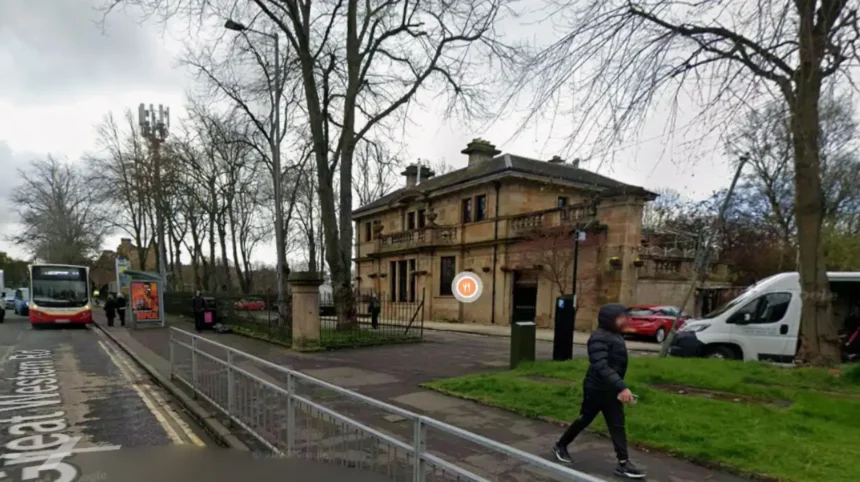
The light drizzling rain that had persisted during the march escalated into heavy downpours, which severely affected the morale of the attendees and diminished the visual impact of the proceedings. Immediately following the conclusion of the formal stone-laying duties, the participating dignitaries quickly dispersed to Great Western Road to board their carriages and return to the city centre.
What Was the Meaning of “Gartnavel” and Why Was the Site Selected?
As documented by archivist Kate Guariento of Glasgow City Archives, the name “Gartnavel” originates from Gaelic, translating directly to the “place of the orchard”.
Despite the strong historical association between the name and the mental health facility, the Gartnavel location was not the original home of the institution. It served as the second site for a facility that had first operated in the inner-city district of Dobbie’s Loan.
As reported by Ann Fotheringham of Glasgow Times, the initial facility at Dobbie’s Loan was selected specifically because of its rural surroundings and significant distance from Glasgow’s densely populated urban core.
In nineteenth-century medical practice, physical isolation from urban centres was considered an essential component of psychiatric treatment, as medical professionals believed that the “moral dangers” and physical industrial noise of expanding cities hindered recovery.
How Were Psychiatric Patients Treated in Glasgow Prior to 1814?
As documented by archivist Kate Guariento of Glasgow City Archives, institutional care for Glaswegians suffering from mental illness was virtually non-existent prior to the opening of the Dobbie’s Loan facility in 1814. The sole public provision maintained by the city consisted of a limited number of basic cells housed within the local poorhouse, known as the Town’s Hospital.
As reported by Ann Fotheringham of Glasgow Times, this lack of dedicated medical infrastructure prompted Robert McNair, a director of the Town’s Hospital, to write to his fellow directors in 1804. In his correspondence, McNair stated that the municipality required
“a house with proper keepers adapted to the situation of those diseased in their minds”.
Following his proposal, a public subscription committee was formed, successfully securing £15,000 in voluntary contributions.
This funding enabled the committee to purchase land at Dobbie’s Loan, commission an architect, and officially lay the foundation stone for Glasgow’s first dedicated lunatic asylum in August 1810 before a large public audience.
How Did Architecture Influence Early Patient Care and Surveillance?
As documented by archivist Kate Guariento of Glasgow City Archives, the initial hospital at Dobbie’s Loan was designed by architect William Stark, who implemented a distinctive star-shaped panopticon layout.
The structure featured a central core from which patient wings radiated outward, enabling hospital staff to maintain constant visual inspection over the patient population from a single observation point.
As reported by Ann Fotheringham of Glasgow Times, the primary medical philosophy promoted within the facility emphasized non-restraint in comparison to older asylum regimes.
However, records indicate that patients remained subject to severe disciplinary measures, rigid schedules, and unrelenting operational oversight. Over the subsequent three decades, rapid industrial growth caused Glasgow’s urban borders to expand outward toward Dobbie’s Loan.
The encroachment of factories and housing developments compromised the rural seclusion deemed necessary by medical administrators, ultimately prompting the decision to purchase land at Gartnavel.
How Was the Gartnavel Facility Constructed to Reflect Social Class?
As documented by archivist Kate Guariento of Glasgow City Archives, the institution commissioned architect Charles Wilson—who later designed Glasgow’s Trinity College—to plan the new Tudor Gothic hospital building at Gartnavel, which officially opened its doors in 1843.
As reported by Ann Fotheringham of Glasgow Times, the architectural layout at Gartnavel explicitly enforced social and economic divisions alongside gender separation. The complex was constructed with two main structural wings that maintained strict operational boundaries:
- The West House: Designed with superior architectural finishes and larger private space, designated exclusively for affluent, fee-paying private patients.
- The East House: Constructed with a simpler, more spartan layout to house “pauper” patients whose care was funded through parish support or public relief funds.
Explore More Local Glasgow News
Glasgow University to Review Jason Arday Appointment Amid Plagiarism Claims 2026
Mitie Begins Windyhill Battery Site Construction in Bearsden 2026
What Is the Historical Background to the Development of Glasgow’s Mental Health Facilities?
The establishment of the Glasgow Lunatic Asylum at Dobbie’s Loan in 1814 and its subsequent relocation to Gartnavel in 1843 represented a major transitional phase in Scottish medical history. Prior to the nineteenth century, individuals experiencing severe psychiatric distress or cognitive disabilities across Scotland were largely cared for by family members or confined within general poorhouses, local gaols, and parish workhouses where no specialized care existed.
The passage of the Madhouses (Scotland) Act 1815 introduced the first formal legal framework for inspecting and regulating Scottish asylums, placing local facilities under the direct oversight of medical authorities such as the Royal College of Physicians and Surgeons of Glasgow.
When the Gartnavel facility opened in 1843, it reflected the broader Victorian trend toward large-scale institutional asylum management. Over the late nineteenth and twentieth centuries, the site underwent repeated expansions to accommodate Glasgow’s growing industrial population, eventually acquiring a Royal Charter in 1924 and being renamed the Glasgow Royal Mental Hospital in 1931.
Following the creation of the National Health Service in 1948, the hospital was incorporated into public healthcare administration, eventually adopting the name Gartnavel Royal Hospital in 1963. While modern psychiatric treatment has shifted toward community-based care models and modern outpatient facilities, the preserved Category A-listed Victorian structures at Gartnavel continue to stand as historical markers of the evolution of medical attitudes toward mental health.
How Will This Archival Discovery Impact Public Awareness and Mental Health Heritage?
The public release and detailed analysis of these historical records by Glasgow City Archives provides researchers, healthcare historians, and the general public with verified context regarding the origins of institutional mental health treatment in Scotland.
By examining the official records of Dobbie’s Loan and Gartnavel, contemporary audiences gain an unvarnished view of how societal attitudes, class distinctions, and medical understandings shaped patient care during the nineteenth century.
For the modern public and healthcare practitioners, these historical disclosures serve as a baseline to measure the extensive progress made in psychiatric medicine, patient rights, and clinical ethics over the last two centuries.
Uncovering the administrative and architectural choices of early asylum administrators highlights the shift away from physical isolation and continuous surveillance toward person-centred care, evidence-based therapies, and integrated community support.
Furthermore, highlighting these records ensures that the historical legacy of Victorian institutional care remains accurately preserved within the public domain, providing valuable educational material without romanticising or distorting the realities faced by past patient populations.