Key Points
- The Govan-Partick footbridge over the River Clyde is undergoing four temporary closures across Saturday, 8 August, and Sunday, 9 August.
- Pedestrian and cycle access across the River Clyde between Water Row in Govan and Pointhouse Quay in Partick will be temporarily suspended during these specified operational windows.
- On Saturday, 8 August, the bridge will close from 9.20 am until 10.00 am, and again in the evening from 5.40 pm until 7.40 pm.
- On Sunday, 9 August, the crossing will be unavailable from 9.50 am until 10.30 am, and later in the evening from 6.10 pm until 8.10 pm.
- Local authorities have advised members of the public, commuters, and active travel users to plan their journeys in advance and seek alternative river crossing routes during these periods.
Glasgow (Glasgow Express) August 8, 2026 – Pedestrians and cyclists in Glasgow are being advised to adjust their weekend travel plans as the Govan-Partick footbridge over the River Clyde is scheduled to temporarily close to the public four separate times across Saturday and Sunday. The vital active travel link, which connects Water Row on the south side of the river to Pointhouse Quay in Partick on the north bank, will experience morning and evening closures on both days to facilitate planned operations along the waterway.
- Key Points
- What is the exact timetable for the Govan-Partick footbridge closures this weekend?
- Who will be affected by these temporary bridge closures?
- What alternative routes can pedestrians and cyclists use during the closures?
- Background of the particular development
- Potential impact on the affected audience and future outlook
The first closure on Saturday, 8 August, commences at 9.20 am and remains in effect until 10.00 am, followed by a two-hour evening disruption from 5.40 pm until 7.40 pm. On Sunday, 9 August, the footbridge will again close to all pedestrian and bicycle traffic between 9.50 am and 10.30 am, with a final evening closure running from 6.10 pm until 8.10 pm before normal access resumes.
What is the exact timetable for the Govan-Partick footbridge closures this weekend?
Members of the public planning to use the crossing between Govan and Partick will face four scheduled operational closures spread across both weekend days. The timing breakdown for the weekend is as follows:
- Saturday, 8 August (Morning Slot): Closed from 9.20 am to 10.00 am (40 minutes duration).
- Saturday, 8 August (Evening Slot): Closed from 5.40 pm to 7.40 pm (2 hours duration).
- Sunday, 9 August (Morning Slot): Closed from 9.50 am to 10.30 am (40 minutes duration).
- Sunday, 9 August (Evening Slot): Closed from 6.10 pm to 8.10 pm (2 hours duration).
Outside of these four specific time windows, full pedestrian, wheelchair, and bicycle access across the River Clyde will remain open as normal.
Who will be affected by these temporary bridge closures?
The weekend closures will impact a broad selection of local users who rely on the active travel corridor between the north and south banks of the Clyde. Key groups affected include:
- Daily Commuters and Healthcare Workers: Hospital staff, patients, and visitors travelling between the University of Glasgow’s Gilmorehill campus in Partick and the Queen Elizabeth University Hospital in Govan.
- Local Residents and Shoppers: Residents in both Govan and Partick who use the step-free crossing for routine daily activities, shopping, and visiting local amenities.
- Leisure Cyclists and Walkers: Recreational users taking advantage of the active travel network connecting the West End to the Southside.
- Visitors to Cultural Landmarks: Tourists and families travelling between major cultural attractions, such as the Riverside Museum and the The Tall Ship Glenlee on the north bank, and historic sites like Govan Old Church on the south bank.
What alternative routes can pedestrians and cyclists use during the closures?
During the hours when the Govan-Partick footbridge is swung open or restricted, direct crossing between Water Row and Pointhouse Quay will not be possible. Pedestrians and cyclists will need to divert to alternative river crossings depending on their starting point and destination:
- Clyde Arc (Squinty Bridge): Located further upstream to the east, providing active travel and road connections between Finnieston and Pacific Quay.
- Subway Services: SPT Subway stations at Partick, Kelvinhall, and Govan provide rapid underground connections across the river, though cyclists must check specific bike carriage restrictions.
- Bells Bridge and Millennium Bridge: Additional active travel footbridges situated east near the Scottish Event Campus (SEC) and Glasgow Science Centre.
Explore More Govan News
Thales Govan Strike Warning: Workers Back Industrial Action, Glasgow 2026
Glasgow Begins 20mph Zones Rollout in Govan 2026
Background of the particular development
The Govan-Partick footbridge is a major civil engineering project delivered under the £29.5 million Glasgow City Region City Deal, funded jointly by the Scottish Government and the UK Government.
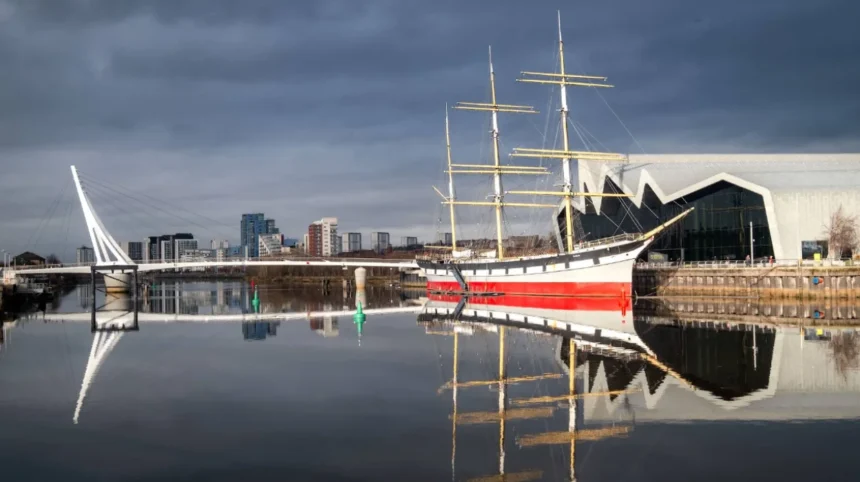
Connecting Water Row in Govan with Pointhouse Quay in Partick beside the Riverside Museum, the structure re-establishes an historic connection across the River Clyde that was once served by traditional ferry routes.
The structure is one of the longest opening pedestrian and cycle bridges in Europe. It features a 110-metre total length with an 8-metre wide deck designed to comfortably accommodate foot traffic, bicycles, wheelchairs, and prams.
The bridge operates as a swing bridge, pivoting on a south pier located at Water Row to allow larger maritime traffic—including historical vessels such as the PS Waverley paddle steamer—to navigate the Clyde safely. When the moving main span swings open to grant passage to river vessels, public access across the deck must be temporarily closed for safety.
In addition to serving as a local community bridge, the infrastructure forms a central pillar of Glasgow’s active travel network, integrating key employment hubs, academic institutions, and health facilities across western Glasgow.
Potential impact on the affected audience and future outlook
The short-term impact of these scheduled closures will mainly be experienced as minor transit delays for weekend commuters, local residents, and leisure visitors.
Because the morning closures are limited to 40 minutes each and the evening closures are capped at two hours, the disruption to surrounding neighbourhoods remains manageable provided travellers plan their movements around the announced timetable.
From a longer-term perspective, periodic swing operations are an intrinsic feature of maintaining a dynamic, multi-modal river corridor on the River Clyde.
The ability to swing the span open ensures that maritime heritage, commercial shipping, and tourist navigation can continue to coexist smoothly with land-based active travel routes.
As active travel adoption increases across Glasgow, clear advance communication regarding operational bridge openings will remain essential to minimising inconvenience for pedestrians and cyclists while preserving the river’s active navigation rights.