Key Points
- Racial hate crimes in Glasgow recorded a 33.97 per cent increase during the first quarter of the financial year, rising to 560 incidents compared to 418 the previous year.
- Police Scotland has linked this sharp spike to ongoing community tensions and a concerning rise in local friction impacting both settled communities and migrants.
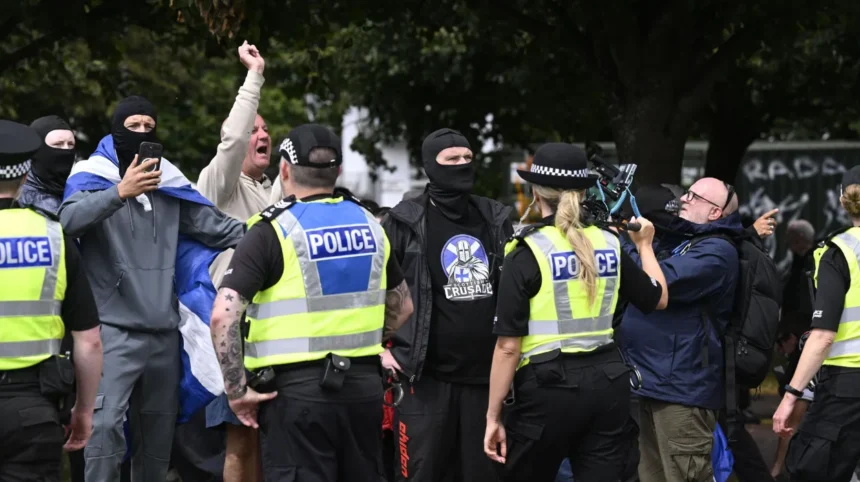
- A violent demonstration on June 9 saw around 250 individuals dressed in black and wearing masks gather in Buchanan Street before marching through the city centre.
- During the June rally, multiple men were assaulted explicitly because of the colour of their skin, marking a rare and alarming instance of groups roaming streets to target individuals.
- Retail staff and police officers have been identified as primary targets facing heightened racial abuse and security threats in the line of duty.
- Police leadership has urged the public to actively dispel misinformation, noting that officers are frequently responding to volatile incidents fuelled by factually incorrect online claims.
Glasgow (Glasgow Express) September 24, 2026 — Racial hate crimes have risen dramatically across Glasgow, prompting a formal warning from law enforcement regarding intensifying community tensions. According to official municipal figures presented at a Safe Glasgow Partnership meeting, reported racial hate crimes jumped by 33.97 per cent. A total of 560 racial hate offences were documented during the opening quarter of the financial year, marking a significant increase from the 418 incidents recorded during the corresponding period the previous year.
The data outlines a troubling environment for local populations and public-facing personnel. As reported by local journalists covering the Safe Glasgow Partnership meetings, the force stressed that these figures reflect a deteriorating climate of local friction.
Why are police concerned about street demonstrations and targeted violence?
Law enforcement officials have highlighted specific public order episodes as major catalysts for alarm. Police Scotland warned that a violent demonstration in June was of deep concern because it represented the first time in recent history that Glasgow witnessed organised groups “roaming the streets, directing violence to targeted individuals”.
Detailing the events of June 9, reports confirmed that approximately 250 people, dressed uniformly in black and wearing face masks, congregated in Buchanan Street before executing a march around the city centre. During the course of this rally, a number of men suffered physical assaults solely due to the colour of their skin.
Which groups are most affected by the rising tide of hostility?
The fallout from these escalating tensions has heavily impacted everyday workers. Glasgow Chief Superintendent Emma Croft informed the partnership meeting that retail staff and police officers have routinely been the targets of racial hate crimes.
A formal Police Scotland report presented to the committee stated:
“There is a sense from our community engagement that there is an increase in local tensions impacting both our communities and migrants.”
The document added:
“Police officers and security staff within the retail sector continue to be the groups most affected by hate crime.”
In response to these vulnerabilities, Chief Superintendent Croft noted that partnerships officers are actively collaborating with relevant stakeholders to provide structural support to the retail sector.
How is misinformation contributing to the rise in hate-fuelled incidents?
Beyond physical street confrontations, authorities have pointed to the digital landscape as a primary driver of unrest. Chief Superintendent Croft issued an explicit call for misinformation to be systematically dispelled, cautioning that frontline officers are frequently dispatched to manage volatile situations born entirely from factually incorrect online narratives.
Echoing these operational concerns, Safe Glasgow Partnership chair Paul McCabe addressed the committee to express gratitude for the ongoing efforts of emergency responders, stating:
“A huge thanks to police officers for keeping us safe.”
Meanwhile, specialized partnerships teams continue working alongside community stakeholders to curb further escalation and stabilize affected neighbourhoods.
Background of the particular development
The sharp increase in Glasgow’s hate crime statistics arrives against a backdrop of mounting social polarization across the United Kingdom regarding immigration, asylum accommodation, and shifting public policy. Over recent years, Scottish authorities have noted a gradual transformation in how community grievances manifest online and translate into physical activism. The emergence of flashpoint demonstrations—often organized through encrypted messaging channels or amplified by anonymous online agitators—has tested the logistical and tactical capabilities of Police Scotland. Legislative changes governing the recording and classification of hate offences have also altered data collection parameters, but law enforcement maintains that the sharp rise in street-level racial hostility represents genuine behavioural shifts rather than purely administrative adjustments.
Prediction
This surge in racially motivated hate crimes and the normalization of aggressive street demonstrations carry profound implications for Glasgow’s ethnic minority communities, retail workers, and frontline emergency personnel. For minority residents and migrants, the persistent threat of targeted violence risks fostering an environment of chronic fear, social withdrawal, and reduced integration. Retail workers and police officers will likely face continued occupational hazards, necessitating heavier investments in personal security training, joint municipal support schemes, and enhanced community policing frameworks. Furthermore, if online misinformation campaigns continue unchecked, municipal leaders and law enforcement agencies may be forced to implement stricter public assembly controls and proactive digital counter-messaging strategies to prevent future summer unrest and safeguard civic cohesion.