Key Points
- Glasgow City Council has partnered with vehicle graphics specialist Roadvert to turn refuse collection vehicles into mobile billboards.
- The campaign coincides with Hate Crime Awareness Week to promote messages of inclusion, respect, and community safety across Glasgow.
- Large-scale graphics and banners on waste vehicles are being utilized as a cost-effective medium to reach residents directly within local neighborhoods.
- Hate Crime Awareness Week operates as a multi-agency initiative across Glasgow, involving local authorities and partner organizations to combat discrimination.
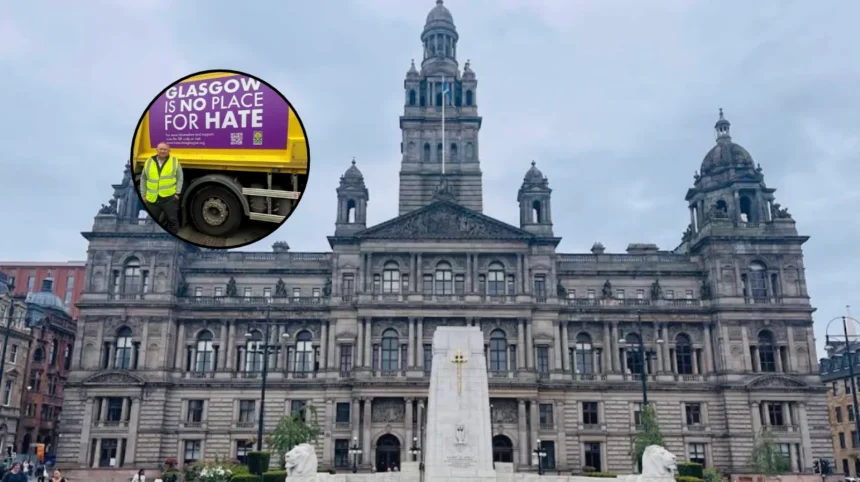
Glasgow (Glasgow Express) October 15, 2026 – Refuse vehicles operating across Glasgow have been transformed into mobile billboards to deliver prominent anti-hate crime messages directly into local communities during Hate Crime Awareness Week. The city-wide campaign, delivered by Glasgow City Council with technical and graphic support from specialist firm Roadvert, aims to promote messages of inclusion and respect across every neighborhood. By utilizing the municipal waste fleet, the local authority seeks to reinforce its commitment to ensuring all residents feel safe, valued, and respected regardless of their background.
- Key Points
- How are Glasgow’s refuse vehicles being used to combat hate crime?
- What role does Roadvert play in the city-wide initiative?
- Why is fleet advertising chosen for public awareness campaigns?
- Background of Glasgow’s hate crime awareness initiatives
- Prediction: How this development will affect local residents and public services
The initiative leverages the extensive daily routes of refuse collection vehicles to maximize public visibility without the expenditure required for traditional static billboard advertising. The banners deployed across the fleet feature high-visibility messaging designed to raise awareness regarding the reporting of hate crimes and to foster community cohesion throughout the city.
How are Glasgow’s refuse vehicles being used to combat hate crime?
The decision to utilize municipal waste vehicles as a primary communications tool stems from their unique access to every residential street in Glasgow. As multi-agency partners mark Hate Crime Awareness Week, local authority leaders identified the refuse fleet as an effective medium for high-impact visual messaging that reaches diverse demographics on a daily basis.
As reported by the media team at Glasgow City Council, the campaign focuses on delivering clear messages of tolerance and solidarity, ensuring that public anti-hate initiatives maintain a constant presence in public spaces. The high-capacity waste vehicles travel through residential areas, commercial districts, and busy thoroughfares, effectively functioning as moving public information displays.
What role does Roadvert play in the city-wide initiative?
The graphic infrastructure and fleet advertising strategy for the campaign have been executed by Roadvert, a specialist organization in commercial and municipal vehicle graphics. The company’s specialized banner systems allow municipal fleets to update public messaging quickly and sustainably across large operational vehicles.
As reported by news staff covering municipal transport developments, Craig Fuller, sales director at Roadvert, stated that
“Council waste vehicles provide a powerful and cost-effective way to deliver messages that matter right into the heart of communities.”
Explaining the visual effectiveness of the medium, Craig Fuller of Roadvert stated that
“The vehicles work as mobile billboards and the size of the banners enables us to create real impact.”
Highlighting the historic collaboration between the graphics provider and the local authority, Craig Fuller of Roadvert stated that
“We have a long-standing relationship with Glasgow City Council and regularly support in delivering effective campaigns directly to residents.”
Further addressing the collaborative framework of the campaign, Craig Fuller of Roadvert stated that
“Hate Crime Awareness Week is a multi-agency initiative in the city.”
Why is fleet advertising chosen for public awareness campaigns?
Municipalities increasingly turn to local authority vehicle fleets to distribute public interest information due to the operational efficiency and broad geographic reach inherent to daily services. Refuse collection crews cover defined residential sectors systematically, providing consistent exposure across distinct economic and social areas within the council’s jurisdiction.
The use of reusable quick-change graphic systems enables local councils to run targeted awareness drives—such as Hate Crime Awareness Week, environmental recycling campaigns, or public health alerts—without incurring the ongoing rental fees associated with private static advertising spaces.
Background of Glasgow’s hate crime awareness initiatives
Hate Crime Awareness Week in Glasgow forms part of a national and regional framework designed to tackle prejudice, bias, and discrimination based on race, religion, disability, sexual orientation, or transgender identity. Over recent years, Police Scotland, Glasgow City Council, third-sector support organizations, and regional transport providers have established multi-agency partnerships aimed at increasing the reporting of hate incidents and supporting affected individuals.
Glasgow City Council has repeatedly prioritized public inclusion strategies across its municipal policy agenda. Previous local awareness efforts have focused on establishing designated third-party reporting centers across the city, including public libraries, community centers, and housing association offices. These centers allow victims and witnesses of hate crimes to report incidents safely and confidentially without visiting a police station directly.
The integration of the council’s fleet services into public social messaging represents an extension of existing municipal communications strategies. By combining operational services with public awareness campaigns, local authorities in Scotland have sought innovative, low-cost avenues to engage residents on legislative rights, public safety measures, and social inclusion agendas.
Prediction: How this development will affect local residents and public services
The deployment of mobile anti-hate billboards across Glasgow’s refuse fleet is anticipated to directly affect local residents, victim support agencies, and municipal public service departments in several key ways:
Increased visibility and reporting within local communities
By bringing clear anti-hate messages into residential streets, the campaign is likely to raise awareness among residents regarding what constitutes a hate crime and how to access support services. Increased visibility traditionally correlates with higher rates of confidence among victims, which may lead to an increase in reporting both directly to Police Scotland and through local third-party reporting centers.
Enhanced cost efficiency for municipal public outreach
For Glasgow taxpayers and local authority budget planners, the successful utilization of existing municipal assets for civic campaigns offers a sustainable template for future public communications. The reliance on internal transport assets reduces dependency on commercial media buys, allowing the council to maintain widespread public messaging despite broader local government budgetary constraints.
Broader adoption across Scottish municipal fleets
If the campaign demonstrates strong community engagement and positive feedback during Hate Crime Awareness Week, other Scottish local authorities may replicate the model. Graphics providers and public sector transport managers are likely to expand similar mobile messaging campaigns across emergency service vehicles, public transport networks, and environmental maintenance fleets in other council regions.