Key Points
- Glasgow City Council paused its controversial plan to dismiss and re-engage more than 23,000 non-teaching members of staff following discussions with the Scottish government and trade unions.
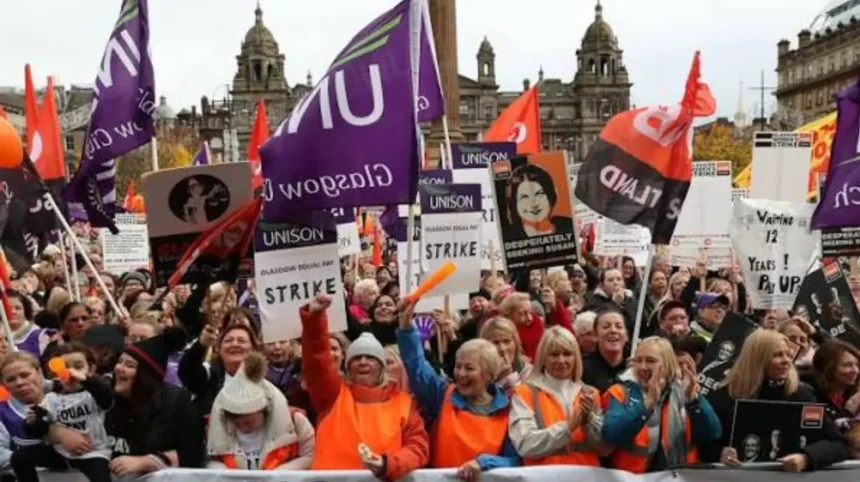
- The initial mass dismissal scheme was triggered after equal pay talks between the local authority and trade unions GMB, Unite, and Unison collapsed.
- Under the paused proposals, employees spanning nursery workers, refuse collectors, social care staff, and administrators were scheduled to receive dismissal notices ahead of contract changes slated for New Year’s Day.
- Workforce convener Councillor Allan Casey confirmed that the pause allows the Advisory, Conciliation and Arbitration Service (ACAS) package to be placed back on the table for intensive negotiations.
- The long-running equal pay dispute stems from a 2006 workforce pay and benefits review that previously cost the council approximately £770 million in compensation.
Glasgow Council (Glasgow Express) September 25, 2026 — Glasgow City Council has officially confirmed that its controversial plan to dismiss and subsequently rehire more than 23,000 of its employees under new contracts has been placed on hold. The temporary halt follows what officials described as “constructive discussions” involving the Scottish government and major trade unions. The local authority had previously faced severe backlash after announcing that all non-teaching staff would be formally dismissed and reintroduced on revised terms, with individual details expected to land with workers.
- Key Points
- Why did Glasgow City Council initially decide to pursue a fire and rehire strategy?
- How did negotiations collapse between the local authority and trade unions?
- What are the next steps following the intervention of the Scottish Government?
- Background of the particular development
- Prediction: How this development can affect the workforce and local community
The drastic workforce restructuring had been planned to take effect on New Year’s Day. This escalation occurred after negotiations aimed at resolving a protracted equal pay dispute involving the GMB, Unite, and Unison unions collapsed. However, following intense political and industrial pressure, the local authority shifted its stance, agreeing to halt the impending issuance of dismissal notices.
Why did Glasgow City Council initially decide to pursue a fire and rehire strategy?
The foundational catalyst behind the council’s actions relates to a historical equal pay dispute originating from the implementation of the 2006 Workforce Pay and Benefits Review. As reported by staff from The Herald, the legacy system was found to have systematically discriminated against predominantly female employees working in roles such as catering and cleaning. Decades of legal battles, including a pivotal 2017 ruling by the Inner House of the Court of Session, forced the local authority to settle thousands of historical claims totaling roughly £770 million.
To establish a permanent lawful framework free from discrimination, council officials and trade unions spent years developing a new job evaluation and pay structure. Although councillors approved this new grading scheme by 13 votes to nine, consensus on its rollout fractured. While roughly 63% of staff stood to gain financially and 26% would experience little change, an estimated 11% faced financial reductions, with the steepest individual losses calculated at around £11,500 per year.
How did negotiations collapse between the local authority and trade unions?
The immediate operational crisis unfolded when negotiations broke down over how the transition should be managed. As detailed by reporters at Glasgow Live, Unite and the GMB indicated a willingness to ballot their members on an improved financial package, but Unison ultimately withdrew its support. Colin Edgar, the council’s director of communication and governance, told the PA news agency that officials were trapped in a “hellish situation” and stated that senior leadership “feel sick” about implementing dismissals.
Mr Edgar defended the timing by pointing out that upcoming changes to employment law taking effect on January 1st would make fire and rehire tactics unlawful unless an employer faced severe financial distress. Consequently, the council argued it had no alternative option to legally replace the discriminatory grading system before statutory windows closed.
The decision provoked sharp rebukes from labor representatives. Speaking to media outlets, Unison representatives condemned the tactic as “utterly immoral” and a “shocking and disgraceful” choice made by the council leadership. Similarly, David Hume, a GMB organiser, criticized the move as “beyond the pale for any decent employer”. Political figures also weighed in heavily, with Scottish Labour leader Michael Marra describing the proposal in The Herald as “despicable” and straight out of the “Tory playbook”.
What are the next steps following the intervention of the Scottish Government?
Following intense intervention by the Scottish government, including dialogue involving Deputy First Minister actions, the trajectory of the dispute shifted dramatically. Workforce convener Councillor Allan Casey issued a statement confirming the breakthrough:
“I’m pleased that we’ve reached a position following a meeting with the Scottish government and the three unions where a pause has been agreed, allowing the ACAS package to be put back on the table and creating the space for further intensive negotiations with the joint trade unions.”
Councillor Casey further emphasized that the primary objective remains unchanged: securing a collective agreement on a modern pay and grading framework that completely removes discrimination and can be formally placed before the workforce in a ballot. Both the council leadership and participating unions are now set to re-engage in intensive talks mediated through the ACAS framework to prevent permanent industrial conflict.
Explore More Glasgow Council News
Glasgow Council Fire and Rehire Crisis Explodes in Glasgow 2026
Council Clears Racist Graffiti in Glasgow 2026
Background of the particular development
The systemic issues underpinning Glasgow City Council’s recent actions trace back nearly two decades to the 2006 Workforce Pay and Benefits Review. Intended to streamline local government compensation, the framework inadvertently introduced severe pay inequalities that heavily impacted female-dominated sectors such as home care, schools support, catering, and cleaning. Successive legal challenges accumulated hundreds of millions of pounds in liabilities, forcing the local authority into unprecedented asset sales—including leasing back prominent city buildings—to finance initial multi-million-pound settlements.
Because compensation payouts could not permanently resolve systemic structural inequality, designing a non-discriminatory replacement evaluation model became a legal mandate. The friction between attempting to rectify historical inequalities while balancing public sector budget constraints ultimately drove the administration toward contentious structural measures, culminating in the recent emergency use of dismissal notices ahead of incoming legislative bans on fire and rehire practices across the United Kingdom.
Prediction: How this development can affect the workforce and local community
The temporary suspension of the fire and rehire process provides immediate emotional and professional relief to more than 23,000 non-teaching council employees who spent days facing imminent contract termination letters. For these workers—ranging from social care providers to refuse collectors—the pause averts an immediate reduction in core terms and conditions and creates an opening for fairer compromise through ACAS.
However, if subsequent negotiations fail to bridge the gap over pay protection for the 11% of staff facing financial detriment, the reinstatement of restructuring threats remains a potent risk. Prolonged uncertainty risks severely denting workplace morale, potentially triggering mass early retirements or voluntary resignations among experienced public servants. For the wider Glasgow community and local residents, any future workforce friction or staff exodus could directly jeopardize the operational reliability of vital municipal services, garbage collection schedules, and social support systems.