Key Points
- Glasgow City Council successfully removed racist graffiti from a city centre wall just hours after media inquiries challenged their initial stance.
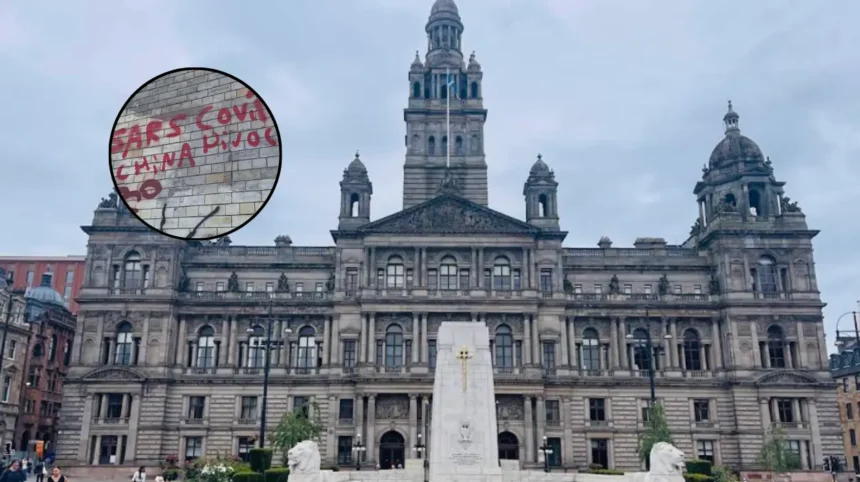
- The vandalism, which appeared to blame China for Covid-19, was located on the corner of Blythswood Street and Sauchiehall Lane.
- Initially, local authorities stated they could not act immediately because the offensive messaging was painted on a privately owned building.
- Chris Cusack, venue manager at BLOC on Bath Street, heavily criticised the prolonged presence of the graffiti, calling it a bad reflection on the city.
- Following contact from reporters, the council’s cleansing team fast-tracked the process by securing formal permission from the property owner, completing the removal within six hours.
Glasgow (Glasgow Express) September 24, 2026 — Glasgow City Council removed racist graffiti from a city-centre wall merely hours after local journalists intervened, reversing an earlier claim that they were powerless to clean the site because it was private property.
Why Did the Council Initially Refuse to Clean the Graffiti?
As reported by staff writers at Glasgow Live, the offensive vandalism was situated on the corner of Blythswood Street and Sauchiehall Lane. Local reports confirmed that the messaging appeared to “blame China for Covid-19”. When initially questioned about the lingering hate speech, Glasgow City Council asserted that because the graffiti was located on a privately owned building, standard removal techniques could risk damaging the structure. Consequently, officials argued they needed to navigate formal permissions from the building owner before any action could be taken.
How Did Local Businesses React to the Delay?
The prolonged display of the hateful messaging drew sharp criticism from prominent local business figures. As reported by journalists at Glasgow Live, Chris Cusack, the venue manager at BLOC on Bath Street, expressed deep frustration over the authorities’ initial inaction.
As stated by Chris Cusack to Glasgow Live,
“I hate seeing this stuff in the area. The graffiti has been there for months now and as a proud Glasgow business with a diverse audience, we at BLOC were bemused that it hadn’t been addressed.”
Chris Cusack further emphasized the importance of inclusivity, adding:
“At BLOC we go out of our way to welcome Chinese persons including using Mandarin signage. These are valued members of the community who deserve to feel welcome. This vandalism does the exact opposite.”
Furthermore, Chris Cusack warned that leaving such prominent hate speech unaddressed sets a very “troubling precedent and is a bad reflection on the city”.
How Quickly Was the Situation Resolved After Media Intervention?
Following renewed inquiries and pressure from Glasgow Live, the local authority expedited the removal process. The entire cleanup operation was completed within six hours of media contact.
Addressing the swift turnaround, a Glasgow City Council spokesperson stated:
“This graffiti is disgraceful and wholly unacceptable. The graffiti in question is located on a privately owned building, and inspections have determined that standard removal techniques could pose a risk or damage to the building, therefore we liaised with the building owners to obtain formal permission to have it removed as quickly as possible.”
The spokesperson concluded with confirmation of the successful operation:
“Our cleansing team has obtained permission from the property owner, and the graffiti has since been removed.”
Background of the Particular Development
The incident highlights ongoing tensions regarding municipal accountability and the rapid removal of hate speech in urban Scottish centres. Graffiti targeting specific nationalities or ethnic groups during and after the pandemic has remained a persistent challenge for urban councils across the United Kingdom. Local authorities frequently face complex bureaucratic hurdles when vandalism occurs on private property, as local government bodies generally lack the legal right to trespass or alter private structures without explicit owner consent or emergency statutory powers. However, pressure from community leaders, local businesses, and regional media outlets frequently exposes gaps in response times, compelling councils to streamline bureaucratic red tape and coordinate faster emergency cleaning protocols for xenophobic or racist incidents.
Prediction
This development is likely to influence how Glasgow City Council and similar municipal bodies handle complaints regarding private-property vandalism moving forward. By demonstrating that private-property constraints can be bypassed swiftly when public pressure mounts, the case sets an operational precedent. For local business owners, residents, and minority communities in Glasgow, this event signals that speaking out and leveraging regional journalism can drastically accelerate administrative responses to hate speech. Consequently, community stakeholders may become more proactive in reporting delayed cleanups, forcing local authorities to prioritize rapid-response frameworks for racist graffiti regardless of whether the affected asset is public or private.