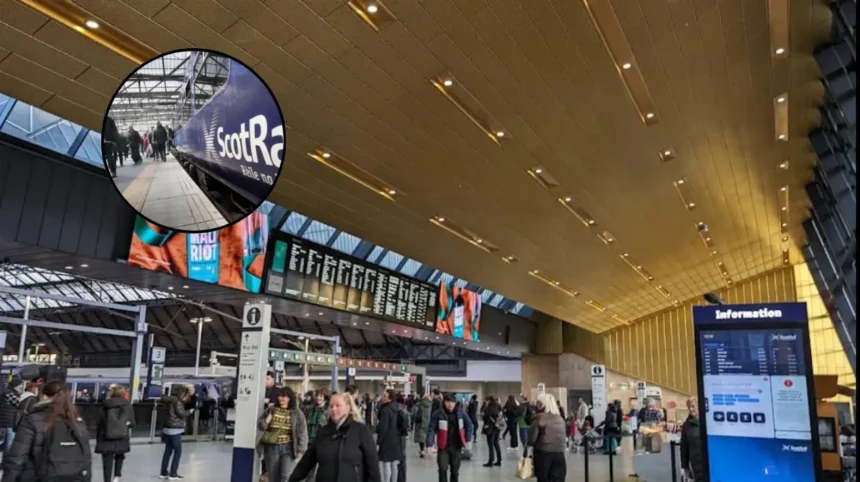
Key Points
- Incident: A small tree fell onto overhead electrical wires in the Bearsden area, disrupting rail traffic along the line.
- Affected Services: Passenger services travelling between Springburn, Glasgow Queen Street, and Milngavie experienced severe delays and service alterations.
- Response Team: Network Rail Scotland dispatched an emergency engineering crew to the location to safely clear the vegetation and inspect infrastructure.
- Impact Zone: The disruption affected key commuter stops across Greater Glasgow, including major transport hubs such as Glasgow Queen Street.
- Public Advice: Passengers were advised to check live journey update tools via ScotRail and Network Rail before travelling.
Glasgow (Glasgow Express) July 25, 2026 — Rail passengers travelling between Springburn, central Glasgow, and Milngavie are facing significant travel delays following an infrastructure incident in the Bearsden area. Network Rail dispatched specialist response teams to clear an obstruction from high-voltage equipment, causing knock-on delays across the urban rail network.
What Caused the Delays Between Springburn and Milngavie?
The disruption was triggered when a small tree made contact with the overhead line equipment near Bearsden. The overhead wires supply high-voltage electricity to electric passenger trains operating along the route.
Because vegetation touching energized overhead lines poses a serious safety hazard and risks damaging current-collecting pantographs on top of trains, rail operators were forced to restrict movement through the affected area while emergency work took place.
As detailed in official social media statements published by Network Rail Scotland on X (formerly Twitter), engineers responded directly to the site to clear the tree.
“We have a team on site at Bearsden, where a small tree on the overhead wires is disrupting services to and from Milngavie. We’re on the case and hope to have this cleared shortly.” — Network Rail Scotland
Which Stations and Services Are Impacted by the Bearsden Line Issue?
The blockage at Bearsden directly impacts the North Strathclyde commuter line that connects Springburn in East Glasgow through Glasgow Queen Street Low Level to Milngavie in East Dunbartonshire.
According to coverage from Kevin Maguire at the Glasgow Times, the ongoing issue has caused wider service alterations that ripple into major city-centre hubs, including Glasgow Queen Street.
Because Milngavie acts as a primary terminal station for several cross-city routes, trains delayed or held at preceding stations disrupt linked timetables across the West of Scotland network.
ScotRail and Network Rail recommended that all passengers travelling through Glasgow Queen Street toward Bearsden, Hillfoot, and Milngavie check real-time service updates prior to arriving at platforms.
Background of Vegetation and Overhead Line Incidents on Scottish Railways
Managing vegetation along railway corridors remains one of Network Rail’s most persistent operational challenges in Scotland. Lines running through suburban areas such as Bearsden, Westerton, and Milngavie feature dense tree cover immediately adjacent to trackside infrastructure.
When trees or heavy branches fall onto overhead power cables—whether due to root instability, adverse weather, or localized decay—they can sever lines, cause electrical short circuits, or spark localized fires. Because overhead cables carry 25,000 volts of electricity, response protocols require specialized isolation procedures.
Before engineers can physically remove a tree, power to the overhead section must be cut and grounded to prevent electrocution hazards for the response crew.
Network Rail routinely conducts vegetation management schemes across Strathclyde to trim back trees within a multi-metre boundary of lines.
However, sudden weather changes or trees situated on private property outside the immediate railway boundary frequently present unforeseen risks to operational continuity.
Prediction: How This Development Will Affect Passengers and Regional Commuters
In the immediate short term, passengers relying on the Springburn-to-Milngavie corridor will likely experience timetable knock-ons even after the physical obstruction at Bearsden is cleared.
Because train crews and rolling stock become displaced when lines are blocked, ScotRail may implement short-turnings—where trains terminate early at intermediate stations such as Hyndland or Westerton—to reset the schedule.
For daily commuters, students, and weekend travellers across East Dunbartonshire and Greater Glasgow:
- Journey Planning: Passengers will need to allow extra travel time and consider alternative bus routes or connection points if service frequencies remain reduced during line recovery.
- Financial Recourse: Commuters delayed by 30 minutes or more will be eligible to submit claims under ScotRail’s Delay Repay scheme, increasing administrative processing for the operator.
- Maintenance Scrutiny: Repeated environmental disruptions along suburban lines often lead local community groups and commuters to call for expanded line-side tree management programs from Network Rail to prevent similar delays during peak travel periods.