Key Points
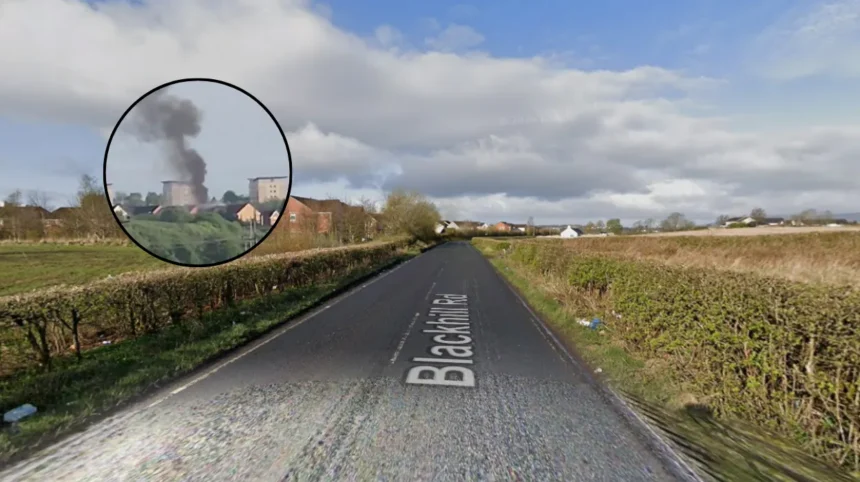
- A substantial fire broke out at a row of houses on Blackhill Road in the Summerston area of Glasgow on Wednesday evening, prompting a major emergency response.
- Five fire engines, including a high‑reach appliance, were dispatched to Blackhill Road to tackle the blaze.
- Thick smoke could be seen billowing into the air above the street, with neighbours and local residents reporting the size of the smoke cloud and the number of vehicles at the scene.
- Fire crews were alerted to the incident just before 8pm and remained on site for several hours to bring the fire under control and ensure there was no further risk.
- Neighbours described the sight of flames and smoke, with some saying the smoke could be seen from a distance and the emergency sirens drew the attention of many in the surrounding area.
- No formal confirmation has yet been released on the number of casualties, injuries or the cause of the blaze; officials have indicated that the fire service will carry out a post‑incident review once the immediate firefighting work is complete.
Summerston (Glasgow Express) May 21, 2026 Summerston in Glasgow’s north‑west has been plunged into emergency mode after a fire tore through a row of houses on Blackhill Road on Wednesday evening, prompting five fire engines – including a high‑reach appliance – to race to the scene. The blaze sent a large plume of smoke into the night sky, with neighbours describing scenes of flame and noise as crews worked for hours to contain the incident.
- Key Points
- Why did five fire engines respond to the Summerston blaze?
- How did neighbours and residents react to the fire?
- What do officials say about casualties and the cause of the fire?
- How is the fire service responding and managing the scene?
- What risks do such house fires pose to nearby homes and streets?
- What safety messages have emerged from this and similar incidents?
- Background: How this Summerston incident fits into broader Glasgow fire trends
- What might this mean for Summerston residents and similar Glasgow neighbourhoods?
Why did five fire engines respond to the Summerston blaze?
The Scottish Fire and Rescue Service (SFRS) was called to Blackhill Road just before 8pm on Wednesday following reports of a fire affecting a house or a row of semi‑detached properties in the Summerston area.
As reported by multiple news outlets summarising the incident, five fire appliances were dispatched to the scene, signalling concerns over the potential for the fire to spread through neighbouring homes or to upper‑floor windows and roofs.
The inclusion of a high‑reach appliance indicates that officers on the ground assessed the risk of vertical spread or difficulty in accessing upper‑storey openings, which is standard practice in taller residential blocks or where neighbours’ windows are involved.
Descriptions circulating on local news and social media noted that the scene was “busy” and “heavy” with emergency vehicles, while the smoke cloud above Blackhill Road was visible from surrounding streets.
How did neighbours and residents react to the fire?
Residents in and around Blackhill Road told local journalists and posted on community‑group pages that they were startled by the sudden arrival of sirens and the sight of smoke rising from nearby homes.
Some neighbours reported seeing flames from windows or roofline areas, while others described the strong smell of smoke and the sound of water being used by crews for prolonged periods.
As relayed on social‑media updates accompanying coverage of the incident, several local residents gathered at a safe distance to watch the operation, with others expressing concern for the occupants of the affected property or properties. One nearby witness, quoted on a Facebook‑based community page, said:
“There was a lot of smoke and the fire engines were everywhere; it looked like a big one.”
Such comments underline the visual and psychological impact of house‑fires on tight‑knit residential streets such as Blackhill Road.
What do officials say about casualties and the cause of the fire?
Despite the scale of the emergency response and the visible smoke and flames, no official statement has yet been issued detailing the number of casualties or injuries, nor has a confirmed cause of the fire been announced.
News outlets summarising the incident have stressed that the situation was still “under investigation” at the time of reporting, with the SFRS expected to carry out a post‑incident review once the scene is deemed safe.
Police Scotland has not, at the time of publication, issued a detailed statement indicating whether the fire is being treated as suspicious, accidental, or linked to any other circumstances.
Media coverage has instead focused on the presence of five fire engines, the timing of the call‑out (just before 8pm), and the fact that crews remained on site for a number of hours to ensure hotspots were fully extinguished and ventilation was carried out in affected properties.
How is the fire service responding and managing the scene?
Firefighters followed standard operating procedures for a residential‑fire incident, first establishing a safe cordon around the affected property or block, then deploying crews to search for any occupants, ventilate rooms, and cool down the structure.
The use of a high‑reach appliance, as reported in coverage of the blaze, suggests that officers were ready to access upper‑floor windows or to spray water from above if needed, particularly if the fire had spread to the roof or adjacent dwellings.
Media reports indicate that the intensity of the fire and the volume of smoke required sustained water application, with crews working in shifts to prevent exhaustion and to maintain safety.
The SFRS has not released a detailed breakdown of the number of firefighters on site or the duration of the operation beyond noting that crews remained at Blackhill Road for several hours after the initial call.
What risks do such house fires pose to nearby homes and streets?
The Summerston incident highlights the vulnerability of rows of semi‑detached or terraced houses to rapid lateral spread, especially where party walls, shared roofs, or close‑set windows are involved.
In a neighbourhood such as Blackhill Road, where properties are built close together, even a single‑house fire can threaten neighbouring homes, balconies, or garages, meaning early containment is critical.
News coverage of other similar incidents in Glasgow has underlined that smoke and heat can travel through shared ventilation routes, roof spaces, and even through adjacent walls, which is why crews often conduct “search and checks” in properties next door to ensure no occupants are trapped or overcome by smoke.
That pattern of response is consistent with the type of incident seen in Summerston, where a large‑scale appliance deployment signals concern for both the originating property and its immediate surroundings.
What safety messages have emerged from this and similar incidents?
While the exact cause of the Blackhill Road blaze has not yet been confirmed, coverage of other house fires in Glasgow has repeatedly emphasised routine fire‑safety measures for residents.
Local stations and the Scottish Fire and Rescue Service have used previous incidents to remind householders to fit and test smoke alarms, keep escape routes clear, avoid overloading electrical sockets, and to seek professional advice if there are concerns about wiring, heating appliances, or flammable materials stored in homes.
Community‑safety groups and local journalists have also used recent house‑fire scenes to highlight the importance of having a plan for evacuating vulnerable residents, such as children, elderly neighbours, or those with mobility issues, and for ensuring that everyone knows what to do if they discover a fire when leaving the home.
Guidance repeated by fire‑service representatives in past interviews stresses that residents should not re‑enter a burning property and should call 999 immediately to alert emergency services.
Background: How this Summerston incident fits into broader Glasgow fire trends
Row‑house and semi‑detached fires in Glasgow’s residential suburbs are not uncommon and have featured in several incidents over recent years, often prompting multi‑engine responses similar to the Summerston blaze. Previous reports from the Scottish Fire and Rescue Service have shown that single‑property fires in close‑knit tenements and terraces can quickly require multiple appliances, especially where there is a risk of the fire spreading vertically or to adjacent dwellings.
In other recent cases around the city, such as apartment‑block fires in Hyndland and derelict‑building fires in Easterhouse, authorities have highlighted how the density of housing stock and the age of some building stock can increase the risk of rapid spread and complicate evacuation efforts.
The deployment of high‑reach and aerial appliances in those incidents has also been justified by the need to reach upper‑floor windows and to control heat and smoke from above.
Against that backdrop, the Blackhill Road incident in Summerston sits within a wider pattern of residential‑fire responses in Glasgow, where early‑warning systems, consistent appliance‑attendance, and community‑safety messaging are key tools for limiting both property damage and harm to residents.
Explore More Glasgow Fire News
Shop Blaze in Rutherglen as Crews Battle Fire, 2026
Glasgow Businesses Struggle After Union Street Fire – Glasgow 2026
What might this mean for Summerston residents and similar Glasgow neighbourhoods?
For residents of Summerston and nearby areas such as Ruchill, Maryhill, and Possilpark, the Blackhill Road fire is likely to prompt renewed attention to home‑fire‑safety measures, including checking smoke alarms, reviewing escape plans, and looking out for vulnerable neighbours.
Community groups and local authorities may use the incident to reinforce existing fire‑safety campaigns, especially if any official review later identifies specific risks linked to the property or street layout.
More broadly, for other Glasgow neighbourhoods with similar housing stock – rows of older semi‑detached or terraced houses – the incident underlines the importance of rapid reporting when residents see smoke or flames and the need for closer coordination between householders and emergency services.
If the fire service finds evidence of particular vulnerabilities (such as blocked escape routes, fuel‑store risks, or electrical‑system issues), those findings could inform future preventative advice issued across the city.