

Key Points
- Glasgow City Council has launched the Good Times Market at the Broomielaw, beside Tradeston Bridge on the banks of the Clyde.
- The council said the street food space offers a wide range of high-quality vendors for people to choose from.
- The market is being presented as a trial that could be expanded to other parts of the city centre if it proves successful.
- Social media posts from the council highlighted the new trading area and encouraged people to visit on 24 April 2026.
- The development adds to efforts to activate the riverfront and bring more footfall into the city centre.
Glasgow (Glasgow Express) April 27, 2026
- Key Points
- What has Glasgow City Council launched at the Broomielaw?
- Why is the council talking about expansion?
- Where exactly is the market located?
- What did the council say about the vendors?
- How does this fit into Glasgow’s wider city-centre plans?
- What is the significance for traders and visitors?
- What happens next?
- Background of this development
- What is the prediction for visitors and traders?
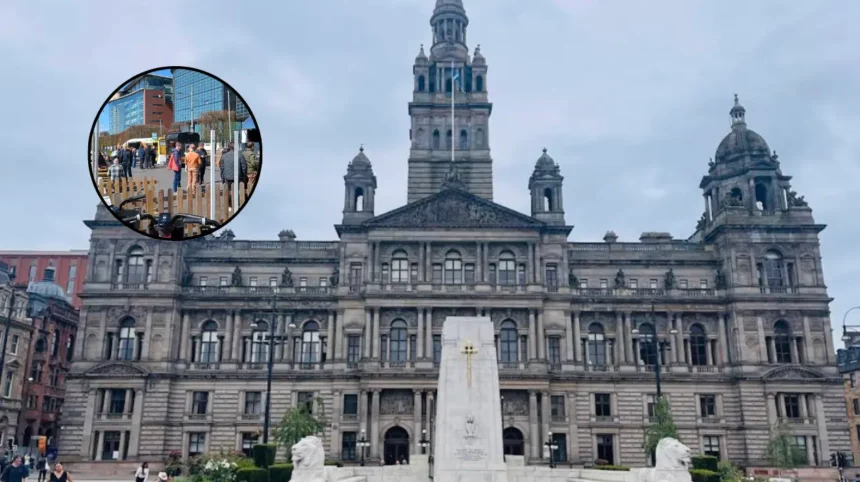
Glasgow City Council has launched a new street food market at the Broomielaw in a move that could lead to similar spaces appearing elsewhere in the city centre if the trial proves successful. The Good Times Market, positioned at Tradeston Bridge on the banks of the Clyde, was promoted by the council on 24 April 2026 as a place where visitors can choose from a varied selection of street food vendors.
What has Glasgow City Council launched at the Broomielaw?
As reported by Glasgow City Council in its social media post, the Good Times Market opened at the Broomielaw beside Tradeston Bridge and was described as a place to enjoy a “wide and varied range of high quality street food”. The council’s message was direct and promotional, encouraging people to head down to the riverside location on 24 April.
The launch appears to be part of a wider effort to create a more active public space in the city centre. The Broomielaw, which sits close to the Clyde, is a prominent part of central Glasgow and has long been associated with regeneration, footfall and links between the city centre and the riverfront.
Why is the council talking about expansion?
The council said in its own post that it is “looking to expand this to elsewhere in the city centre” if the market performs well. That wording suggests the Broomielaw site is being treated as both a public amenity and a test case for future food market spaces.
A move like this can be significant for city-centre management because it combines hospitality, public realm use and local economic activity in one place. It may also help the council gauge demand for more informal food trading areas in locations that already attract workers, residents and visitors.
Where exactly is the market located?
The council identified the market as being at the Broomielaw, specifically by Tradeston Bridge. That places it on the south side of the Clyde, in an area that is already well known for heavy pedestrian movement and city-centre connections.
The location matters because central riverfront spaces are often used to draw people into areas that might otherwise pass through quickly. In practical terms, a visible food market can encourage longer stays, more lunchtime trade and greater use of the surrounding public realm.
What did the council say about the vendors?
The council said visitors could choose from a “wide and varied range of high quality street food”. It also shared images of the site and some of the vendors involved in the market.
That language suggests the focus is not just on setting up stalls, but on presenting a curated offer that can appeal to different tastes. The phrasing also indicates that the council wants the market to be seen as a quality destination rather than a temporary or informal cluster of traders.
How does this fit into Glasgow’s wider city-centre plans?
The launch fits a familiar pattern in city-centre regeneration, where councils use food, events and small-scale trading to make central spaces feel busier and more welcoming. Glasgow has previously used public-facing initiatives to support footfall in key areas, and a successful market could strengthen that approach.
The council’s statement that it hopes to expand the idea elsewhere in the city centre shows the broader ambition. If the market draws enough custom, similar setups could be considered in other parts of Glasgow that have suitable space, transport access and enough passing trade.
What is the significance for traders and visitors?
For traders, a council-backed market can offer visibility, access to a central location and a chance to test demand in a high-footfall area. For visitors, it creates another food option in the city centre and may make the riverside area more attractive as a place to stop rather than simply pass through.
The project also has a practical public-space role. Street food markets can add daytime activity, increase casual spending and make underused spaces feel more active, especially when they are placed near major routes or landmarks.
What happens next?
The key question now is whether the Good Times Market attracts enough customers to justify the council’s expansion hopes. The council has not, in the information currently available, set out a timetable for any further locations or confirmed which areas might be considered next.
For now, the Broomielaw launch appears to be the main test. If it proves popular, the council may use it as a model for how small, food-led interventions can help shape the city centre experience.
Background of this development
This development sits within Glasgow’s ongoing use of public and semi-public spaces to support city-centre regeneration. The Broomielaw has long been one of the city’s more visible waterfront locations, and food, retail and leisure uses are often part of wider attempts to increase activity around major urban corridors.
The council’s own language shows that the market is not just a one-off event but potentially a pilot for further city-centre food spaces. That makes the launch important not only as a new place to eat, but also as a test of how central Glasgow can use temporary or flexible trading to improve vibrancy.
What is the prediction for visitors and traders?
For visitors, the most likely effect is a modest but noticeable increase in choice at the Broomielaw, especially for people working, living or spending time in the city centre. For traders, success at the site could mean greater exposure and the possibility of future opportunities if the council decides to roll out more market spaces.
If the market draws steady custom, it may encourage more regular use of the riverfront and support a broader push to make central Glasgow feel more active throughout the day. If it does not perform strongly, the council may keep it as a short-term initiative rather than scaling it up.