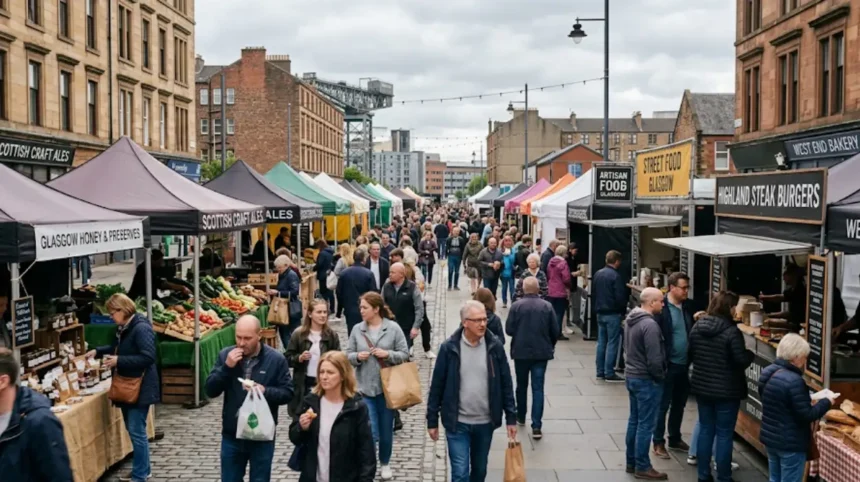
The Finnieston Food Market is a weekly street food, artisan produce, and crafts market located in the West End of Glasgow, Scotland. Operating primarily on Sundays, this commercial gathering serves as a centralized hub for independent regional traders, micro-breweries, agricultural producers, and local consumers. The market occupies a designated footprint within the Finnieston neighborhood, an area historically defined by its industrial shipping heritage that has transitioned into a prominent retail, hospitality, and residential corridor. As a structured commercial event, the market regulates the distribution of locally sourced commodities, facilitates micro-economic growth within the city of Glasgow, and functions as a focal point for contemporary urban food culture in West Scotland.
- What Is the Finnieston Food Market Sunday Event?
- Where Is the Sunday Market Located and How Do Visitors Access It?
- Geographic Parameters and Layout
- Public Transport Infrastructure
- Pedestrian, Active Travel, and Parking Provisions
- What Specific Food and Drink Options Do Traders Offer?
- Hot Street Food and Ready-to-Eat Vendors
- Primary Agricultural Produce and Artisanal Ingredients
- Dairy, Bakery, and Confectionery Sectors
- Craft Beverages and Distilled Liquors
- Why Is the Market Economically Important for Glasgow’s Independent Traders?
- Low-Overhead Incubation for Micro-Enterprises
- Local Economic Multiplier Effect
- Tourist Attraction and Foot-Traffic Generation
- How Does the Market Support Environmental Sustainability and Food Traceability?
- Reduction of Food Miles and Carbon Footprint
- Packaging Minimization and Waste Management Policy
- Ingredient Traceability and Agricultural Standards
- What Should Visitors Expect Regarding Costs, Logistics, and Timing?
- Pricing Structures and Value Proposition
- Peak Hours, Crowds, and Operational Timelines
- Payment Infrastructure and Technology
- Weather Mitigation and Seasonal Adaptability
- What Is the Future Outlook for the Finnieston Market Model?
What Is the Finnieston Food Market Sunday Event?
The Finnieston Food Market Sunday event is a weekly commercial marketplace in Glasgow that showcases independent Scottish food producers, street food vendors, and artisan crafters. It operates as a regulated community hub for sourcing regional agricultural goods and prepared hot food.
Historical Development of the Finnieston District
The geographic positioning of the market within Finnieston connects directly to the broader economic evolution of Glasgow. During the nineteenth and twentieth centuries, Finnieston operated as a dense industrial zone dominated by engineering works, foundries, and shipping infrastructure tied closely to the River Clyde. The construction of the Queen’s Dock in 1877 established the area as a global shipping hub, handling millions of tons of cargo annually.
Following the deindustrialization of the mid-to-late twentieth century, the vacancy of maritime infrastructure prompted urban regeneration initiatives. The opening of the Scottish Exhibition and Conference Centre (SECC) in 1985, followed by the OVO Hydro in 2013, reframed the district as an entertainment and cultural quarter. This influx of foot traffic catalyzed the growth of Argyle Street as a specialized culinary corridor, frequently designated by urban planning studies as one of the primary food destinations in the United Kingdom. The establishment of a dedicated Sunday market represents the formalization of this localized food culture, moving from permanent brick-and-mortar restaurants to an adaptable, open-air trading framework.
Institutional Framework and Governance
The market operates under a specific legal and regulatory framework managed by local authorities and private event coordinators. Glasgow City Council regulates the event via the Civic Government (Scotland) Act 1982, which mandates specific licenses for street trading and market operators. These licenses ensure that all participating vendors comply with national environmental health standards, waste management protocols, and public safety duties.
Food safety inspections are conducted by Environmental Health officers to verify adherence to the Food Hygiene (Scotland) Regulations 2006. Vendors must maintain verified Hazard Analysis Critical Control Point (HACCP) systems to ensure food safety. Furthermore, the market framework prioritizes the micro-local economy by restricting stalls to independent businesses operating within a defined geographical radius, typically covering Strathclyde, Central Scotland, and the Scottish Borders.
Where Is the Sunday Market Located and How Do Visitors Access It?
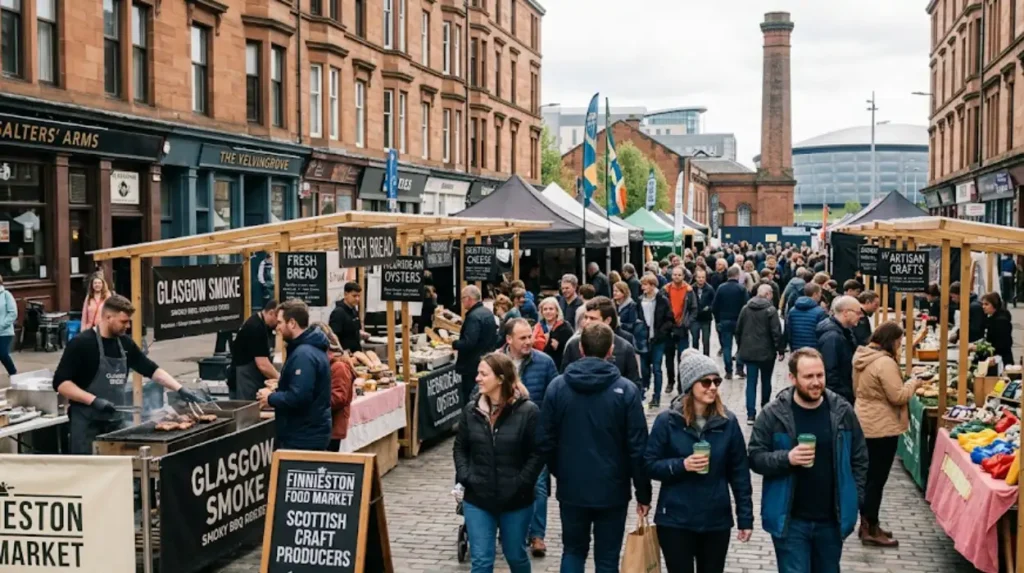
The market is located in the Finnieston neighborhood of Glasgow, centered around accessible outdoor spaces near Argyle Street. Visitors access the site via multiple public transportation modes, including the nearby Exhibition Centre railway station and local bus routes.
Geographic Parameters and Layout
The precise footprint of the market utilizes open-air venues, repurposed industrial yards, or indoor architectural spaces within the G3 postal code area of Glasgow. This positioning places the market within walking distance of major municipal landmarks, including the Kelvingrove Art Gallery and Museum to the north and the Scottish Event Campus to the south. The layout of the market features a organized grid of modular stalls, gazebos, and mobile food trucks. This structural organization establishes clear pedestrian corridors that manage the flow of visitors during peak operating hours, preventing overcrowding and ensuring compliance with Scottish fire safety regulations regarding emergency egress routes.
Public Transport Infrastructure
The site connects to the wider Glasgow metropolitan transport network, making it highly accessible without the use of private motor vehicles. First Glasgow operates multiple bus services, including the 2, 3, and 77 routes, which traverse Argyle Street and drop passengers within 100 meters of the primary market entrances.
The Exhibition Centre railway station, positioned on the Argyle Line of the ScotRail network, sits approximately 400 meters south of the market site. Trains run regularly from Glasgow Central station, providing a transit duration of approximately five minutes. For long-distance travelers, Buchanan Bus Station provides regional links, connecting to local low-level rail lines or inner-city bus connections that lead directly into the West End.
Pedestrian, Active Travel, and Parking Provisions
Glasgow’s active travel infrastructure supports pedestrian and bicycle access to Finnieston. The Nextbike cycle-hire scheme maintains multiple docking stations across the West End, including points at Kelvingrove Park and near the SEC. The Kelvin Way and the Clyde Walkway serve as dedicated pedestrian and bicycle arteries that isolate active travelers from vehicular traffic.
For visitors utilizing private automobiles, parking is strictly regulated by Glasgow City Council parking zones. Finnieston falls within a restricted parking zone where on-street parking requires payment via electronic meters or mobile applications like RingGo during operational hours. The presence of low emission zones (LEZ) in central Glasgow also requires that all vehicles entering the city center boundary meet specific European emission standards, specifically Euro 4 for petrol and Euro 6 for diesel vehicles.
What Specific Food and Drink Options Do Traders Offer?
Traders at the market offer hot street food, fresh agricultural produce, baked goods, and regional craft beverages. The selection emphasizes seasonal Scottish ingredients transformed into diverse culinary formats by local chefs, bakers, and independent distillers.
Hot Street Food and Ready-to-Eat Vendors
The ready-to-eat sector of the market comprises diverse culinary options reflecting both traditional Scottish foodways and international gastronomy. Street food vendors utilize mobile catering units equipped with commercial-grade cooking appliances to prepare dishes to order. Examples of hot food offerings include:
- Slow-cooked Scottish venison burgers served on brioche buns
- Artisanal sourdough wood-fired pizzas topped with locally cured charcuterie
- Plant-based street food items, such as vegan haggis tacos and spiced chickpea curries
These vendors prioritize the use of traceable ingredients, often sourcing their raw meats and vegetables directly from companion stalls within the same market network. The preparation of these food items adheres to strict allergen labeling requirements under the Food Information (Scotland) Regulations 2014, requiring explicit disclosure of the 14 major allergens, including gluten, dairy, nuts, and celery.
Primary Agricultural Produce and Artisanal Ingredients
The market acts as a direct-to-consumer retail outlet for primary producers who manage farms, smallholdings, and apiaries across Scotland. This direct model eliminates intermediaries, ensuring higher profit margins for producers and fresher inventory for consumers.
The agricultural inventory varies by season, providing root vegetables like heritage carrots and turnips in the winter, and soft fruits like Perthshire raspberries and strawberries during the summer months.
Monstrously diverse artisanal ingredients are available, including:
- Raw, unpasteurized honey harvested from apiaries in East Lothian
- Cold-pressed rapeseed oils infused with locally foraged botanicals
- Small-batch sea salts harvested from the coastal waters of the Isle of Skye
Dairy, Bakery, and Confectionery Sectors
The bakery and dairy stalls represent an important economic component of the Sunday market. Independent bakeries supply long-fermentation sourdough loaves, pastries, and traditional Scottish baked goods, such as taters scones and empire biscuits. These products utilize flour sourced from traditional mills like Mungoswells Malt & Flour in East Lothian.
The dairy sector features specialized cheesemongers retailing artisanal Scottish cheeses made from cow, goat, and sheep milk. Examples of notable regional cheeses found at the market include:
- St Andrews Farmhouse Cheddar, a hard, sharp cow’s milk cheese
- Lanark Blue, a unpasteurized ewe’s milk cheese comparable to traditional Roquefort
- Bonnet, a hard goat’s milk cheese produced in Ayrshire
Craft Beverages and Distilled Liquors
The beverage category includes non-alcoholic options, such as specialty coffees roasted in Glasgow, and alcoholic products regulated under the Licensing (Scotland) Act 2005. Independent coffee roasters supply single-origin beans sourced via direct-trade networks, brewing espresso-based drinks on-site using commercial espresso machinery.
The alcohol sector features micro-breweries and craft distilleries selling packaged goods for off-site consumption. Traders display beers ranging from traditional Scottish heavy ales to contemporary India Pale Ales (IPAs).
Distillery representatives sample and sell small-batch spirits, including:
- Botanical gins infused with native Scottish sea kelp and heather
- Single malt whiskies from independent blenders and micro-distilleries
- Small-batch rums fermented and distilled completely within Glasgow city limits
Why Is the Market Economically Important for Glasgow’s Independent Traders?
The market is economically important because it provides a low-overhead commercial incubator for start-ups, retains wealth within the local economy, and stabilizes seasonal revenue streams. It bridges the gap between digital micro-enterprises and permanent brick-and-mortar commercial retail spaces.
Low-Overhead Incubation for Micro-Enterprises
The commercial real estate market in Glasgow poses barriers to entry for early-stage food and beverage businesses. High commercial rents, long-term lease commitments, and commercial rates (business taxes) present financial risks for entrepreneurs. The Finnieston Food Market mitigates these financial barriers by providing a low-overhead incubation platform.
Traders pay a predictable, flat stall fee per market day, which covers space rental, basic electricity access, and collective waste disposal services. This cost structure permits micro-enterprises to validate their product concepts, test pricing structures, and gather direct consumer feedback without committing to long-term commercial property contracts.
Local Economic Multiplier Effect
The economic framework of the market relies heavily on the local economic multiplier effect, an economic concept where currency circulated within a local geographic area generates additional localized economic value. When a consumer purchases goods at the market, a high percentage of that financial transaction remains within the regional economy.
Market traders utilize their revenues to purchase raw inputs from regional suppliers, hire local staff, and employ regional service providers like Glasgow-based graphic designers, logistics drivers, and packaging manufacturers. This contrasts with multinational supermarket chains, where profits leave the local economy to satisfy corporate shareholders and centralized administrative costs.
Tourist Attraction and Foot-Traffic Generation
The market serves as a primary weekend tourist attraction, drawing visitors from across the United Kingdom and international destinations into the West End of Glasgow. This influx of visitors generates positive economic externalities for the surrounding permanent businesses along Argyle Street, Derby Street, and Kelvingrove Street.
Foot-traffic monitoring data indicates that hospitality venues, independent bookshops, and vintage clothing boutiques experience increased weekend sales volumes due to the spillover effects of the market. The integration of temporary market stalls with permanent retail offerings creates a diverse commercial ecosystem that enhances the economic vitality of the entire municipal district.
How Does the Market Support Environmental Sustainability and Food Traceability?
The market supports environmental sustainability by reducing food miles, eliminating single-use plastic packaging, and enforcing rigorous ingredient traceability. It aligns agricultural distribution with national carbon reduction targets established by the Scottish Government.
Reduction of Food Miles and Carbon Footprint
The conventional global food supply chain relies on long-distance logistics networks that generate significant greenhouse gas emissions through maritime, air, and road freight. The Finnieston Food Market short-circuits this model by enforcing geographic boundaries on ingredient sourcing.
The average distance traveled by goods sold at the market—commonly referred to as “food miles”—is significantly lower than that of conventional supermarket inventory. For instance, vegetables harvested in the morning in Fife or Lanarkshire are transported directly to Finnieston via road corridors under 50 miles, minimizing transport-related carbon dioxide emissions ($CO_2$) and preserving the nutritional profile of the produce.
Packaging Minimization and Waste Management Policy
The market framework incorporates sustainability goals aimed at reducing municipal solid waste. Under localized market operating guidelines, vendors must minimize the distribution of single-use, non-biodegradable plastics.
Street food vendors use compostable or recyclable food containers made from bagasse (sugar cane residue), unbleached cardboard, and polylactic acid (PLA) bioplastics. Consumers are encouraged to bring reusable canvas bags, containers, and coffee cups through coordinated incentive schemes, such as minor discounts on beverage purchases. The market operator manages centralized recycling stations to ensure correct sorting of food waste, dry mixed recyclables, and general waste, diverting significant volumes of material away from landfill sites.
Ingredient Traceability and Agricultural Standards
Traceability is an essential component of consumer confidence and food safety at the Sunday market. Participating meat and dairy producers operate under audited quality assurance schemes, such as Quality Meat Scotland (QMS) or the Red Tractor assurance framework. These schemes guarantee that livestock are reared according to strict animal welfare standards, receive appropriate veterinary care, and are slaughtered humanely at localized abattoirs.
For organic producers, certification by bodies like the Soil Association verifies that no synthetic chemical fertilizers, pesticides, or genetically modified organisms (GMOs) were utilized during crop production. This transparency allows consumers to query producers directly regarding farming practices, soil health management, and pesticide usage profiles.
Explore More Area Guide
The Best New Restaurants That Opened in Glasgow in 2026
What Are the Most Common Well-Paid Jobs Found in Glasgow City Centre?
What Should Visitors Expect Regarding Costs, Logistics, and Timing?
Visitors should expect variable pricing structures based on artisanal production costs, peak operational hours between 11:00 AM and 2:00 PM, and complete reliance on digital payment methods. The outdoor venue requires preparation for variable Scottish weather conditions.
Pricing Structures and Value Proposition
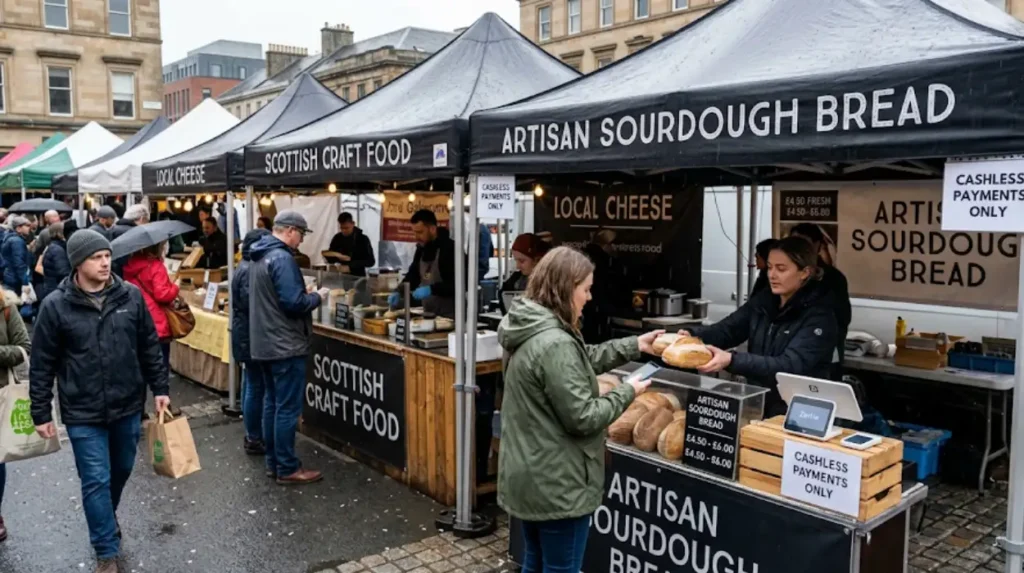
Prices at the market reflect the higher production costs associated with small-batch manufacturing, fair labor wages, and high-quality raw materials. Prepared street food meals generally range from £8.00 to £14.00 per portion. Artisanal loaves of sourdough bread average £4.50 to £6.00, while specialty cheeses retail between £5.00 and £9.00 per 200-gram unit.
While these price points exceed those of mass-produced supermarket alternatives, the value proposition lies in the product quality, unique flavor profiles, and direct financial support provided to the primary producer.
Peak Hours, Crowds, and Operational Timelines
The market operates within a fixed Sunday schedule, typically opening gates at 10:00 AM and concluding trading activities at 4:00 PM. Operational data reveals distinct consumer traffic patterns across this six-hour window:
| Time Horizon | Visitor Density | Inventory Status | Optimal Consumer Profile |
| 10:00 AM – 11:30 AM | Low | Full Availability | Grocery buyers, families, vulnerable individuals |
| 11:30 AM – 2:00 PM | High (Peak) | Diminishing | Street food consumers, social groups |
| 2:00 PM – 4:00 PM | Moderate | Limited (Sell-outs) | Discount seekers, casual walkers |
Early attendees secure the most complete selection of limited-availability goods, such as specialized pastries or rare cuts of meat, whereas late attendees face the risk of vendor sell-outs but may occasionally access end-of-market promotions on perishable items.
Payment Infrastructure and Technology
The contemporary commercial landscape of Glasgow markets has transitioned almost completely toward cashless infrastructure. The vast majority of traders utilize mobile point-of-sale (mPOS) terminals powered by financial technology platforms such as Square, Zettle, or SumUp.
These devices accept chip-and-pin transactions, contactless debit/credit cards, and mobile wallet configurations like Apple Pay and Google Pay. While a minor percentage of traders continue to accept cash sterling notes, digital payments are preferred to speed up transactions, reduce queue wait times, and eliminate the security risks associated with storing physical currency on-site.
Weather Mitigation and Seasonal Adaptability
Given Glasgow’s oceanic climate, characterized by frequent precipitation and variable wind speeds, the market infrastructure must adapt to shifting meteorological conditions. Stalls utilize commercial-grade, weighted pop-up gazebos designed to withstand wind gusts up to certain thresholds.
Visitors must dress appropriately for outdoor exposure, utilizing waterproof outer layers and sturdy footwear, as large sections of the market utilize uncovered outdoor asphalt or gravel surfaces. During severe winter weather events involving amber or red weather warnings from the UK Met Office, market operators implement contingency protocols, which may include delaying opening times, scaling back operations, or canceling the market event to ensure public safety.
What Is the Future Outlook for the Finnieston Market Model?
The future outlook involves greater digital integration, permanent physical structural enhancements, and expansion into mid-week community programming. The model serves as a blueprint for sustainable urban development and localized commerce across Scotland.
Digital Integration and E-Commerce Hybridization
As consumer habits evolve, the Finnieston Food Market model is adopting hybrid digital commerce structures. Market management and individual traders are introducing click-and-collect platforms that allow consumers to pre-order specialty groceries online during the week and collect them packaged at the physical site on Sunday.
This digital framework stabilizes vendor income by providing predictable sales volumes before the physical market opens, while reducing food waste by ensuring that perishable products are already sold before transport. Furthermore, data analytics tools are being deployed to track visitor footfall and purchase trends, helping operators optimize the vendor mix to meet changing consumer demands.
Structural Integration into Urban Planning
The success of the market has influenced Glasgow City Council’s long-term urban planning strategies, such as the City Centre District Regeneration Frameworks. Urban planners increasingly view temporary markets not merely as weekend events, but as essential components of resilient municipal infrastructure.
Future initiatives focus on upgrading the physical sites used by the market, including installing permanent subterranean electrical connections to eliminate noisy diesel generators, improving integrated graywater drainage systems, and building permanent overhead canopy structures. These structural enhancements protect vendors and visitors from inclement weather, improving the overall market experience and extending operational longevity throughout the winter months.
Expansion of Community and Educational Frameworks
The market model is expanding beyond commercial transactions to incorporate educational and community-focused initiatives. Operators are partnering with regional food charities, such as FareShare Scotland, to manage surplus food redistribution and address local food insecurity.
Plans for future market seasons include dedicated community spaces for live cooking demonstrations, food preservation workshops, and nutritional education sessions led by local chefs and public health experts. By transforming the commercial marketplace into an educational forum, the Finnieston Sunday market reinforces its role as a sustainable, community-led asset that strengthens the social and economic fabric of Glasgow.
What is the Finnieston Food Market?
The Finnieston Food Market is a weekly Sunday market in Glasgow’s Finnieston district that brings together street food vendors, artisan producers, local farmers, craft brewers, and independent retailers.