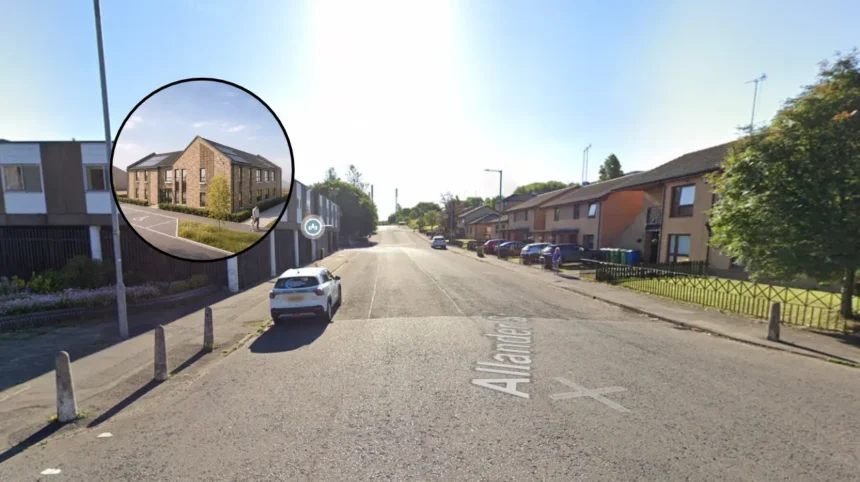
- Planning Permission Granted: West of Scotland Housing Association (WSHA) has secured planning approval from Glasgow City Council to transform a long-term vacant site in the north of Glasgow into 33 affordable homes.
- Site Location: The site is situated on Allander Street, located on the edge of Cowlairs Park in Posilpark.
- Housing Mix: The project will feature a mix of terraced houses and cottage flats specifically aimed at social rent, addressing the regional shortage of larger family properties.
- Property Breakdown: The accommodation includes nine three-bedroom houses, twelve four-bedroom houses, and twelve two-bedroom cottage flats (including ground-floor accessible units).
- Net Zero Standards: All 33 homes are designed to meet Net Zero Carbon standards in operation, featuring high levels of fabric energy efficiency and zero-direct-emissions heating systems.
- Community Benefits: The design incorporates high-quality landscaping, communal green space, active travel connections to Cowlairs Park, and enhanced biodiversity measures.
- Project Partners: WSHA is delivering the development alongside project partners CCG (Scotland) Ltd, Hub West Scotland, and MAST Architects.
Glasgow (Glasgow Express) November 5, 2026 – West of Scotland Housing Association has officially been granted planning permission by Glasgow City Council to redevelop a long-term vacant site on Allander Street into 33 energy-efficient, affordable social rented homes. Situated on the edge of Cowlairs Park in the Possilpark area in the north of Glasgow, the ambitious residential scheme will focus heavily on delivering much-needed larger family accommodation, comprising nine three-bedroom houses, twelve four-bedroom houses, and twelve two-bedroom cottage flats. Designed to achieve operational Net Zero Carbon status, the proposal aims to alleviate local housing queues while simultaneously supporting Scotland’s statutory targets for decarbonisation and urban regeneration.
- What are the key details of the Allander Street development?
- How will the project achieve Net Zero Carbon status?
- Who are the key partners involved in delivering the project?
- Background of the Allander Street development
- Prediction: How will this development affect local residents and social housing applicants?
What are the key details of the Allander Street development?
The newly approved residential scheme on Allander Street marks a substantial investment in the north of Glasgow. By bringing a long-derelict piece of land back into productive community use, the project addresses both land remediation and the acute shortage of quality social housing in the city.
The site layout has been carefully crafted by MAST Architects to respect the local urban fabric and integrate smoothly with the adjacent Cowlairs Park. The 33 properties will be managed by West of Scotland Housing Association (WSHA) and offered entirely for social rent through the local housing register.
| Property Type | Quantity | Target Household Size |
| 2-Bedroom Cottage Flats | 12 | 2–4 Persons (Includes Accessible Ground Units) |
| 3-Bedroom Terraced Houses | 9 | 5–6 Persons |
| 4-Bedroom Terraced Houses | 12 | 6–8 Persons |
A core focus of the layout is addressing the documented shortfall of larger family units within Possilpark and the broader Glasgow area. By allocating over 60 per cent of the development to three- and four-bedroom houses, the project enables larger households currently living in overcrowded conditions to access suitable, modern accommodation.
How will the project achieve Net Zero Carbon status?
The design strategy for the Allander Street homes prioritises environmental performance and low running costs for incoming tenants. Built to meet stringent operational Net Zero standards, the homes incorporate a “fabric first” architectural approach alongside zero-direct-emissions heating technologies.
Key energy and environmental features of the development include:
- Advanced Thermal Envelope: High performance insulation in walls, roofs, and floors to minimize space heating demand and reduce thermal bridging.
- Zero-Emissions Heating: Replacement of traditional fossil-fuel gas boilers with zero-direct-emissions technology, such as air-source heat pumps.
- Renewable Energy Generation: Integration of roof-mounted solar photovoltaic (PV) panel arrays to generate clean electricity on-site.
- Mechanical Ventilation: Heat recovery ventilation systems to maintain high indoor air quality while recapturing waste heat.
- Active Travel Infrastructure: Dedicated cycle storage facilities and direct pedestrian pathways linking the development into Cowlairs Park and surrounding transit routes.
These design measures ensure that the homes will carry low operational energy requirements, helping to protect social housing tenants against fuel poverty while eliminating operational carbon emissions.
Who are the key partners involved in delivering the project?
The Allander Street housing scheme is being delivered through a collaborative partnership bringing together housing association expertise, public sector procurement routes, and specialist construction capabilities.
WSHA is working in partnership with development partner Hub West Scotland and main contractor CCG (Scotland) Ltd. Architectural design services have been provided by MAST Architects, with engineering and consultancy support provided by the wider design team.
This partnership model has previously delivered several residential developments across the West of Scotland, focusing on high-efficiency off-site manufacturing techniques to maintain build quality, reduce construction waste, and shorten overall on-site schedules.
Background of the Allander Street development
The approval of the Allander Street scheme forms part of a broader, multi-phase masterplan strategy aimed at regenerating Possilpark and the historic Cowlairs area in northern Glasgow. For several decades, significant tracts of land in Cowlairs lay vacant following the closure and clearance of heavy industrial works, railway yards, and legacy housing schemes.
In recent years, Glasgow City Council and regional housing associations have prioritised the northern arterial corridor for strategic residential investment. The Cowlairs Masterplan represents one of the largest brownfield housing regeneration efforts in the city, aiming to deliver hundreds of new energy-efficient homes alongside upgraded public realm, green space, and active travel routes.
WSHA’s acquisition and planning success at Allander Street represents a key milestone within this wider regeneration initiative. By transforming long-term vacant land on the perimeter of Cowlairs Park into low-carbon family housing, the development contributes directly to Glasgow’s Strategic Housing Investment Plan (SHIP) and Scotland’s national target to deliver 110,000 affordable homes by 2032.
Prediction: How will this development affect local residents and social housing applicants?
The planning approval for 33 net-zero homes on Allander Street is set to deliver tangible, long-term outcomes for several distinct groups across the north of Glasgow:
1. Local Families and Housing Applicants
For households currently on the WSHA and Glasgow Housing Register waiting lists, the inclusion of 21 three- and four-bedroom family houses provides immediate relief to chronic local overcrowding. Larger family homes are historically under-represented in new-build social housing developments. The provision of modern, spacious homes will allow larger families to remain within their local community close to schools, support networks, and facilities.
2. Social Tenants and Fuel Poverty Mitigation
With energy costs remaining a major concern for households across the UK, the Net Zero operational standard of these properties offers vital financial protection. The combination of high-grade insulation, solar PV generation, and efficient heating systems ensures that space heating and hot water costs will remain significantly lower than in traditional housing stock, directly safeguarding tenants against fuel poverty.
3. The Wider Possilpark Community
Beyond the immediate benefit to new residents, the transformation of a long-term vacant site removes a source of urban blight on Allander Street. The integration of high-quality landscaping, improved streetscapes, and new pedestrian access points to Cowlairs Park enhances the physical environment for all neighbouring residents, promoting biodiversity and encouraging outdoor active travel throughout the area.