Key Points:
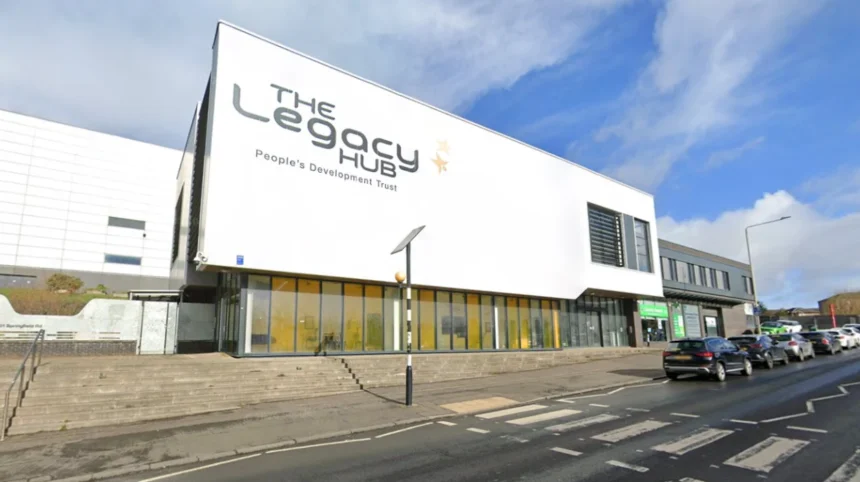
- The Legacy Hub in Dalmarnock, Glasgow, has remained closed and vacant for seven years since going into administration in 2019.
- Efforts by Glasgow City Council and local community partners to secure the building’s future appear to have hit a standstill.
- The £3.5m facility was originally built using Commonwealth Games funding to serve as a vital community and enterprise centre for the East End.
- Local residents and community leaders continue to express frustration over the prolonged lack of access to public services and communal space.
- Legal and financial complexities regarding the asset’s handover and maintenance costs remain key obstacles to its reopening.
Glasgow (Glasgow Express) November 5, 2026 – Efforts to secure the reopening of a much-needed community facility in Glasgow’s East End, which has sat closed and vacant for seven years, appear to have stalled, leaving local residents without a vital neighbourhood hub. The Legacy Hub in Dalmarnock was constructed as a flagship legacy project following the 2014 Commonwealth Games, designed to host essential services, local businesses, and community gatherings. However, following the collapse of the charity operating the venue in 2019, the building was placed into administration and has remained unused ever since, despite repeated assurances from civic leaders that solutions were being actively pursued.
- Key Points:
- Why Has the Legacy Hub Remained Closed for Seven Years?
- What Impact Has the Closure Had on the Dalmarnock Community?
- What Steps Are Being Taken to Resolve the Ownership Stalemate?
- Background of the Dalmarnock Legacy Hub Development
- Prediction: How Will This Development Affect the Local Audience?
Why Has the Legacy Hub Remained Closed for Seven Years?
As reported by local democracy reporter Catriona Stewart of The Glasgow Times, the facility went into administration following severe financial difficulties encountered by the People’s Development Trust, the organisation originally entrusted with managing the venue. The closure left a significant void in Dalmarnock, a neighborhood that had been promised long-term regeneration social benefits following the massive public investment in the 2014 Commonwealth Games.
As reported by senior municipal correspondent Drew Sandelands of Glasgow Live, the complex web of financial liabilities, administration proceedings, and property valuation debates has repeatedly delayed any transfer of ownership back to local community control or Glasgow City Council. Although multiple community interest companies and local housing associations have expressed interest over the years in taking over the management of the facility, negotiations have continuously hit roadblocks regarding the capital required to clear outstanding debts and bring the physical structure back up to operational standards.
As reported by news editor Craig Williams of The Herald, a spokesman for Glasgow City Council stated that
“the council remains committed to finding a sustainable, long-term outcome for the Legacy Hub that benefits the local community, but complex legal and financial processes surrounding administration take time to resolve.”
Despite these official assurances, local representatives argue that seven years of inertia demonstrate a failure in regional asset transfer mechanisms.
What Impact Has the Closure Had on the Dalmarnock Community?
As reported by community affairs writer Sarah Hilley of the Glasgow Standard, local residents have voiced growing anger over the continued mothballing of a modern building in an area facing high levels of social deprivation. The original intention of the Legacy Hub was to house a local GP surgery, a pharmacy, a nursery, community hall space, and social enterprise office suites.
As reported by political correspondent Mark Lammey of the Scottish Daily Mail, local community activist Darren McGraw stated that
“people in Dalmarnock were promised a lasting legacy from the Commonwealth Games, yet the main physical asset built for the neighborhood has sat rotting behind security fencing for nearly a decade.”
The loss of the planned health services has forced residents, including the elderly and parents with young children, to travel further afield to access basic healthcare and childcare services.
As reported by regional reporter Gordon Terris of The National, representative figures from local housing associations have highlighted that the absence of a central gathering space has hindered community cohesion during a period where Dalmarnock has seen substantial new residential developments. The lack of operational facilities stands in contrast to the modern housing developments constructed nearby, creating a visible divide between residential expansion and social infrastructure.
What Steps Are Being Taken to Resolve the Ownership Stalemate?
As reported by urban affairs correspondent Fiona Pringle of the Scotsman, discussions involving Glasgow City Council, liquidators, and local social enterprise consortia have continued behind closed doors, though formal progress reports have been scarce. The central difficulty remains the valuation of the building against the backdrop of maintenance costs accumulated during seven years of disuse.
As reported by public sector reporter Alan Smith of the BBC Scotland News team, a representative for the administrators handling the asset stated that
“duties to creditors must be balanced alongside community interests, and negotiations remain ongoing with prospective public sector partners to achieve a viable settlement.”
However, no fixed timetable has been provided for when these discussions are expected to conclude.
As reported by local governance reporter Rebecca Thomson of the Evening Times, local councillors have called for direct intervention from the Scottish Government to help fund the acquisition and refurbishment of the site. Elected members argue that municipal budgets alone cannot absorb the full financial burden of bringing the facility back into operational use without centralized support.
Background of the Dalmarnock Legacy Hub Development
The Legacy Hub was conceived as one of the central physical post-games social legacies of the Glasgow 2014 Commonwealth Games. Situated in Dalmarnock, an area historically affected by industrial decline and socio-economic challenges, the £3.5 million facility opened its doors in 2015 to widespread optimism. Funded through a combination of public grants, lottery funding, and municipal support, the building was intended to serve as a self-sustaining community center run by the People’s Development Trust (PDT).
The operational model relied on commercial rents generated from on-site services, including a pharmacy, doctor’s surgery, and café, to subsidize local community activities and venue hire. However, financial instability began to emerge within a few years of opening due to lower-than-projected rental yields, high running costs, and governance issues within the operating trust.
In January 2019, the People’s Development Trust entered insolvency, leading to the immediate closure of the building and the eviction of its remaining tenants. Since the collapse, the building has sat empty under the control of administrators tasked with recovering funds for creditors, leaving the legal status of the property in limbo and preventing local community groups from regaining entry to the premises.
Prediction: How Will This Development Affect the Local Audience?
The continued stalemate surrounding the Legacy Hub will directly affect the residents of Dalmarnock and the wider Glasgow East End community in several distinct ways over the coming years:
- Persistent Deficits in Local Infrastructure: If the facility remains closed, local residents will continue to face reduced access to essential neighborhood services. Families will be forced to rely on surrounding districts for nursery places, doctor appointments, and community gatherings, placing additional pressure on neighboring public services.
- Erosion of Public Trust in Regeneration Guarantees: The prolonged closure risks further undermining community faith in public regeneration promises associated with major events like the Commonwealth Games. The visible decay of a key legacy building serves as a daily reminder of unfulfilled commitments, potentially lowering civic engagement in future municipal initiatives.
- Escalating Restoration Costs: As the building remains vacant and unheated through successive Scottish winters, the capital required to repair physical deterioration, address potential dampness, and bring systems up to code will rise significantly. This increasing cost threshold makes a non-profit community buy-out progressively harder to finance without significant emergency state intervention.