Key Points
- Glasgow City Council’s planning applications committee has again refused retrospective planning consent for unauthorised signage and advertisements installed by Mòr Bakehouse.
- The decision targets two prominent city centre locations operated by the bakery chain: 110 Argyle Street and 1A Dundas Street.
- Planning officers and committee members deemed the extra lightbox signage and advertisements to be “unnecessary visual clutter” that harms the character of the streetscape.
- Both applications faced formal statutory objections from the Architectural Heritage Society.
- Councillor Ken Andrew, Chair of the Planning Applications Committee, stated that local authorities must “hold the line” to prevent losing control over historic architectural standards.
- Councillor Paul Leinster highlighted the success of public realm improvements near Queen Street station, arguing that removing the unauthorised signs would not negatively impact business operations.
- Supporting submissions were previously made by several local residents in favour of retaining the shopfront features.
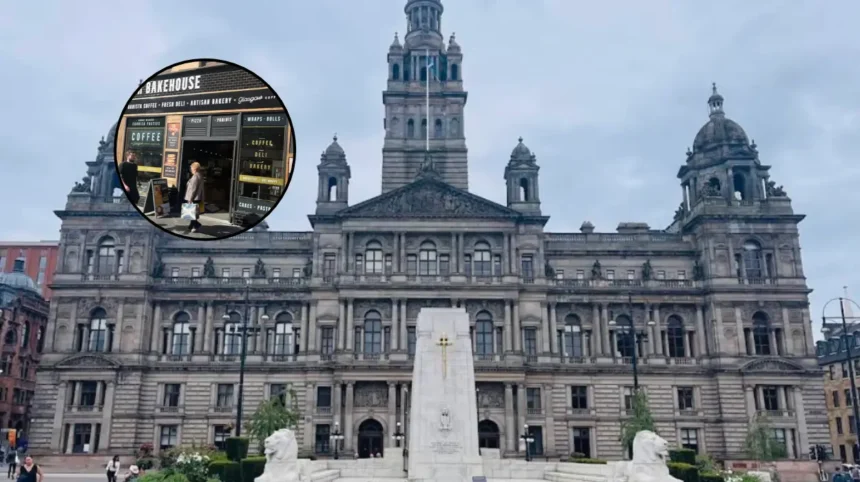
Glasgow (Glasgow Express) October 23, 2026 – Glasgow City Council has maintained its strict stance on urban heritage design by refusing planning permission for unauthorised advertisements and lightboxes installed at two outlets operated by Mòr Bakehouse. The local authority’s planning applications committee determined during its latest meeting that the commercial fixtures mounted at 110 Argyle Street and 1A Dundas Street represent “unnecessary visual clutter”. Both venues, situated in busy pedestrian corridors near historic transit hubs, have been subject to ongoing scrutiny regarding shopfront alterations that were carried out without prior listed building or advertisement consent.
As reported by Sarah Hilley of the Glasgow Times, planning officers had previously detailed that Mòr Bakehouse was urged to obtain statutory consent, yet elected to install additional fixtures that exceeded acceptable architectural limits. The decision reinforces a initial refusal issued by local authorities in May, upholding recommendations from municipal planning officers who assessed that the installed signage detracted from the visual character of the host structures and surrounding conservation settings.
What were the key arguments raised by city councillors and heritage bodies?
The planning applications faced formal opposition from civic heritage organisations, which raised concerns over the cumulative impact of aggressive commercial branding on listed properties. As reported by Drew Sandelands, Local Democracy Reporter for Glasgow Live, both applications received official objections from the Architectural Heritage Society. During committee debates, municipal representatives highlighted the necessity of enforcing established conservation guidelines across the city centre.
As reported by Drew Sandelands, Local Democracy Reporter for Glasgow Live, Councillor Ken Andrew, SNP, Chairman of the Planning Applications Committee, addressed the committee on the risk of setting a precedent, stating:
“To allow this, or allow a little more latitude, we could quite easily lose control of things, albeit that each planning application is looked upon individually on its own merits.”
Councillor Ken Andrew added:
“Nevertheless, we do get pressured about consistency. I think the original decision we made in May should stand.”
As reported by Sarah Hilley of the Glasgow Times, Councillor Ken Andrew further noted in earlier proceedings regarding the Argyle Street site:
“It looks to me they have taken that and run with it further in the hope of pushing the boundaries. We need to hold the line here. It is an interesting Art Nouveau building and its listed status is well merited.”
Councillor Ken Andrew added:
“These extra lightboxes they have installed are a step too far. I’m prepared to accept the recommendation to refuse the advertising consent and listed building consent.”
Supporting the planning officer recommendations, committee members pointed to ongoing civic investments in urban infrastructure as a primary consideration for maintaining neat streetscape standards. As reported by Drew Sandelands of Glasgow Live, Councillor Paul Leinster, SNP, highlighted the visible benefits of the council’s shopfront enforcement policies, stating:
“It’s clearly a much nicer row of retail now, with that former traditional shopfront.”
Councillor Paul Leinster elaborated on the wider area:
“That’s an area that wasn’t particularly nice, there has been the regeneration of Queen Street station and the improvement of the retail frontages on Dundas Street.”
Councillor Paul Leinster further remarked:
“We want to keep this area as nice as it possibly can be, especially with all the public realm improvement works around there as well. There’s absolutely no way that you can imagine the removal of these four signs having an impact on the business.”
While municipal officers and committee members voted to uphold the refusal, public response was not entirely uniform. As reported by Sarah Hilley of the Glasgow Times, a number of supporting comments were submitted to the local authority by local residents who spoke in favour of the bakery chain’s operational presence and modern shopfront appearance.
Background of the particular development
The regulatory debate surrounding Mòr Bakehouse stems from broader public domain and heritage conservation policies overseen by Glasgow City Council across key commercial zones. In recent years, public agencies have injected substantial capital into public realm improvements, notably surrounding major transit hubs like Glasgow Queen Street station and the pedestrianized segments of Argyle Street and Dundas Street. To safeguard the historic fabric of listed structures, the council enforces guidelines that restrict oversized, internally illuminated, or non-traditional shopfront signage.
Mòr Bakehouse, an independent Scottish bakery chain known for serving regional baked goods and coffee, expanded its footprint in Glasgow by acquiring locations on Argyle Street and opening near Queen Street station on Dundas Street. However, the installation of retrospective lightboxes and secondary projecting signboards without prior regulatory approval triggered statutory enforcement notices. Initial applications for advertisement and listed building consent were formally refused by the council’s planning committee in May. The latest meeting saw councillors re-evaluate the chain’s submissions after Mòr Bakehouse urged the committee to grant permission, resulting in a re-affirmation of the initial rejection.
How this development can affect retail business owners and heritage conservation in Glasgow
The decision by Glasgow City Council sets a distinct enforcement precedent that directly impacts commercial tenants, property developers, and local heritage advocates across Glasgow’s primary retail districts.
Impact on local retail operators and chain businesses
- Mandatory Signage Compliance Costs: Business owners operating within listed buildings or designated conservation zones face clear financial risks if branding is installed without full prior permission. Mòr Bakehouse now faces potential enforcement mandates to modify or entirely remove the unauthorised lightboxes at its own expense.
- Operational and Marketing Restrictions: High-street chains seeking high-visibility marketing tools like illuminated projecting signs will be constrained by strict size and illumination limits, forcing businesses to rely on alternative, compliant promotional methods.
- Clarity on Planning Precedents: The firm rejection signals to existing and incoming high-street tenants that local authorities will not grant leniency for retrospective applications that breach established visual standards.
Impact on civic heritage and public realm development
- Protection of Architectural Identity: Historic properties, such as the Art Nouveau structure on Argyle Street, remain shielded from incremental alterations that dilute their cultural and aesthetic value.
- Consistency in Urban Aesthetics: Maintaining strict oversight ensures that ongoing public realm investments—such as those around Dundas Street and Queen Street station—deliver a cohesive, clutter-free streetscape for shoppers and tourists.