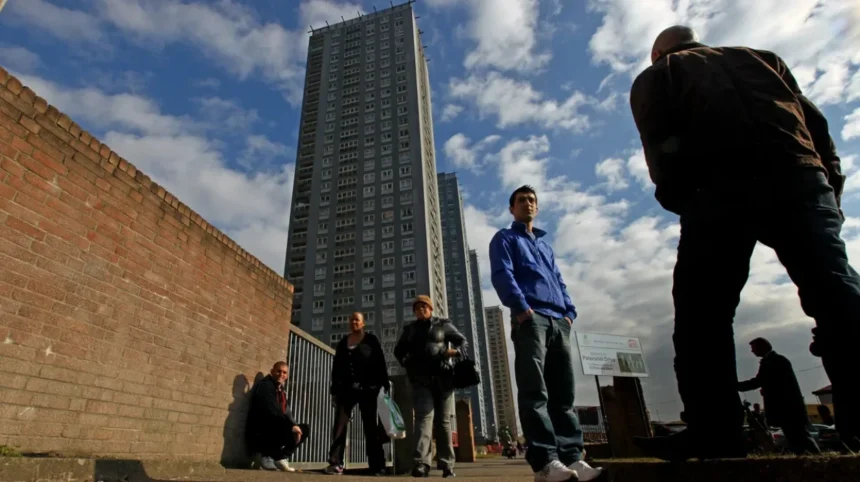
Key Points
- A total of 450 homes are planned for development on the derelict land where the Red Road tower blocks previously stood.
- Wheatley Homes is set to construct affordable housing on the Barmulloch plot, with hopes for some private housing provision.
- A formal business case is being prepared for presentation to the Scottish Government to secure additional funding for necessary site remediation.
- City councillor Graham Campbell previously voiced concerns regarding the prolonged delays and slow progress on the abandoned site since demolition began in 2012.
- The regeneration initiative follows more than a decade of the land remaining vacant after the phased demolition of the iconic high-rise complex.
Glasgow (Glasgow Express) September 30, 2026 — Plans to build new homes on a demolished high-rise site in Glasgow are finally moving forward after more than a decade of vacancy. As reported by Sarah Hilley, Local Democracy Reporter of Glasgow Live, a total of 450 homes are set to be constructed on the derelict land where the iconic Red Road tower blocks once stood. Wheatley Homes is lined up to construct affordable housing on the Barmulloch plot, while discussions during a recent council meeting indicated that hopes also remain for a portion of private homes to be integrated into the masterplan.
How Is the Funding and Remediation for the Barmulloch Plot Being Handled?
To ensure the land is safe and suitable for residential construction, formal financial mechanisms are currently being put into motion. According to local authority disclosures highlighted by Sarah Hilley of Glasgow Live, a comprehensive business case will soon be presented to the Scottish Government. This submission aims to secure vital funding dedicated to carrying out thorough site remediation, a critical step given the heavy industrial and high-rise legacy of the location.
What Concerns Have Been Raised Regarding Past Delays?
The progression of the site has been a subject of intense local scrutiny over the years. City councillor Graham Campbell has previously voiced sharp criticisms concerning what he described as “slow progress” on the abandoned plot. The high-rise structures that previously defined the skyline were systematically demolished in phases, with the process originally commencing back in 2012. Since the final rubble was cleared, local representatives have repeatedly pressed for definitive timelines to revitalize the empty space and bring community benefits back to the northeast of the city.
Background of the Particular Development
The Red Road flats were originally constructed between 1964 and 1969 as a ambitious post-war solution to Glasgow’s severe housing shortage. Consisting of eight high-rise blocks—including six 31-storey point blocks that were among the tallest residential buildings in Europe—the complex became a prominent feature of the city’s urban landscape between the districts of Balornock and Barmulloch.
Over the decades, the estate faced complex socio-economic challenges, maintenance hurdles, and changing public housing policies. Consequently, the Glasgow Housing Association and Glasgow City Council decided to phase out the high-rises. Demolition began in 2012 and culminated in a televised, controlled implosion of the remaining blocks in 2015. Since then, the vast expanse of land has remained largely derelict, prompting ongoing calls from local community councils and councillors like Graham Campbell to accelerate regeneration efforts. The current intervention by Wheatley Homes represents the most concrete step toward restoring residential utility to the historically significant plot in over ten years.
Prediction on How This Development Can Affect the Local Community and Housing Sector
The progression of the 450-home development on the former Red Road site is poised to significantly alter the socio-economic fabric of Barmulloch and the wider northeast Glasgow area. For local residents and housing applicants, the introduction of modern, energy-efficient affordable housing by Wheatley Homes will directly address acute local waiting list pressures and offer high-quality living standards designed to current regulatory benchmarks.
Economically, the infusion of Scottish Government funding for site remediation will stimulate local construction activity, generating supply chain opportunities and local employment. Furthermore, successfully transforming a high-profile derelict site that has sat vacant for over a decade can restore confidence in urban regeneration initiatives across the city, removing a lingering visual reminder of past demographic and structural challenges. However, the ultimate success of the project will depend on how swiftly the business case is approved and whether the integration of affordable and potential private housing can successfully harmonize with existing neighborhood infrastructure.