Key Points
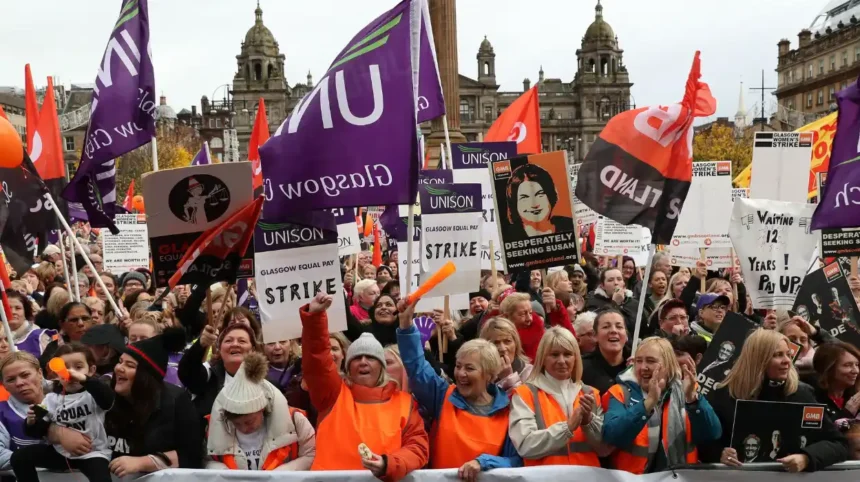
- Trade unions used an emergency debate at Labour’s UK conference in Liverpool to address the Glasgow equal pay dispute and the SNP-run council’s fire-and-rehire threat against over 23,000 workers.
- Delegates overwhelmingly backed a motion condemning the threat, but union representatives urged the Labour party to show “a wee bit of humility” regarding its own historical role in the dispute.
- Mary Finn of GMB Scotland reminded delegates that the equal pay injustice originated under previous Labour administrations in Glasgow back in 2006.
- Dismissal letters were initially scheduled to go out to non-teaching staff following the collapse of talks between the council and the GMB, Unite, and Unison unions.
- While GMB and Unite were prepared to support the deal, Unison withdrew its support, leading the SNP-run local authority to argue that sacking and re-hiring workers was the only way to implement a lawful pay and grading scheme.
- The fire-and-rehire threat was temporarily paused following an intervention by Deputy First Minister Jenny Gilruth, allowing negotiations to resume.
- Louise Noble, Unison Scotland’s deputy convenor, moved the original motion, emphasizing that pausing the process is insufficient and that fire and rehire must be completely eliminated.
Glasgow (Glasgow Express) September 29, 2024 — Trade unions utilized an emergency debate at the Labour Party’s annual conference to address the escalating equal pay dispute in Glasgow, combining fierce opposition to current SNP policies with a call for historical accountability from the Labour leadership.
Delegates gathered in Liverpool overwhelmingly endorsed a motion condemning the SNP-run Glasgow City Council for issuing fire-and-rehire threats affecting more than 23,000 workers. However, the session quickly pivoted toward self-reflection, with union representatives insisting that the party acknowledge its own historical footprint in the ongoing crisis.
As reported by Mary Finn of GMB Scotland, the equal pay injustice presently under negotiation actually began under previous Labour administrations in Glasgow. Mary Finn stated that
“Today, it is an SNP council threatening workers with fire and rehire, and there should be absolutely no doubt about our opposition to that.”
Furthermore, Mary Finn added that
“A wee bit of humility from this party would go a long way too, because the equal pay injustice we are still trying to fix today began under previous Labour administrations in Glasgow,” stressing that
“Our members will not allow any attempt to rewrite that history simply because somebody else is now in power.”
Why did Glasgow City Council issue fire-and-rehire threats to workers?
The contentious issue escalated after equal pay talks between the local authority and three major trade unions—GMB, Unite, and Unison—collapsed. Dismissal letters were originally scheduled to be dispatched to all non-teaching staff.
While GMB and Unite were prepared to endorse the proposed settlement, Unison’s withdrawal of support stalled the process entirely. Consequently, the SNP-run local authority stated it had “gone as far as it can,” asserting that without an agreement, the sole legal mechanism to replace the unlawful pay and grading scheme with a lawful alternative was to terminate existing contracts and immediately re-engage workers under new terms.
What role did the Scottish Government play in pausing the dismissals?
The threat of fire and re-engagement was subsequently paused following a direct intervention by Deputy First Minister Jenny Gilruth. This political pause enabled negotiations between the council and labor representatives to resume promptly.
As reported by Mary Finn of GMB Scotland, union negotiators remained “within touching distance” of a negotiated settlement. Highlighting worker solidarity, Mary Finn stated that
“Throughout this fight, our members have stood together. Our refuse workers refused to cross a picket line; they stood shoulder to shoulder with the women in Glasgow, and they lost pay doing it because they understood something fundamental.”
Additionally, Mary Finn noted that
“Equal pay doesn’t mean making one group of workers poorer to make another group better off. It means raising everyone up. Glasgow City Council must not be allowed to blow that up.”
How does historical context shape the current political debate?
Although the immediate political pressure falls heavily on the SNP administration, political analysts note that the core structural issue dates back nearly two decades. The disputed pay and grading system was originally established by a Labour-run council in 2006. Despite recognizing legal vulnerabilities, successive authorities continued legal challenges against female employees, resulting in substantial financial costs.
Moving the original motion to the conference floor, Louise Noble, Unison Scotland’s deputy convenor, reaffirmed the union’s absolute opposition to the practice of fire and rehire. Louise Noble stated that
“We welcome the fact that the dismissal and re-engagement process has now been paused while further negotiations take place.”
Emphasizing the union’s ultimate stance, Louise Noble concluded that
“But paused is not enough. Fire and rehire must be taken off the table completely.”
Background of the Particular Development
The dispute centers on long-standing equal pay claims within Glasgow City Council, stemming from a 2006 pay and grading review (the Workforce Pay and Benefits Review) implemented under a previous Labour administration. This review disproportionately affected female-dominated roles—such as care workers, caterers, and school support staff—by paying them significantly less than male-dominated roles of equal value in sectors like refuse collection and cleansing, leading to years of legal battles, employment tribunal claims, and multi-million-pound settlement liabilities.
When the SNP took control of the council, they inherited these unresolved liabilities and sought to implement a new, legally compliant pay and grading structure. However, reaching a consensus across multiple trade unions proved difficult. The recent crisis emerged when talks stalled, prompting the council to utilize the controversial “fire and rehire” mechanism to enforce structural changes, which subsequently triggered fierce national backlash from unions and political intervention from the Scottish Government.
Prediction
This ongoing development carries significant implications for public sector workers, trade union relations, and political accountability across Scotland and the wider United Kingdom. For the affected workforce of over 23,000 non-teaching and municipal employees in Glasgow, the immediate outcome of these negotiations will determine the security of their contracts, the fairness of their pay structures, and whether controversial dismissal tactics can be successfully neutralized in public sector labor disputes.
Politically, the situation creates a delicate dynamic for both the SNP and the Labour Party. For the SNP-run council, how this dispute is ultimately resolved will test its ability to manage complex municipal labor relations without alienating its core working-class support base. For the Labour Party, the conference debate highlights the enduring legacy of past administrative decisions, serving as a reminder that historical policy choices continue to shape modern industrial relations. If trade unions successfully push for a complete ban on fire and rehire within municipal governance, it could set a powerful precedent for labor protections nationwide, fundamentally altering how local authorities across the UK negotiate structural reforms and workforce compensation in the future.