Key Points
- Creative Scotland has officially opened a formal bidding process for 350 Sauchiehall Street, the former home of Glasgow’s Centre for Contemporary Arts (CCA), which went into liquidation earlier this year.
- The funding body has stated a clear preference to sell or transfer ownership of the category A-listed building rather than simply leasing it out again.
- Property agents Graham + Sibbald are handling the open bidding process, with a final submission deadline set for 5:00 PM on 30 October 2026.
- The move follows an initial expressions of interest stage that drew 13 responses from various cultural organisations and consortia.
- Creative Scotland explained that property ownership and building management fall outside its core remit, strategy, and expertise, which focuses instead on supporting artists and creative programmes across Scotland.
Glasgow (Glasgow Express) September 29, 2026 – Following months of uncertainty after the sudden financial collapse and liquidation of one of Scotland’s premier cultural institutions, formal steps are now underway to secure a viable future for its historic home.
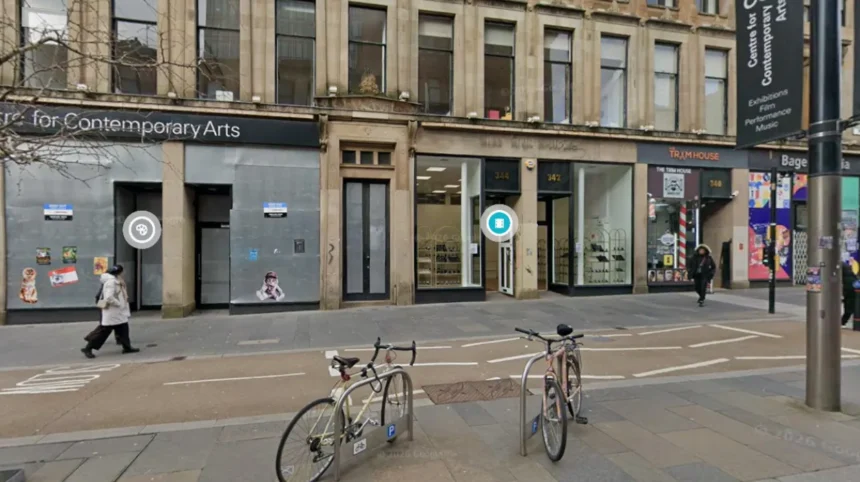
As reported by Brian Ferguson, Arts and Entertainment Journalist of the Year for The Herald, Creative Scotland has officially opened the bidding process for the property located at 350 Sauchiehall Street, inviting detailed proposals to either purchase, transfer ownership of, or lease the prominent three-storey blond sandstone building.
The site, designed by renowned architect Alexander “Greek” Thompson, has remained boarded up since the Centre for Contemporary Arts (CCA) entered liquidation at the end of January, immediately ceasing all operations and making staff redundant amidst severe financial challenges.
Why is Creative Scotland keen to sell rather than lease the property?
As noted in the official solicitor’s brochure managed by agents Graham + Sibbald, Creative Scotland has stated that its primary preference is to completely sell or transfer ownership of the building rather than enter into another leasing agreement.
The arts funding body clarified its institutional position regarding the asset. As detailed by arts journalist Brian Ferguson in The Herald, Creative Scotland stated:
“The reason for this is that Creative Scotland’s focus is on developing and supporting artists, creative practitioners, organisations and public programmes across Scotland. Our core remit, strategy and expertise does not include the ownership or operation of buildings or other major assets of this type.”
By divesting itself of the property asset, the organization aims to return to a standard funding client relationship while ensuring the historic venue remains protected for public and artistic use. Survey data indicates that the building requires significant remedial work after decades of relatively low levels of maintenance, a factor that prospective buyers must account for in their development timelines.
What response has the initial interest phase generated from the cultural sector?
The launch of the formal bidding stage follows an initial call for expressions of interest that attracted substantial attention from the creative community.
According to coverage by arts journalist Emily Godwin of Arts Professional, Creative Scotland confirmed it received 13 expressions of interest from various cultural organisations, theatre companies, and consortia hoping to transform the space into a vibrant creative hub. Among these have been proposals from collaborative groups of Scottish theatremakers aiming to establish dedicated spaces for innovative performance work that struggles to find a stage elsewhere in the country.
The formal brochure emphasizes the deep historical roots of the location, reminding stakeholders of its international reputation cultivated first as the Third Eye Centre from the mid-1970s until 1991, and subsequently as the CCA from 1992 onward. Interested parties have until 5:00 PM on 30 October 2026 to submit their final, full bid proposals to Graham + Sibbald.
Background of the particular development
The building at 350 Sauchiehall Street has served as a cornerstone of Glasgow’s cultural landscape for over half a century. Its history as a public-facing multi-disciplinary arts venue began with the establishment of the Third Eye Centre in 1975, which later transitioned into the Centre for Contemporary Arts in 1992. Creative Scotland held the overarching ownership of the structure while leasing it to the independent CCA charity.
However, deep-seated fiscal pressures culminated in January when the charity announced its insolvency, leading to immediate closure, job losses, and the appointment of liquidators. Since then, policymakers, unions, and artists have debated the best trajectory for the vacant space, prompting Creative Scotland to survey building conditions and evaluate long-term options to safeguard the site’s cultural legacy.
Prediction on how this development can affect the cultural sector and local community
The successful sale or transfer of 350 Sauchiehall Street will profoundly influence Glasgow’s artistic community and the wider regeneration of Sauchiehall Street. If Creative Scotland secures a well-funded, visionary custodian with a commitment to public benefit and a legally binding cultural covenant—which requires a minimum of 25 years dedicated exclusively to the arts—the venue could be successfully resurrected as a dynamic engine for grassroots performance, visual arts, and community engagement.
Conversely, failure to manage the building’s substantial maintenance liabilities or select an economically viable operator risks prolonged vacancy, further stalling the revitalisation of a prominent city-centre thoroughfare. For local artists, creators, and Glasgow residents, the outcome of this October deadline will determine whether a historic sanctuary for independent thought and multidisciplinary creativity can reclaim its vibrant place in Scotland’s cultural ecosystem.