

Key Points
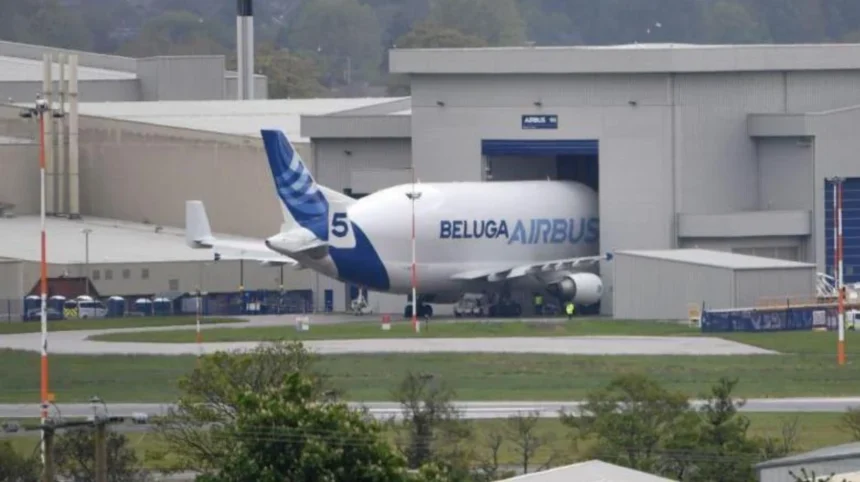
- An Airbus BelugaXL5 aircraft operating a flight from Toulouse to Hawarden was forced to divert mid-flight on Tuesday morning.
- Thick fog and poor visibility over North Wales prevented the giant transporter from completing its scheduled landing at Hawarden Airport in Flintshire.
- Flight tracking data confirmed that the whale-shaped aircraft abandoned its initial approach near Chester and headed north to Scotland.
- The aircraft landed safely at Glasgow Prestwick Airport, where it is expected to remain until weather conditions at its destination improve.
- The BelugaXL fleet is regularly utilized by Airbus to transport oversized parts—such as wings manufactured at the Broughton plant—between European sites.
Glasgow (Glasgow Express) September 22, 2026 – Thick fog enveloping parts of the United Kingdom created severe disruptions on Tuesday morning, forcing an iconic oversized cargo aircraft off its intended flight path. As reported by regional news providers including the Ayr Advertiser and The Herald, the Airbus BelugaXL5 was travelling from Toulouse in France to Hawarden Airport in Flintshire when low visibility compromised the final stages of the journey.
Flight tracking systems demonstrated that instead of touching down in North Wales as scheduled, the distinctive whale-faced transporter had to abort its approach. As noted in flight tracking data reviewed by aviation journalists, the aircraft diverted more than 200 miles north, eventually touching down securely at Glasgow Prestwick Airport in South Ayrshire.
What Role Does the BelugaXL Play in European Manufacturing?
The BelugaXL fleet functions as a fundamental link in the overarching production network maintained by Airbus. These specialized transport aircraft are explicitly engineered to carry massive aircraft sections—including commercial wings—that cannot fit inside conventional freight carriers.
Local reporting emphasizes that the aircraft is an exceptionally familiar presence above Flintshire due to its frequent service to the major manufacturing facility in Broughton. Aviation networks track these movements closely because the Broughton facility stands as one of the largest regional employers, responsible for building wings that are subsequently flown across Europe for final assembly. While weather-related diversions are relatively infrequent, dense ground fog and low cloud ceilings occasionally compel flight crews to seek out designated alternates with longer runways and optimal meteorological conditions, such as Prestwick.
Background of the Particular Development
Weather-induced disruptions at Hawarden Airport and the surrounding North Wales airspace have historical precedent within European aerospace logistics. Because the airfield handles specialized, oversized freight operations tied directly to tightly timed industrial schedules, sudden visibility drops routinely trigger safety protocols. Aircrews operating the specialized Beluga fleet must adhere strictly to visual and instrument flight rules that prioritize absolute safety over schedule adherence. Glasgow Prestwick Airport frequently serves as a preferred diversion alternate for heavy or oversized aircraft routing through British airspace due to its extensive runway capacity and robust handling capabilities for exceptional cargo.
Prediction on How This Development Can Affect Stakeholders
Temporary weather diversions generally cause minimal long-term disruption to broader industrial timelines, but they introduce short-term logistical adjustments for supply chain coordinators and local personnel. For Airbus and its manufacturing workforce in Flintshire, an aircraft grounded temporarily in Scotland means that flight schedules must be recalibrated once local meteorological conditions clear, fuel is replenished, and the return leg to North Wales is cleared. While production cadence at the Broughton plant is built to absorb minor transit windows, prolonged weather holds can temporarily shift delivery windows for component transfers across European assembly lines.