Key Points
- Proposal Submission: Fresh plans have been formally submitted to the Glasgow City Council to transform a former place of worship into a commercial furniture showroom and workshop.
- Site History: The building was previously occupied by the Candlish Wynd United Free Church of Scotland before local worshippers moved out, leaving the property vacant since September.
- Proposed Commercial Use: Pending local authority approval, the site will feature a bespoke sofa craft studio alongside a carpet showroom space.
- On-Site Modifications: The layout blueprints include three designated parking spaces on site, which necessitates the installation of a dropped kerb for vehicular access.
- Community Resistance: Local residents have voiced strong opposition, arguing that the development will exacerbate chronic parking shortages on Daisy Street and erode the neighbourhood’s residential character.
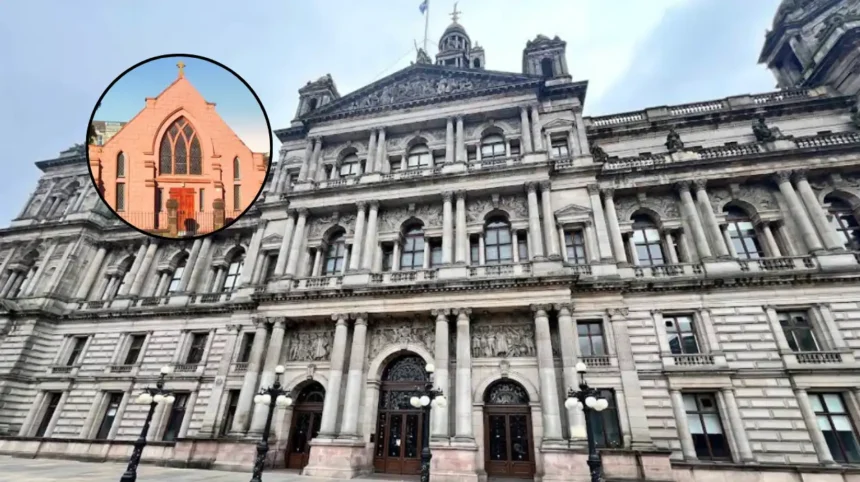
Glasgow (Glasgow Express) September 21, 2026 — Plans have been submitted to the Glasgow City Council seeking permission to convert a building previously occupied by the Candlish Wynd United Free Church of Scotland into a commercial furniture showroom and workshop. As reported by the Glasgow Times, the building has remained entirely empty since regular worshippers moved out of the premises.
Under the submitted planning application, the soon-to-be furniture showroom will comprise a bespoke sofa craft studio and a dedicated carpet showroom space. Additionally, the operational plans layout includes provision for three on-site parking spaces. However, this specific provision requires the creation of a new vehicular access point via a dropped kerb, which has immediately sparked friction among people living nearby.
Why are local residents objecting to the furniture showroom plans?
Local residents living around Daisy Street have expressed significant displeasure over the commercial proposal, warning that the development will create further logistical and aesthetic challenges.
As reported by the Glasgow Times, one local resident stated that,
“This proposal would permanently remove another on-street parking space through the creation of a new vehicular access.”
Elaborating further on the existing neighbourhood conditions, the same resident was quoted by the Glasgow Times as saying that,
“Daisy Street already experiences severe parking pressures, with residents frequently having to park two or three streets away from their homes and double parking being commonplace due to the lack of available spaces.”
In addition to parking grievances, the resident raised concerns regarding architectural preservation. As published by the Glasgow Times, they added:
“The former church is an attractive building which contributes positively to the character of Daisy Street. Replacing part of its frontage with another vehicular entrance and parking area would further erode the residential character of the street.”
What stance have other members of the community taken regarding the commercial application?
While opposition is clear, feedback from the neighbourhood reflects nuanced perspectives on commercial reuse versus structural changes. Another resident stated that although he is not fundamentally against converting the church building for commercial purposes, he holds deep reservations about the current parking arrangement.
As detailed by the Glasgow Times, the second resident stated:
“If granted, this proposal will cause additional parking issues for residents. Parking is already extremely difficult in the area.”
Seeking to clarify his position, the resident further noted to the Glasgow Times:
“Please note, I don’t object to the church being used as an appointment-only showroom. I do, however, object strongly to existing parking being taken away from residents. If the proposed plan were to be considered without removing existing on-street parking, I would not oppose it.”
The planning application remains under consideration by the Glasgow City Council, where local officials will weigh the economic regeneration of a vacant religious asset against the amenity concerns raised by the local community.
Background of the Particular Development
The transition of redundant ecclesiastical buildings into commercial or residential spaces has become an increasingly common trend across urban centres in Scotland. Denominations frequently rationalise their property portfolios due to shifting demographic patterns, declining congregation sizes, and the high maintenance costs associated with older stone-built structures. In this instance, the Candlish Wynd United Free Church of Scotland property became surplus to requirements when worshippers vacated the premises. Local authorities routinely face the complex task of balancing the revitalisation of empty commercial or community assets against the preservation of residential amenity, particularly in densely built historic districts where infrastructure like street parking is already operating at maximum capacity.
Prediction and Impact on the Local Community
For the residents of Daisy Street and the immediate surrounding neighbourhood, this development proposal highlights ongoing vulnerabilities regarding urban density and public space management. If the Glasgow City Council approves the plans in their current form, the permanent loss of even a single on-street parking bay—compounded by increased vehicular manoeuvring from commercial clients—risk intensifying daily friction over space. Conversely, if conditions are successfully negotiated to preserve public parking or restrict operations to low-traffic appointment models, the project could serve as a blueprint for sensitively repurposing vacant religious heritage without degrading local living standards.