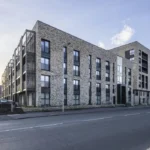
Glasgow remains one of Scotland’s most important residential property markets. House prices have increased over the past year, but the market is not experiencing uniform growth across every property type or neighbourhood.
- Is now a good time to buy a flat in Glasgow?
- How much do flats cost in Glasgow in 2026?
- Why are Glasgow house prices rising?
- Are Glasgow flats cheaper than other property types?
- How do mortgage rates affect buying a Glasgow flat now?
- What should buyers check before purchasing a Glasgow flat?
- Should first-time buyers wait for Glasgow house prices to fall?
- Which Glasgow locations are important for flat buyers?
- What is the long-term outlook for Glasgow flat buyers?
- What does the current Glasgow flat market mean for buyers?
The latest official data show that the average Glasgow property price reached £194,000 in June 2026, compared with £186,000 in June 2025. This represents annual growth of 3.9%. Scotland recorded annual growth of 2.3% during the same period.
Flats and maisonettes remain considerably cheaper than detached, semi-detached and terraced properties. The average Glasgow flat or maisonette price was £163,000 in June 2026, while the average price for detached properties was £507,000. Flat prices increased by 2.9% annually, below the overall Glasgow rate.
This creates an important distinction for prospective buyers. Glasgow house prices are rising, but flat prices are increasing at a slower rate than the city’s overall market. The decision to buy therefore depends on affordability, mortgage costs, property condition, location, intended ownership period and the price paid relative to the Home Report valuation.
Is now a good time to buy a flat in Glasgow?
Now is a reasonable time to buy a Glasgow flat for buyers with secure finances, a suitable mortgage and a long ownership horizon. Prices are rising, but flat growth remains moderate, creating opportunities for careful buyers who prioritise value over short-term price movements.
The latest official figures provide a clear starting point. Glasgow’s average property price was £194,000 in June 2026, up 3.9% year on year. Scotland’s average was £195,000, meaning Glasgow remained close to the national average.
For flats specifically, the average Glasgow price was £163,000. Annual flat-price growth was 2.9%. This is lower than the 7.0% annual increase recorded for detached properties in Glasgow.
The figures indicate that the Glasgow flat market is not rising at the same pace as every other property segment. That matters because a buyer looking specifically for an apartment is not exposed to exactly the same market conditions as someone purchasing a detached house.
The strongest case for buying now exists when the property meets a genuine housing need and the buyer can comfortably afford the mortgage. A purchaser planning to remain in the flat for several years has a different financial position from someone expecting to sell quickly.
Short-term price forecasting is less useful than affordability. A buyer who can comfortably service the mortgage, maintain the property and cover ownership costs has greater protection against temporary market fluctuations.
How much do flats cost in Glasgow in 2026?
The average Glasgow flat or maisonette cost £163,000 in June 2026, according to official UK House Price Index data. This average covers different neighbourhoods, property sizes and conditions, so individual flats can sell substantially above or below this citywide figure.
The £163,000 figure provides a useful citywide benchmark rather than a valuation for an individual property. Glasgow contains a wide range of residential markets, from traditional tenement flats in established inner-city neighbourhoods to modern apartments and larger properties in higher-value districts.
The official data also show the difference between Glasgow’s property categories. In June 2026, detached properties averaged £507,000, semi-detached properties averaged £303,000, terraced properties averaged £248,000, and flats and maisonettes averaged £163,000.
This makes flats an important entry point into Glasgow’s owner-occupied housing market.
The average price paid by first-time buyers across all property types in Glasgow was £174,000 in June 2026, compared with £168,000 a year earlier. Home movers paid an average of £242,000.
The difference demonstrates why flat buyers need to examine property-specific data. A citywide average does not establish whether a particular flat represents good value. Size, floor area, tenure arrangements, condition, energy performance, parking, transport access and local demand all influence the appropriate price.
The Home Report is particularly important in Scotland. It contains a single survey and valuation, a property questionnaire and an energy report. The single survey provides information about the property’s condition, accessibility, repairs and valuation.
Why are Glasgow house prices rising?
Glasgow house prices are rising because demand remains supported by the city’s employment base, universities, transport connections and housing needs, while mortgage conditions and broader economic factors continue to influence purchasing power. Official data show 3.9% annual growth in Glasgow prices to June 2026.
Glasgow is Scotland’s largest city and a major centre for employment, education, healthcare, finance, technology, culture and professional services. These economic functions support continuing demand for homes.
The city’s universities also contribute to housing demand. The University of Glasgow, University of Strathclyde and Glasgow Caledonian University attract large student populations, while the wider metropolitan economy supports graduates and professional workers.
Transport connectivity is another structural factor. Glasgow has extensive rail services, subway connections, bus networks and road links to surrounding communities. Areas with strong transport connections can attract buyers who want access to employment and education without living directly in the city centre.
However, rising prices do not mean every Glasgow property is increasing at the same rate. The latest official figures show a 3.9% annual increase across the city but a 2.9% increase for flats and maisonettes.
Market research from property consultancy Rettie also identifies Glasgow as one of the Scottish cities recording stronger price growth. Its 2026 market briefing reported house-price growth of about 4% in Glasgow in the period covered by its analysis.
The supply side is also important. New housing construction has faced financial and viability pressures across Scotland. Rettie’s research reported that Scotland’s new-build market had fallen below 2020 levels in the higher-value segment, while second-hand property showed greater resilience.
When demand remains active while suitable housing supply is constrained, competition can support prices. This does not guarantee continued price increases, but it helps explain the underlying market pressure.
Are Glasgow flats cheaper than other property types?
Yes. Glasgow flats remain substantially cheaper than other major property categories. In June 2026, the average flat or maisonette was £163,000, compared with £248,000 for terraces, £303,000 for semi-detached homes and £507,000 for detached properties.
The price difference makes flats particularly relevant to first-time buyers and households seeking lower purchase prices.
A flat priced around the citywide average requires a smaller deposit than a similarly located house at a higher price, although the exact mortgage requirement depends on the lender’s loan-to-value criteria.
The lower purchase price also affects transaction costs. In Scotland, buyers pay Land and Buildings Transaction Tax, commonly called LBTT, rather than Stamp Duty Land Tax used in England and Northern Ireland. LBTT is administered by Revenue Scotland.
The Scottish Government also operates housing assistance schemes. The First Homes Fund is currently available to eligible first-time buyers and provides up to £10,000 toward a home with a Home Report value of up to £300,000.
The Open Market Shared Equity scheme provides another route for eligible buyers. Under this scheme, the purchaser normally funds 60% to 90% of the property cost while the Scottish Government holds the remaining share.
These schemes do not make every flat affordable. Buyers still need to meet eligibility requirements, obtain appropriate mortgage finance and budget for repairs, insurance, council tax and other ownership expenses.
Flat ownership also creates specific costs that do not apply in exactly the same way to standalone houses. These can include communal repairs, factoring charges, building insurance arrangements and maintenance of shared areas.
The purchase price therefore represents only one part of the financial calculation.
How do mortgage rates affect buying a Glasgow flat now?
Mortgage affordability remains a central consideration because interest rates determine the cost of borrowing. The Bank of England held Bank Rate at 3.75% in July 2026, while its next scheduled Monetary Policy Committee decision is on 17 September 2026.
Bank Rate is the interest rate set by the Bank of England’s Monetary Policy Committee. It influences borrowing and saving rates throughout the economy.
The Bank of England maintained Bank Rate at 3.75% at its July 2026 meeting. Three committee members voted for a 0.25 percentage-point increase, while six voted to maintain the rate.
The Bank also reported inflation at 2.6% in its July monetary policy statement, although it expected inflation to rise later in 2026 because of higher energy prices.
Mortgage rates are not identical to Bank Rate. Lenders consider factors including the borrower’s risk, loan-to-value ratio, mortgage term and product structure. The Bank of England explicitly notes that loan rates depend on more than Bank Rate alone.
This makes deposit size particularly important.
A buyer with a larger deposit generally requires a smaller mortgage relative to the property value. A lower loan-to-value ratio can also provide access to different mortgage products, depending on lender criteria.
The Bank of England’s mortgage statistics show that borrowing activity remained substantial in 2026. In the second quarter of 2026, gross mortgage advances reached £77.4 billion, 31.7% higher than a year earlier. New mortgage commitments reached £79.2 billion.
A Glasgow flat buyer should therefore assess mortgage affordability using the actual proposed loan rather than relying on headline house-price growth.
The relevant calculation includes the mortgage payment, council tax, factoring charges, buildings and contents insurance, utilities, maintenance and other regular costs.
What should buyers check before purchasing a Glasgow flat?
Buyers should check the Home Report, valuation, building condition, factoring arrangements, communal repairs, energy performance, council tax, title information and mortgage affordability before committing. These checks identify financial and structural risks that are not visible from the asking price alone.
The Scottish Home Report is a central part of the residential buying process. It contains three main documents: the single survey and valuation, property questionnaire and energy report.
The single survey is prepared by a chartered surveyor. It provides information about the property’s condition and identifies repairs or maintenance issues.
The property questionnaire provides information supplied by the seller. It covers matters such as council tax, alterations, previous damage, specialist works and other issues affecting the property.
The energy report provides information about energy efficiency and the property’s Energy Performance Certificate rating. It also provides information about energy use and estimated heating, lighting and hot-water costs.
Flat buyers should pay particular attention to communal areas. Roofs, external walls, staircases, entrances, communal heating systems and other shared elements can create costs for multiple owners.
Factoring arrangements also require examination. A factor is responsible for managing shared property services where owners have appointed one. The buyer should establish the current management arrangement, regular charges, outstanding maintenance and planned major works.
A low purchase price does not automatically represent good value if a building requires substantial communal expenditure.
The buyer should also examine the Home Report valuation. Scottish properties can be marketed using different pricing approaches. Some properties are advertised at a fixed price, while others are marketed with an indication that offers should be above or around a stated level.
If several buyers formally note interest, the seller can establish a closing date for offers. If there is limited competing interest, direct negotiation can instead be possible.
This process makes local market knowledge important. The highest advertised price is not necessarily the same as the property’s valuation or eventual selling price.
Should first-time buyers wait for Glasgow house prices to fall?
First-time buyers should base the decision on affordability, mortgage security and the expected ownership period rather than waiting solely for a forecast price fall. Glasgow prices have risen, but flat prices increased by only 2.9% annually to June 2026, below overall city growth.
Waiting can provide additional time to increase a deposit, reduce debts or improve mortgage affordability. It does not guarantee a lower purchase price.
The latest Glasgow data show that the average first-time buyer price was £174,000 in June 2026, up from £168,000 in June 2025.
For buyers specifically targeting flats, the citywide flat average of £163,000 provides a useful benchmark. However, individual properties require individual analysis.
A buyer who waits for prices to decline also faces changes in mortgage rates, rental costs, savings returns and available properties. These factors can move independently.
Renting while waiting also carries a cost. Greater Glasgow’s average private rent was £1,264 per month in July 2026, up 1.4% from £1,246 in July 2025.
This does not mean buying is automatically financially superior to renting. Ownership creates mortgage interest, maintenance, insurance, tax and other expenses. The appropriate decision depends on individual circumstances.
The strongest reason to buy now is a combination of financial readiness and a suitable property. A buyer with a secure income, sufficient deposit, manageable mortgage payment and long-term need for a home does not need to predict the exact market bottom.
The strongest reason to wait is affordability pressure. If the mortgage would consume too much household income, the buyer has a small emergency reserve or the property requires unaffordable repairs, delaying the purchase provides an opportunity to improve financial resilience.
Which Glasgow locations are important for flat buyers?
Important Glasgow flat markets include the city centre, West End, Southside and established residential districts across the city. Prices differ substantially by neighbourhood, property condition, transport access and local demand, so buyers should compare recent sales rather than relying on one citywide average.
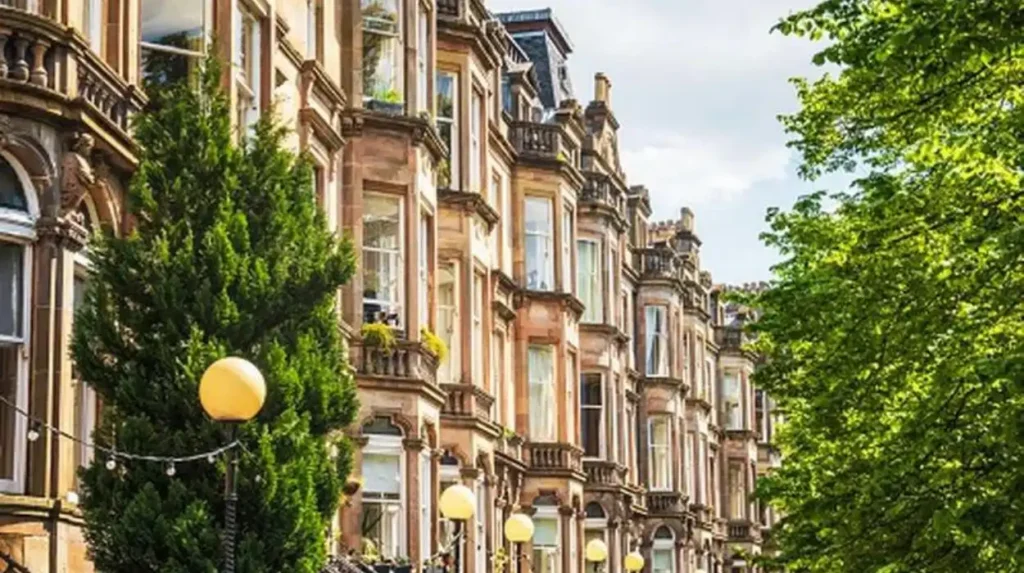
The West End includes areas such as Hillhead, Partick, Kelvinbridge and Hyndland. The area has strong access to the University of Glasgow, Subway stations, shops, restaurants and cultural venues.
The Southside includes districts such as Shawlands, Strathbungo, Pollokshields and Battlefield. These areas contain substantial traditional tenement housing alongside newer residential developments.
The city centre has a significant apartment market, including modern developments and converted properties. City-centre flats appeal to buyers prioritising proximity to offices, universities, transport, restaurants and cultural attractions.
Other districts offer different combinations of affordability, housing stock and transport access. Buyers should therefore compare individual neighbourhoods rather than treating Glasgow as one uniform housing market.
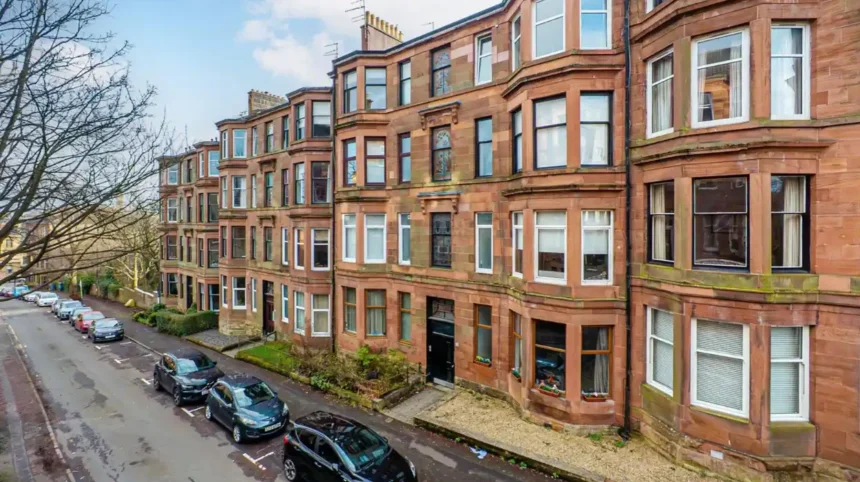
Property type also influences long-term costs. Traditional tenement flats can offer substantial floor space and period character, but buyers need to examine roof condition, stonework, common stair maintenance and communal repairs.
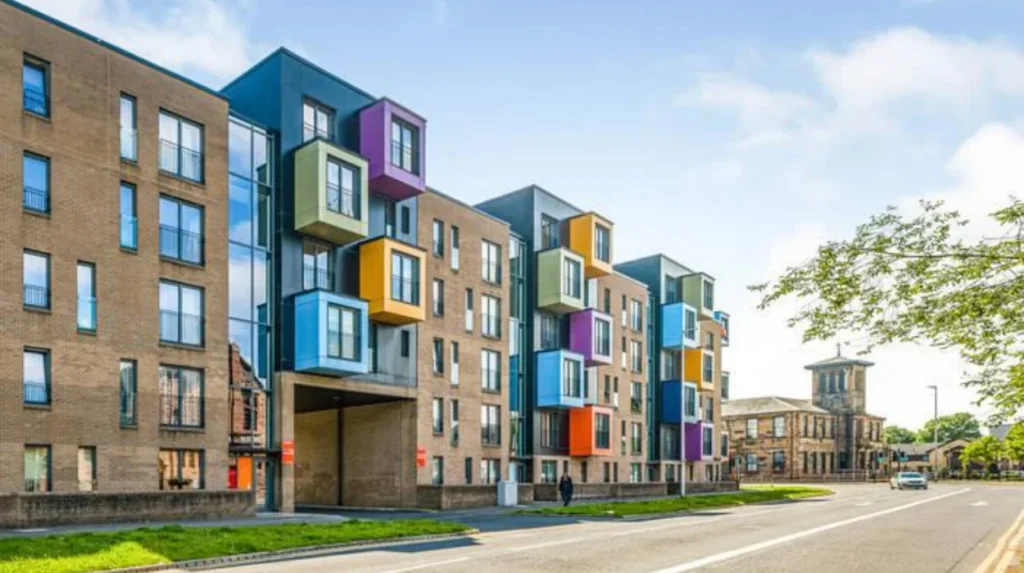
Modern apartment buildings can provide lifts, secure entrances, communal facilities and newer building systems, but factoring charges can be higher.
Transport accessibility is another relevant factor. Flats close to rail stations, Subway stations and major bus routes can attract strong demand from commuters, students and city-centre workers.
The appropriate Glasgow flat is therefore determined by more than its purchase price. Location, building quality, recurring charges and resale demand all form part of the investment and ownership decision.
Explore More Area Guide
Glasgow East End Safety: What Locals Think Now
Glasgow Crime Rate vs Manchester: 2026 Comparison
What is the long-term outlook for Glasgow flat buyers?
The long-term Glasgow outlook remains supported by employment, education, population demand and the city’s role as Scotland’s largest urban economy. Short-term conditions remain sensitive to interest rates, inflation and economic growth, making affordability and property quality more important than timing alone.
Glasgow’s housing market entered 2026 with positive price momentum. Official figures show the city average rising 3.9% over the year to June 2026, compared with 2.3% across Scotland.
However, market growth is not uniform. Flats recorded 2.9% annual growth, demonstrating that different property categories are responding differently to demand and affordability conditions.
Rettie’s 2026 Scottish market research described the wider market as relatively subdued and expected broadly flat conditions during 2026, citing economic uncertainty and interest-rate risks.
This creates a market where buyers need to distinguish between rising headline prices and actual value.
A well-maintained flat in a strong location with reasonable factoring costs, good transport access and a competitive Home Report valuation has different prospects from a poorly maintained building with significant communal liabilities.
Long-term ownership also changes the importance of short-term fluctuations. Property transaction costs make frequent buying and selling expensive. A purchaser planning to remain in Glasgow for several years has more time to absorb normal market cycles than a purchaser expecting to sell within a short period.
Future mortgage costs will also remain important. The Bank of England’s monetary policy decisions will influence the broader borrowing environment, although individual mortgage rates will continue to depend on lenders and borrower circumstances.
The next scheduled Bank of England monetary policy decision is 17 September 2026.
For Glasgow flat buyers, the central issue is therefore not simply whether prices are rising. The more useful question is whether the property represents sustainable value at a mortgage payment the buyer can comfortably afford.
What does the current Glasgow flat market mean for buyers?
The current Glasgow market supports careful buying rather than rushed buying. Prices are rising, flat growth is moderate, mortgage borrowing remains active and average flat prices remain below other property categories. Buyers should prioritise affordability, valuation, building condition and long-term suitability.
The latest evidence presents a balanced picture.
Glasgow’s average property price reached £194,000 in June 2026, representing 3.9% annual growth. The average flat and maisonette price was £163,000, with annual growth of 2.9%.
These figures show that rising Glasgow property prices do not automatically mean buyers have missed the market. Flat prices remain substantially below the average prices of detached, semi-detached and terraced homes.
Mortgage conditions remain a major consideration. Bank Rate was 3.75% in July 2026, while the Bank of England continued monitoring inflation and economic risks.
A buyer should therefore establish a realistic maximum purchase price before viewing properties. The calculation should include the deposit, mortgage payment, LBTT where applicable, legal costs, moving costs, insurance, council tax, factoring and likely maintenance.
The Scottish buying system also makes the Home Report particularly valuable. Buyers can assess the survey, valuation, property questionnaire and energy report before making a formal offer.
For buyers who find a suitable flat within budget, the current market provides a valid opportunity to purchase. For buyers who are stretching their finances to match rising prices, waiting and improving affordability is the stronger approach.
The most reliable strategy is not to predict the exact month when Glasgow prices peak or fall. It is to identify a suitable property, establish its realistic market value, secure affordable finance and understand the full cost of ownership.
On the available evidence, 2026 is not a market that requires Glasgow flat buyers to rush, but it is also not a market that provides a clear reason to wait solely for a large price decline. The latest data show continued growth, particularly across the wider Glasgow market, while flat prices remain comparatively accessible.
For long-term owner-occupiers with stable finances, a well-valued Glasgow flat can therefore be a rational purchase in the current market. The quality of the individual property and the affordability of the mortgage matter more than attempting to time the market perfectly.
Is now a good time to buy a flat in Glasgow?
Yes. 2026 is a reasonable time to buy a Glasgow flat for buyers with secure finances, an affordable mortgage and a long-term ownership plan. Glasgow property prices are rising, while flat prices are increasing more moderately.