Key Points
- Major operators sign up: First Bus, McGill’s, and Stagecoach have confirmed participation in the £2 single bus fare cap across the Strathclyde region.
- Voluntary scheme framework: Transport Scotland confirmed that the initiative remains completely voluntary for private transport companies, which are free to join or opt out based on financial terms.
- Tight launch timeline: First Minister John Swinney announced the initiative during his Programme for Government speech on Tuesday, setting an immediate implementation date of Monday, 7 September 2026.
- Cross-regional scope: The cap applies across the Strathclyde Partnership for Transport (SPT) area, including Glasgow, Renfrewshire, Ayrshire, Dunbartonshire, Lanarkshire, and Inverclyde.
- Political backlash: Opposition figures and transport union representatives have raised concerns over the short notice given to operators and the voluntary nature of the policy, warning that uncommitted providers could lead to patchy coverage.
- Industry calls for wider investment: Industry body Confederation for Passenger Transport (CPT) noted that reduced fares alone will not address structural issues such as congestion and declining bus speeds.
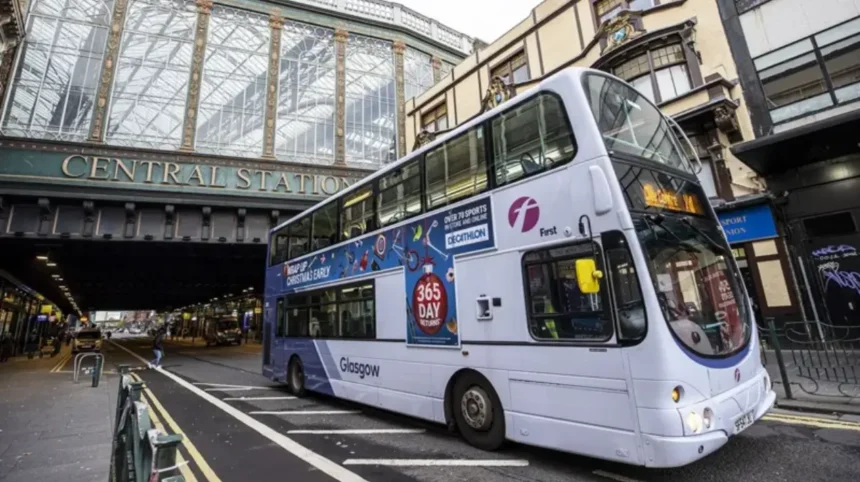
GLASGOW (Glasgow Express) September 3, 2026 — Three major bus operators in Glasgow and the West of Scotland have confirmed their participation in First Minister John Swinney’s voluntary £2 single fare cap scheme ahead of its planned launch on Monday. The announcements from First Bus, McGill’s, and Stagecoach offer a significant boost to the Scottish Government’s public transport policy, following concerns that a tight implementation window and the voluntary nature of the arrangement could lead to inconsistent availability across the region.
Which operators have agreed to the £2 fare cap?
As reported by The Herald, First Bus, McGill’s, and Stagecoach have confirmed they will support the scheme across the Strathclyde region starting Monday, 7 September 2026.
A spokesperson for First Bus stated:
“First Bus welcomes the expansion of the £2 single fare cap to the Strathclyde region by Transport Scotland… We will continue to work in partnership with national, regional and local government to ensure the £2 fare cap is a success and helps to keep current customers as well as attract new passengers to travel by bus”.
Similarly, a representative for McGill’s Buses affirmed their involvement, stating:
“We are pleased to confirm that McGill’s will be participating in the £2 bus fare cap scheme for the Strathclyde area recently announced by the First Minister. Our focus is now on ensuring the scheme is introduced smoothly on Monday 7th September and works effectively for passengers on all McGill’s buses operating in the Strathclyde area”.
Stagecoach has also confirmed its participation, noting that while single tickets will be capped at £2, its existing range of day, weekly, and longer-duration passes will remain available, as these may still offer better value for frequent travellers.
Why is the scheme described as voluntary?
Despite the headline announcement delivered during the First Minister’s Programme for Government address to Parliament, participation in the scheme is not legally mandatory for bus firms.
As reported by Chris McCall and Rachel Cronin of Glasgow Live, transport officials clarified that private operators are under no statutory obligation to enforce the cap. A spokesperson for Transport Scotland explained:
“We have engaged closely with bus operators on the £2 fare cap scheme and grant offer letters are now being issued. Participation in the scheme is voluntary and operators will make their own decisions on joining based on the terms offered”.
The framework relies on operators accepting state-funded grant agreements to offset the loss of revenue on longer routes, where standard single fares can otherwise reach £7 to £9.30.
How have political opposition and industry bodies responded?
The announcement met with significant scrutiny regarding the compressed timeline between the policy address and the public launch date.
As detailed by David Walker of the Scottish Daily Express, Scottish Labour transport spokesperson Daniel Johnson expressed concern over the lack of finalised agreements prior to the parliamentary announcement, stating:
“It beggars belief that the SNP hasn’t actually done the work to deliver its big announcement on bus fares. If the SNP government fails to deliver the fare cap promised by Monday it would be an astonishing broken promise and an appalling start to the new term. John Swinney must come clean and clarify exactly how many bus operators are signed up to the scheme so far”.
As reported by The Herald, Reform UK MSP Graham Simpson highlighted potential confusion for passengers, warning that
“we could end up with a situation on Monday next week that somebody goes and expects to pay £2 for their fare and they’re having to pay more”
if smaller local operators choose not to participate. Furthermore, Scottish Greens MSP Iris Duane raised concerns in parliament regarding the long-term stability of the measure, noting that because the cap is voluntary, participating providers “could also leave at any time”.
Representing the bus sector, Paul White, Director of the Confederation for Passenger Transport (CPT) Scotland, stated:
“The First Minister’s confirmation of a September 7 launch date comes before Transport Scotland has provided operators with an opportunity to review or commit to the scheme”. He added: “To deliver the reliable services passengers expect, we also need measures that keep buses out of congestion, improve journey times and reduce operating costs. Without action on bus speeds and reliability, a fares-only approach will not address the wider challenges facing the network”.
Explore More Local Glasgow News
Provanmill Road Closure to Bring September Roadworks Disruption: Glasgow 2026
Glasgow City Council Facing £110m Budget Gap: EY Audit Rating Glasgow 2026
Background of the particular development
The £2 regional fare cap represents the latest phase of the Scottish Government’s incremental approach to public transport subsidisation. The policy model was initially tested through a pilot scheme in the Highlands and Islands, which ministers cited as a success in encouraging regional travel.
Expanding the scheme to Glasgow and the wider West of Scotland—covering Renfrewshire, Ayrshire, Dunbartonshire, Lanarkshire, and Inverclyde—marks the first large-scale urban rollout of the initiative in Scotland.
This aligns with broader Scottish National Party (SNP) manifesto commitments aimed at reducing travel costs to £2 nationwide by the conclusion of the current parliamentary term in 2031. Similar fixed-fare mechanisms have already been operational in various English regions, including Manchester, Liverpool, and London.
Prediction
The rollout of the £2 bus fare cap in the Strathclyde area is expected to directly impact commuters, regional bus operators, and local transport authorities in several distinct ways:
- For Bus Passengers and Commuters: Commuters travelling long distances into Glasgow from outlying areas such as Hamilton, Dumbarton, or Ayrshire stand to experience significant financial relief, with single-journey savings reaching up to 70 per cent on select routes. However, because participation is voluntary, passengers using smaller, independent operators that have not signed grant agreements may encounter a two-tier pricing system across the same geographical corridor.
- For Regional Bus Operators: Private firms will see increased passenger volumes, particularly on longer commuter lines. Nevertheless, operational margins will depend heavily on the accuracy and promptness of Transport Scotland’s grant subsidy reconciliations. Operators may also face capacity pressure during peak hours without immediate capital investment in fleet expansion or driver recruitment.
- For Local Authorities and Transport Infrastructure: While discounted fares incentivize public transit usage over private vehicle reliance, local transport networks may encounter bottlenecks if traffic management and bus-lane priority schemes are not updated alongside the fare reduction. As highlighted by industry representatives, without complementary infrastructure measures to combat urban congestion, reduced fares alone may lead to increased passenger demand on schedules vulnerable to operational delays.