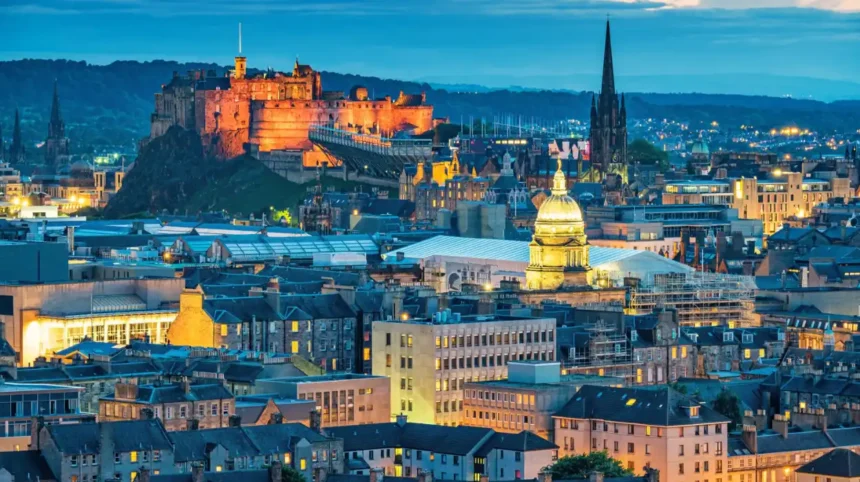
Moving to Scotland involves more than choosing a postcode. Glasgow and Edinburgh are Scotland’s two largest urban centres, but they differ in housing costs, employment structure, transport, architecture, geography, culture, population density and everyday lifestyle. The choice affects commuting patterns, household budgets, access to services and the type of neighbourhood available.
- Why are Glasgow and Edinburgh different places to live?
- How do Glasgow and Edinburgh compare in population and urban scale?
- Is Glasgow cheaper than Edinburgh for housing?
- Which city offers better transport for someone moving to Scotland?
- How different are Glasgow and Edinburgh for commuting?
- What are the main employment differences between Glasgow and Edinburgh?
- Is Glasgow more suitable for families than Edinburgh?
- How different are the city centres of Glasgow and Edinburgh?
- Which city has the stronger cultural and entertainment scene?
- How different is the natural environment around Glasgow and Edinburgh?
- What are the biggest advantages of Glasgow for someone moving to Scotland?
- What are the biggest advantages of Edinburgh for someone moving to Scotland?
- Should someone moving to Scotland choose Glasgow or Edinburgh?
- What should someone research before choosing between Glasgow and Edinburgh?
Glasgow is Scotland’s largest city by population. Edinburgh is the Scottish capital and a major centre for government, finance, tourism, education and professional services. National Records of Scotland estimated the Glasgow City population at 654,330 and the City of Edinburgh population at 531,370 on 30 June 2025. Glasgow therefore had about 123,000 more residents within its council boundary.
The two cities are also closely connected. ScotRail operates frequent services between Glasgow Queen Street and Edinburgh Waverley, with direct services providing a practical link between the two urban economies.
For someone moving to Scotland, the distinction is therefore not simply Glasgow versus Edinburgh. It is a decision between two different urban environments within the same national system.
Why are Glasgow and Edinburgh different places to live?
Glasgow is larger, more industrial in historical character and generally associated with broader residential districts, while Edinburgh is Scotland’s capital with a stronger administrative, financial and historic identity. Both provide major employment, education, transport, cultural and healthcare services.
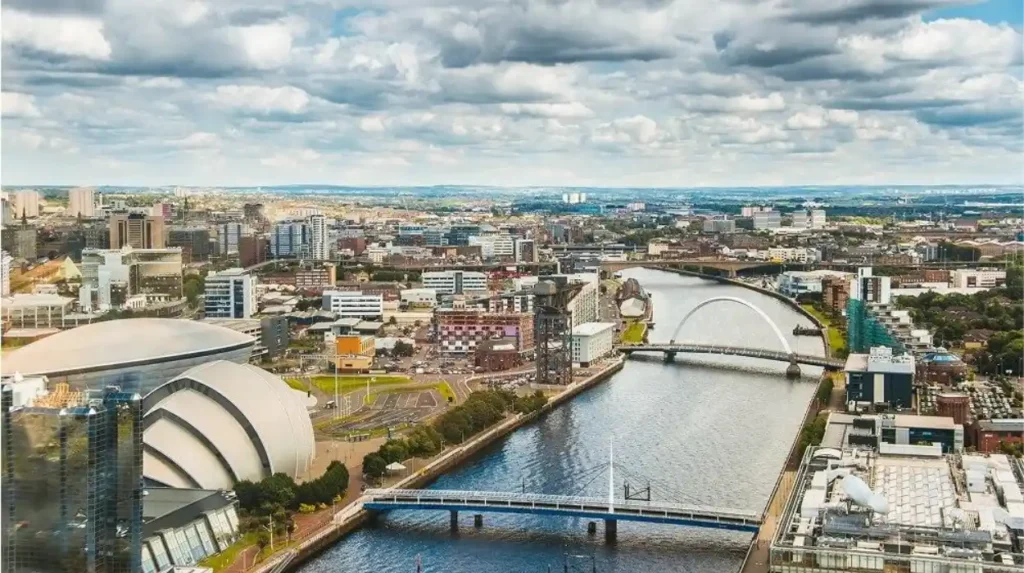
Glasgow developed as a major industrial and commercial city on the River Clyde. Shipbuilding, engineering, manufacturing and international trade shaped its economic history. The city later developed strong sectors in financial services, technology, education, healthcare, retail, tourism and creative industries.
Edinburgh developed around its medieval Old Town, New Town and political institutions. The city became Scotland’s capital and hosts the Scottish Parliament, the national government’s main institutions, major universities and an extensive financial-services sector.
The physical character is immediately different. Edinburgh contains prominent historic districts, steep streets and a compact central area. Glasgow has a larger continuous urban footprint and extensive residential neighbourhoods spreading beyond the city centre.
The distinction affects daily routines. Someone living in Glasgow can choose from dense city-centre accommodation, traditional tenement neighbourhoods, suburban districts and communities surrounding the council boundary. Edinburgh offers similar variety but has a particularly strong concentration of historic and high-demand central neighbourhoods.
Both cities are international destinations. Edinburgh has a particularly strong tourism economy because of its historic centre, festivals, castle and status as Scotland’s capital. Glasgow has a strong cultural economy centred on music, museums, galleries, events, universities and major sporting venues.
How do Glasgow and Edinburgh compare in population and urban scale?
Glasgow has the larger council-area population, with 654,330 residents at mid-2025 compared with 531,370 in Edinburgh. The difference gives Glasgow a broader urban population base, while Edinburgh remains a major compact capital with substantial employment and visitor activity.
National Records of Scotland recorded 654,330 residents in Glasgow City and 531,370 in the City of Edinburgh at mid-2025. Glasgow ranked first among Scotland’s 32 council areas by population, followed by Edinburgh at 531,370.
Population figures need careful interpretation because council boundaries do not represent the entire metropolitan areas. Glasgow’s wider urban region extends into neighbouring authorities including East Dunbartonshire, East Renfrewshire, Renfrewshire, North Lanarkshire and South Lanarkshire. Edinburgh’s wider commuter region extends into areas including West Lothian, Midlothian and East Lothian.
The population difference therefore does not mean Glasgow is simply 23% larger in every practical sense. It means the Glasgow City council area contains more residents.
Housing supply also reflects Glasgow’s scale. National Records of Scotland recorded 329,581 dwellings in Glasgow City in 2025, the highest number among Scotland’s 32 council areas.
This larger housing stock creates a wider range of neighbourhoods within the city boundary. Edinburgh has substantial housing stock as well, but central demand, historic building constraints and the city’s geography create a different residential environment.
For movers, the important issue is the relationship between population, housing supply and location. Glasgow offers a broad urban geography. Edinburgh offers a smaller council population with a particularly concentrated central economy.
Is Glasgow cheaper than Edinburgh for housing?
Glasgow generally has a lower residential property price level than Edinburgh, although prices vary substantially by neighbourhood and property type. Registers of Scotland recorded Edinburgh as Scotland’s highest-priced local authority in May 2026, with an average property price of £296,000.
Housing is one of the clearest practical differences between the cities.
Registers of Scotland reported an average residential property price of £196,000 across Scotland in May 2026. The City of Edinburgh recorded £296,000, making it the highest-priced local authority area in Scotland at that point.
The annual Property Market Report for 2025-26 provides another useful measure. Edinburgh had the highest median residential sale price among Scotland’s cities at £275,000. Glasgow had one of the largest volumes of transactions, with 11,305 residential sales, compared with 11,169 in Edinburgh.
These figures show an important difference between market size and market price. Glasgow and Edinburgh both have large residential markets, but Edinburgh commands a higher price level.
Property type also matters. Scotland-wide data for 2025-26 recorded a median price of £138,017 for flats and £324,995 for detached properties.
A person moving to Glasgow therefore has access to a broad range of flats, tenement properties, terraces and suburban houses across different price bands. Edinburgh also offers these property types, but central and well-connected locations frequently carry stronger price premiums.
Renters should evaluate the same factors. The exact rent depends on the neighbourhood, property size, furnishing, transport access and market conditions at the time of the move. A comparison between city averages alone does not identify the actual monthly cost of a specific home.
For buyers, Edinburgh requires a larger housing budget on the available evidence. Glasgow provides a broader opportunity to trade location, property size and price.
Which city offers better transport for someone moving to Scotland?
Glasgow and Edinburgh both have extensive public transport networks, but their systems are structured differently. Glasgow combines rail, subway and buses, while Edinburgh combines rail, tram and buses, with strong links to the airport and surrounding commuter areas.
Transport is a major consideration because the two cities function as connected but distinct employment centres.
Glasgow has a dense suburban rail network, the Glasgow Subway, extensive bus services and major stations including Glasgow Central and Glasgow Queen Street. The Subway provides a rapid-transit loop serving central Glasgow and western inner-city areas.
Edinburgh has an extensive bus network, national rail services through Edinburgh Waverley and Haymarket, and the Edinburgh Trams network. Edinburgh Trams provide a direct public transport connection between the city centre and Edinburgh Airport.
The railway connection between the two cities is particularly important for people who work across both locations. ScotRail timetable data shows regular services between Glasgow Queen Street and Edinburgh, with trains serving stations including Falkirk High and Edinburgh Waverley.
The journey is short enough to support regular intercity commuting, although the practical journey time depends on the specific service, station and final destination.
Transport Scotland’s statistics also demonstrate the scale of urban transport demand. In its 2024 Scottish Transport Statistics, Edinburgh recorded around 205.1 million passenger journeys across reported local public transport categories, while Glasgow recorded approximately 245.0 million in the corresponding data.
The best city therefore depends on where the workplace is located. A Glasgow-based worker benefits from Glasgow’s rail and Subway network. An Edinburgh-based worker benefits from Edinburgh’s rail, tram and bus structure.

How different are Glasgow and Edinburgh for commuting?
Glasgow is particularly practical for commuters across the west of Scotland, while Edinburgh is strongly connected to eastern Scotland and national institutions. Both cities support cross-city commuting through direct rail services, making either city viable for selected jobs based in the other.
Glasgow functions as the major employment hub for western Scotland. Its commuting catchment includes communities across Lanarkshire, Renfrewshire, East Dunbartonshire and East Renfrewshire.
Edinburgh serves as a major employment hub for eastern Scotland. Its commuting area includes West Lothian, Midlothian, East Lothian and parts of Fife.
The rail connection between Glasgow and Edinburgh adds another layer. Direct trains make cross-city commuting possible without changing trains on the main Glasgow Queen Street–Edinburgh route. ScotRail published timetable information showing frequent departures throughout the daytime.
Location within each city remains critical. Living close to a main station can reduce the total journey considerably. A home on the edge of a city can create a longer first or final section even when the intercity train itself is fast.
For hybrid workers, either city provides access to the other without requiring a permanent relocation. For office-based workers travelling five days a week, however, the total door-to-door journey matters more than the headline train duration.
What are the main employment differences between Glasgow and Edinburgh?
Edinburgh has a particularly strong concentration of government, financial services, professional services, tourism and technology, while Glasgow has major strengths in finance, healthcare, education, technology, creative industries, retail, engineering and advanced services.
Employment is one of the strongest reasons for choosing between the cities.
Edinburgh is Scotland’s political centre. The Scottish Parliament, established in 1999 and located at Holyrood, creates a substantial concentration of government-related employment. The city also has a major financial-services sector, professional-services firms, universities, technology businesses and tourism operations.
Glasgow has a broader industrial and commercial legacy. The River Clyde historically supported shipbuilding and heavy engineering. Modern Glasgow has a diversified economy covering financial services, healthcare, higher education, technology, retail, professional services, cultural industries and tourism.
The two universities illustrate the importance of higher education. The University of Glasgow publishes student population data across undergraduate, postgraduate taught and postgraduate research levels, demonstrating the scale of the university sector within the city.
Edinburgh is also a major university city. The University of Edinburgh contributes to education, research, medicine, technology and international academic activity.
For professionals, the correct comparison depends on occupation. A government, financial-services or policy career has a particularly strong Edinburgh connection. Healthcare, higher education, creative industries, engineering and a broad range of commercial roles have substantial Glasgow opportunities.
Neither city functions as a single-industry economy. Both have diversified employment bases.
Is Glasgow more suitable for families than Edinburgh?
Glasgow provides a large selection of family-oriented residential districts, schools, parks, transport links and larger homes across different price levels. Edinburgh also offers extensive family infrastructure, but housing costs and central property prices create a different affordability calculation.
Families moving to Scotland should compare neighbourhoods rather than cities alone.
Glasgow contains established residential areas with access to schools, parks, local shopping and rail services. Areas such as the West End, Southside and parts of the north and east provide different combinations of housing types and transport connections.
Edinburgh also contains extensive family neighbourhoods, including districts beyond the central historic core. The city has access to schools, parks, libraries, sports facilities and public transport.
Housing affordability is an important family consideration. Edinburgh’s higher property price level means a household seeking additional bedrooms or outdoor space requires a larger budget than for an equivalent property in many Glasgow locations.
Glasgow’s larger housing market creates more scope for comparing property size against commuting distance. A family can examine suburban locations while retaining access to the city centre through rail or bus connections.
The correct decision depends on school requirements, workplace location, property budget, childcare arrangements and transport needs. A city-wide reputation does not replace neighbourhood-level research.
How different are the city centres of Glasgow and Edinburgh?
Edinburgh’s centre is strongly defined by medieval and Georgian architecture, major historic landmarks and a compact topography, while Glasgow’s centre has Victorian commercial architecture, modern retail districts and a broader grid-based urban structure shaped by industrial expansion.
The architectural contrast is one of the most visible differences.
Edinburgh’s Old Town contains medieval street patterns and major landmarks including Edinburgh Castle and the Royal Mile. The New Town, largely developed from the late 18th century, contains planned Georgian streets and squares.
The historic centre forms part of the Old and New Towns of Edinburgh UNESCO World Heritage Site. This heritage status reflects the international importance of the city’s architectural and urban character.
Glasgow’s central area developed strongly during the industrial and commercial expansion of the 18th and 19th centuries. Victorian commercial buildings, warehouses, civic structures and large streets reflect the city’s role as a major industrial and trading centre.
Glasgow also has an internationally recognised design heritage associated with Charles Rennie Mackintosh, whose work forms an important part of the city’s cultural identity.
For someone moving to Scotland, the difference affects the daily environment. Edinburgh’s central streets contain unusually high concentrations of historic architecture and tourist attractions. Glasgow’s centre has a strong commercial, cultural and entertainment role with a different architectural pattern.
Both city centres provide shopping, restaurants, cultural institutions, offices and public transport.
Which city has the stronger cultural and entertainment scene?
Glasgow has a major live-music, arts and entertainment identity, while Edinburgh has an internationally recognised festival, heritage and performing-arts profile. Both cities provide museums, galleries, theatres, concerts, sporting events and year-round cultural programmes.
Glasgow is widely recognised for live music. The city contains major venues including Barrowland Ballroom, OVO Hydro and King Tut’s Wah Wah Hut, alongside theatres, galleries and independent cultural spaces.
The city also contains Kelvingrove Art Gallery and Museum, the Gallery of Modern Art and the Riverside Museum.
Edinburgh has an exceptional concentration of historic and performing-arts attractions. The city hosts the Edinburgh International Festival and the Edinburgh Festival Fringe, alongside other major annual festivals.
Edinburgh Castle, the National Museum of Scotland, the Scottish National Gallery and the Royal Mile form part of the city’s established visitor economy.
The cultural difference is therefore structural. Glasgow has a particularly strong music, contemporary arts and entertainment identity. Edinburgh has a particularly strong heritage, festival, literary and performing-arts identity.
Both cities provide year-round activities. A person moving to either city has extensive access to cultural institutions without needing to travel to another Scottish city.
How different is the natural environment around Glasgow and Edinburgh?
Glasgow provides quick access to the Clyde, Loch Lomond and western Scotland, while Edinburgh offers coastal areas, hills and countryside around the capital. Both cities provide parks and green spaces, but their surrounding landscapes differ significantly.
Glasgow sits on the River Clyde in western Scotland. Its location provides access to destinations across the west, including Loch Lomond and the wider Loch Lomond & The Trossachs National Park.
The city itself contains major green spaces such as Glasgow Green, Kelvingrove Park and Pollok Country Park.
Edinburgh has a distinctive relationship with hills and the coast. Arthur’s Seat, part of Holyrood Park, provides a prominent natural landscape close to the city centre. The city also has access to the Firth of Forth and coastal communities.
The geographic difference affects weekend travel and outdoor recreation. Glasgow is particularly well positioned for western Highlands access. Edinburgh provides straightforward access towards East Lothian, the Forth and eastern Scotland.
Both cities therefore provide urban living alongside access to outdoor environments.
What are the biggest advantages of Glasgow for someone moving to Scotland?
Glasgow’s main advantages include its larger population, extensive housing stock, major employment base, strong public transport, cultural diversity and comparatively lower residential property prices than Edinburgh. The city also provides direct rail connections to Edinburgh and western Scotland.
Glasgow offers a broad choice of residential environments. Its 329,581 dwellings in 2025 represented the largest dwelling stock of any Scottish council area.
The city also had the largest council population in Scotland at 654,330 in mid-2025.
Its housing market provides access to traditional tenements, flats, terraces and suburban houses. Property prices differ considerably by location, allowing movers to compare affordability with proximity to central employment.
Glasgow’s cultural infrastructure is another major feature. The city has established museums, galleries, music venues, universities, theatres and sporting facilities.
Transport provides another advantage. The Subway, extensive rail network and bus services create multiple ways to move around the metropolitan area.
For someone relocating without a fixed workplace, Glasgow therefore provides a broad employment and housing base.
What are the biggest advantages of Edinburgh for someone moving to Scotland?
Edinburgh’s main advantages include its capital-city employment base, strong professional-services economy, major universities, historic environment, international tourism sector, extensive public transport and proximity to eastern Scotland. Its central districts provide unusually concentrated access to national institutions and services.
Edinburgh’s capital status creates employment that is less concentrated in other Scottish cities. The Scottish Parliament and national government institutions provide a distinctive public-sector employment ecosystem.
The city also has a major financial-services sector and established professional-services industries.
Its universities contribute significant research and international connections. Tourism is another major economic component, supported by historic landmarks, festivals and cultural attractions.
Edinburgh’s transport infrastructure connects the city centre with the national rail network and airport. The tram network adds an important east-west transport corridor through the city.
Housing remains the key financial constraint. Registers of Scotland recorded Edinburgh as the highest-priced Scottish local authority in May 2026, at an average property price of £296,000.
For a household with a strong employment connection to Edinburgh, the higher housing cost needs to be evaluated against reduced commuting time.
Explore More Area Guide
Moving to Glasgow From London as a Young Professional
Glasgow Tenement Flats: What Buyers Should Check in 2026
Should someone moving to Scotland choose Glasgow or Edinburgh?
The better choice depends on employment location, housing budget, preferred urban environment, commuting requirements and access to specific services. Glasgow suits a broader urban housing market, while Edinburgh suits people prioritising capital-city employment, historic surroundings and eastern Scotland connectivity.
The decision should start with employment rather than tourism.
Someone working in central Edinburgh should first compare Edinburgh neighbourhoods and nearby commuter areas. Someone working in Glasgow should first examine Glasgow and its surrounding rail-connected communities.
Housing budget comes next. The available property evidence shows a clear price difference at city level, with Edinburgh recording a substantially higher average property price than the Scottish average and Glasgow supporting a larger housing market.
Transport then determines how practical the chosen home is. A property close to a rail, Subway, tram or major bus connection can significantly change the daily commuting experience.
Lifestyle factors should follow. Edinburgh provides a compact historic environment and capital-city setting. Glasgow provides a larger urban footprint, extensive neighbourhood diversity and a major cultural economy.
The two cities are not isolated choices. The direct railway connection between Glasgow Queen Street and Edinburgh Waverley creates a strong relationship between their employment and cultural economies.
For someone moving to Scotland, Glasgow and Edinburgh therefore represent two distinct versions of major-city life. Glasgow combines scale, housing choice, transport connectivity and cultural breadth. Edinburgh combines capital-city institutions, historic character, professional employment and international visibility.
The most reliable decision comes from comparing the actual workplace, monthly housing budget, required property size, preferred neighbourhood and daily transport route. City reputation provides context. Local conditions determine the practical outcome.
What should someone research before choosing between Glasgow and Edinburgh?
A relocation decision should compare housing costs, workplace location, commuting time, council services, neighbourhood facilities, schools where relevant, transport connections and property availability. Current local data provides a more accurate basis for choosing than general comparisons between the two cities.
A mover should establish the maximum monthly housing budget before selecting a city. Buyers should compare recent local property transactions rather than relying on national averages.
Registers of Scotland publishes monthly house-price statistics covering median and mean residential prices, sales volumes and market values.
The next step is mapping the daily commute. Glasgow Queen Street, Glasgow Central, Edinburgh Waverley and Haymarket are important rail hubs. The Glasgow Subway and Edinburgh Trams also create city-specific transport options.
Neighbourhood research should then examine local shopping, green space, schools, healthcare access and walking routes.
Finally, the decision should consider future flexibility. Scotland’s two largest cities are strongly connected economically and by rail. A person who starts in one city can retain access to employment and cultural opportunities in the other.
The central distinction is clear. Glasgow is the larger Scottish city by council population and has a larger housing stock, while Edinburgh is the capital and has a higher residential price level. National Records of Scotland’s 2025 estimates and Registers of Scotland’s 2025-26 property data provide the strongest current statistical foundation for understanding that difference.
For most movers, the choice is therefore determined by the interaction between housing, employment and transport. Glasgow offers greater scale and a broad urban housing market. Edinburgh offers capital-city employment, historic surroundings and strong eastern connectivity. Both provide major universities, cultural institutions, public transport, healthcare, green spaces and access to the wider Scottish economy.
Is Glasgow cheaper than Edinburgh for someone moving to Scotland?
Yes. Glasgow generally has lower residential property prices than Edinburgh. Registers of Scotland recorded Edinburgh as Scotland’s highest-priced local authority in May 2026, with an average property price of £296,000.