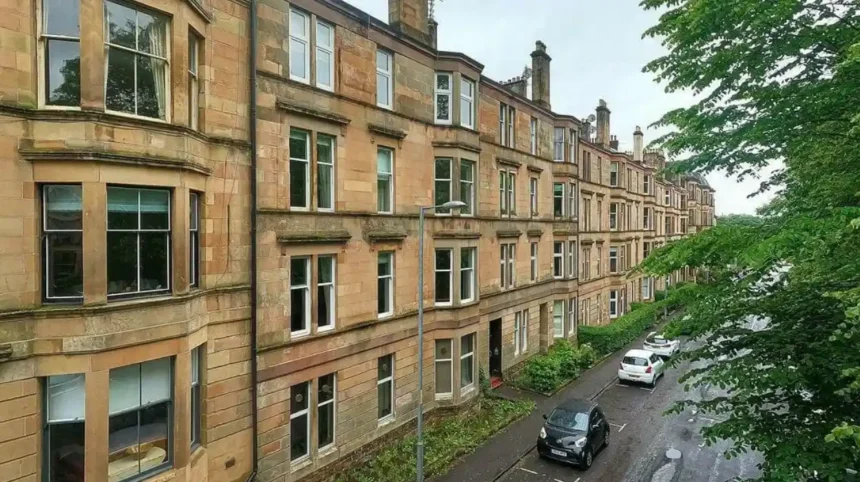
Glasgow tenement flats remain an important part of the city’s housing market and architectural identity. Their appeal comes from historic sandstone buildings, generous room proportions, established neighbourhoods, high ceilings, traditional features, and locations close to central Glasgow. Their age also creates specific ownership responsibilities. Buyers need to assess the flat itself, the shared building, title deeds, repair history, factoring arrangements, insurance, energy performance, and future maintenance liabilities before purchasing.
- Why are Glasgow tenement flats so popular?
- When were Glasgow’s traditional tenements built?
- What architectural features make Glasgow tenement flats distinctive?
- What should you check before buying a Glasgow tenement flat?
- How important are the roof, stonework and external walls?
- How should you check the communal close and stairwell?
- Why do title deeds matter so much in Glasgow tenements?
- What common repair liabilities should buyers investigate?
- How does a property factor affect tenement ownership?
- What should you check about building insurance?
- What should you check for damp and water damage?
- What should you check about windows and traditional features?
- What alterations should you investigate before buying?
- How should you assess the energy efficiency of a Glasgow tenement?
- What should buyers know about future repair costs?
- Which Glasgow locations are strongly associated with traditional tenements?
- Why should buyers inspect the whole building rather than only the flat?
- What is the best way to decide whether a Glasgow tenement flat is worth buying?
Why are Glasgow tenement flats so popular?
Glasgow tenement flats are popular because they combine historic architecture, spacious interiors, established neighbourhoods, traditional features, and central locations with relatively efficient apartment living. Their sandstone façades, high ceilings, large rooms, communal closes, and mature streetscapes create distinctive homes across many Glasgow neighbourhoods.
The traditional Glasgow tenement developed as an urban housing form during the city’s rapid population growth. Glasgow Life records that traditional tenements had emerged by the mid-19th century and commonly contained several storeys of flats accessed through a shared entrance and stair known as a close.
The buildings became a defining feature of Glasgow because they provided substantial numbers of homes within dense urban neighbourhoods. Their layout supported access to employment, shops, schools, public transport, churches, parks, and other city facilities.
Modern demand is also connected to the physical characteristics of many traditional flats. Rooms often have substantial floor areas, high ceilings, large windows, fireplaces, cornicing, timber flooring, and other period details. The exact features vary significantly according to construction date, location, renovation history, and individual ownership.
The term “tenement” has a wider legal meaning in Scotland. A tenement is a building containing two or more separate flats divided horizontally. This definition includes traditional sandstone buildings as well as newer apartment blocks, high-rise buildings, cottage flats, and buildings containing commercial premises.
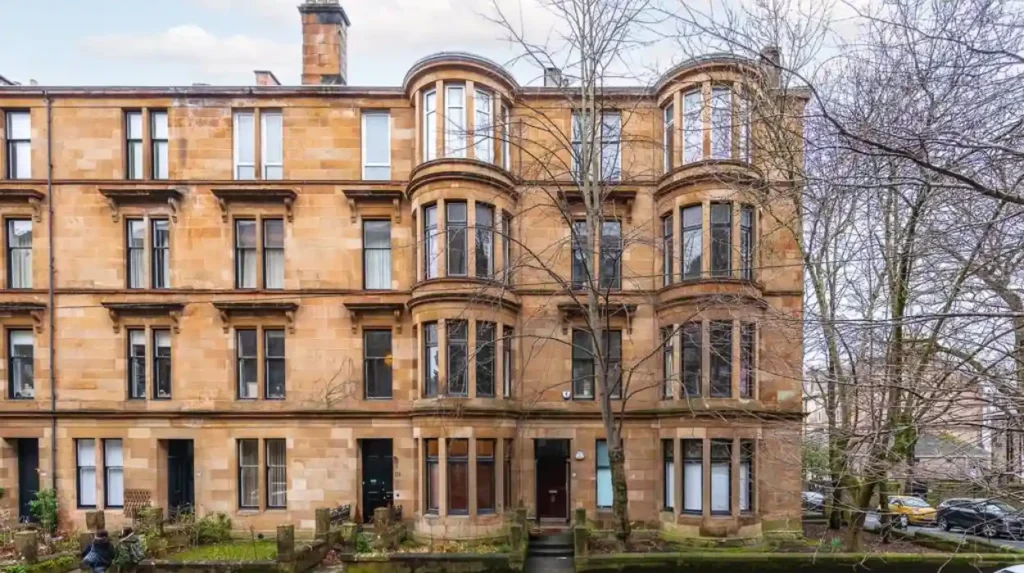
For buyers searching specifically for traditional Glasgow architecture, the classic sandstone tenement is the most recognisable form. Many examples contain three or four residential storeys, shared closes, rear courts, communal roofs, external walls, and shared structural elements.
When were Glasgow’s traditional tenements built?
Glasgow’s traditional tenements developed during the nineteenth century and expanded substantially from the late Victorian period into the early twentieth century. Buildings constructed between 1885 and 1920 are strongly represented in Glasgow’s architectural records, creating much of the city’s recognisable tenement streetscape.
Glasgow Life identifies the mid-19th century as the period when the traditional tenement form became established. The city’s population growth created intense demand for urban housing, particularly close to industrial employment and transport routes.
The 1866 Glasgow Improvement Act created an important intervention in the city’s housing history. Glasgow Corporation established the City Improvement Trust with powers to acquire properties and land, demolish unhealthy housing, create streets, and support replacement housing.
Housing conditions varied considerably during this period. Some early tenements were associated with overcrowding and poor sanitation, while later developments were constructed to higher standards. The City Improvement Trust itself constructed model tenements intended to demonstrate improved housing standards to private builders.
Architectural materials also changed over time. Glasgow’s older surviving tenements commonly use honey-blond sandstone. After improved railway connections from around 1890, sandstone from areas including Ayrshire and Dumfriesshire became more widely available, contributing to the red sandstone buildings seen across the city.
This historical development explains why two Glasgow tenements can look substantially different despite both being described as traditional sandstone properties. Construction period, architect, developer, neighbourhood, materials, and later alterations all influence the building.
What architectural features make Glasgow tenement flats distinctive?
Traditional Glasgow tenement flats commonly feature sandstone elevations, shared closes, high ceilings, large windows, generous rooms, timber floors, fireplaces, sash-and-case windows, and communal rear courts. The presence and condition of each feature depend on the building’s construction date and subsequent alterations.
Sandstone is one of the most important visual characteristics. Glasgow’s historic buildings commonly use blonde, grey, or red sandstone. Glasgow City Council conservation guidance emphasises that historic sandstone requires compatible repair materials because inappropriate pointing and stone treatments can damage the building fabric.
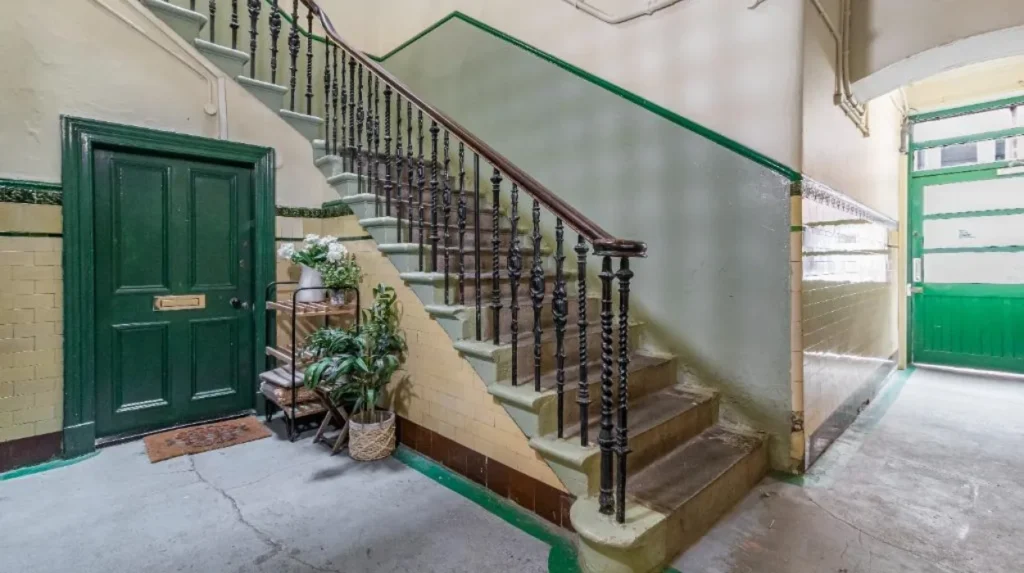
The close is another defining feature. It is the shared entrance and stair serving several flats. Traditional closes provide access to upper floors and form an important part of the building’s communal structure.
Large windows provide another characteristic feature. Traditional sash-and-case windows are particularly common in historic Glasgow properties. Where buildings sit within listed status or conservation areas, alterations can be subject to planning and conservation requirements. Glasgow City Council guidance promotes retaining and repairing traditional windows where practical.
High ceilings and large rooms contribute to the perception of space. Some flats contain separate front and rear rooms, long hallways, kitchens positioned toward the rear, and substantial storage areas. Internal layouts have often been altered over decades, so buyers should assess the current configuration rather than rely solely on historic descriptions.
Rear courts also form part of the traditional tenement environment. These spaces can include drying areas, gardens, bin facilities, storage structures, and access routes. Responsibility for these areas depends on the title deeds and the legal arrangements governing the building.
What should you check before buying a Glasgow tenement flat?
Before buying a Glasgow tenement flat, check the Home Report, structural condition, roof, stonework, windows, close, damp, services, title deeds, common repair liabilities, factoring arrangements, building insurance, alterations, energy performance, and any outstanding or planned major works affecting the building.
A tenement purchase requires assessment beyond the individual flat. Shared building elements can create financial responsibilities that affect every owner.
The first document to examine is the Scottish Home Report. A Home Report contains a Single Survey and valuation, Property Questionnaire, and Energy Report. The Single Survey provides information about condition, accessibility, repairs, and valuation.
The report should be read in detail rather than treated as a formality. Repair categories, visible defects, recommendations, and potential future work provide important information about the property’s condition.
A buyer should then inspect the building itself. Look at the roofline, chimneys, stone elevations, gutters, downpipes, windows, close, stairwell, rear court, basement areas, and visible structural elements.
The building inspection is particularly important because a well-presented interior does not establish the condition of the entire tenement.
How important are the roof, stonework and external walls?
The roof, external walls, foundations, load-bearing structures, and related common elements are critical parts of a Glasgow tenement because repair costs are normally shared between owners. Buyers should establish existing defects, planned works, repair history, and cost-sharing arrangements before committing.
Scottish Government guidance identifies the ground, foundations, external walls, roof, supporting roof structure, relevant gable walls, and load-bearing walls, beams or columns as common elements known as scheme property in specified circumstances.
Stonework deserves particular attention in Glasgow because historic sandstone requires appropriate maintenance. Cracked stone, open joints, failed pointing, staining, water penetration, damaged lintels, defective gutters, and deteriorating chimney masonry can all indicate maintenance requirements.
The roof should be checked for visible deterioration, water ingress, damaged coverings, defective flashing, chimney problems, and evidence of previous repairs. A surveyor should investigate concerns identified in the Home Report.
Gutters and downpipes are also important. Poor rainwater management directs water toward sandstone elevations and can accelerate deterioration.
Glasgow City Council conservation guidance states that historic stone repairs should use compatible materials matching the original masonry in relevant characteristics such as colour, texture, porosity, density, and coursing.
This matters financially because specialist repairs to traditional buildings require appropriate contractors and materials. A low-cost repair that traps moisture or damages historic stone does not provide an effective long-term solution.
How should you check the communal close and stairwell?
Inspect the communal close, stair, entrance doors, lighting, plasterwork, flooring, handrails, windows, electrical systems, ventilation, drainage, and general cleanliness. A poorly maintained close indicates wider management problems and requires investigation of repair responsibilities and planned expenditure.
The close is a shared part of the building and provides direct evidence about communal maintenance.
Check for cracked plaster, damp staining, water marks, damaged flooring, loose handrails, defective lighting, damaged doors, poor ventilation, and signs of recurring water penetration.
The condition of the entrance door also matters. In privately rented tenements, Scottish repairing-standard guidance specifically addresses safe access to common parts, including common closes and stairs.
A buyer should also establish who manages communal cleaning, lighting, repairs, insurance, gardening, and other shared services.
Where a property factor manages the building, request information about recent inspections, outstanding repairs, planned works, insurance, maintenance funds, and previous owner communications.
A clean close does not prove that the building has no liabilities. Conversely, minor cosmetic defects do not automatically indicate major structural problems. The relevant evidence comes from the Home Report, repair records, professional inspection, title documentation, and factor information.
Why do title deeds matter so much in Glasgow tenements?
Title deeds establish important ownership obligations within a tenement, including responsibility for common repairs, decision-making procedures, cost-sharing arrangements, and property burdens. Buyers should have their solicitor examine these provisions before purchase because building responsibilities vary between individual tenements.
Title deeds are central to understanding tenement ownership in Scotland. Government guidance states that owners should check their title deeds to establish responsibility for common repairs and how costs should be allocated.
These obligations are commonly referred to as real burdens. They form part of the legal conditions attached to ownership.
One Glasgow tenement can therefore operate under different arrangements from another building nearby. The title deeds can specify which owners maintain particular parts, how costs are divided, how decisions are made, and whether a property factor is required.
The Tenement Management Scheme provides statutory default rules when title deeds are silent, unclear, defective, or contradictory. It identifies scheme property, decision-making procedures, and cost-sharing arrangements.
Under the scheme, each property normally has one vote for scheme decisions. Where title deeds do not specify another cost-sharing arrangement, owners generally share maintenance costs equally, subject to specific exceptions including situations involving areas used by only some owners or significant differences in floor area.
A solicitor should therefore explain the actual title conditions affecting the specific flat rather than relying on assumptions about how Glasgow tenements normally operate.
What common repair liabilities should buyers investigate?
Buyers should investigate roof repairs, stonework, pointing, gutters, drainage, chimney repairs, close maintenance, structural defects, window work, insurance issues, and other shared projects. Existing repair notices and planned works can create substantial liabilities after completion.
Common repairs are one of the most important financial considerations when purchasing an older tenement.
A building can appear attractive while requiring major communal investment. The responsibility for the work does not disappear because the flat interior is recently renovated.
Ask for documentation covering recent and planned repairs. This includes invoices, contractor reports, survey reports, factor correspondence, repair notices, insurance claims, and records of owner decisions.
Check whether scaffolding has recently been erected or is planned. Scaffolding often accompanies external stone repairs, roof work, painting, pointing, window replacement, or structural investigation.
Glasgow City Council has operated statutory repair programmes involving primarily pre-1919 tenement properties. Council documentation states that owners remain responsible for the cost of statutory repairs even where the council intervenes to secure and repair buildings.
This makes historic repair records particularly important. A buyer should establish whether the building has received recent major works and whether further works remain outstanding.
How does a property factor affect tenement ownership?
A property factor manages shared building services such as roofs, external walls, stairwells, entrances, lifts, gardens, and maintenance contracts. Buyers should check the factor’s identity, fees, service statement, maintenance fund, insurance arrangements, repair history, and complaints record before purchasing.
A property factor is a company or organisation responsible for managing shared residential areas. Scottish Government information identifies common responsibilities including roofs, external walls, stairwells, entrances, lifts, shared gardens, and paths.
Factors can arrange repairs, organise inspections, manage building insurance, and coordinate contractors.
Their fees vary according to the building and services provided. Common charges include regular management fees, floats for routine repairs, and maintenance funds for larger projects.
All property factors in Scotland must be registered and follow the Property Factor Code of Conduct.
A buyer should therefore identify the factor before purchasing and review the written statement of services.
The factor’s financial information is also relevant. Ask whether owners have unpaid common charges, whether a maintenance fund exists, whether major works are being planned, and whether insurance claims remain unresolved.
The quality of management directly affects the practical experience of owning a tenement flat. Clear records, regular inspections, transparent finances, and organised repair programmes provide useful evidence about how the building is managed.
What should you check about building insurance?
Tenement owners need appropriate building insurance covering the shared structure and relevant communal risks. Buyers should confirm the current policy, insured value, excesses, claims history, policy exclusions, and how premiums are divided among owners before completing the purchase.
Building insurance is different from contents insurance. Building insurance covers the physical structure and specified risks under the policy.
In a factored tenement, the factor commonly arranges the building insurance. Scottish Government guidance states that property factors must arrange appropriate building insurance and provide proof of insurance when requested.
Request the current policy schedule and check the insured amount.
Ask about previous claims involving water damage, roof problems, structural issues, fire, or other building defects. A history of repeated claims requires careful investigation.
Also establish the policy excess. A large excess can create significant costs following an insured event.
The title deeds and factor arrangements should clarify how insurance premiums and relevant excesses are allocated between owners.
What should you check for damp and water damage?
Damp inspection should cover ceilings, external walls, chimney breasts, window surrounds, skirting boards, floors, kitchens, bathrooms, and areas beneath gutters. Water staining requires investigation because roof, masonry, plumbing, condensation, and drainage problems have different causes and repair requirements.
Damp is particularly important in older sandstone buildings because moisture can enter through defective gutters, roofs, pointing, windows, external masonry, plumbing, or internal condensation.
Look for brown or yellow staining, peeling finishes, mould growth, damaged plaster, salt deposits, swollen timber, deteriorated skirting boards, and musty smells.
Pay attention to chimney breasts and external walls. These areas can show historic or ongoing moisture problems.
Window surrounds also deserve inspection. Defective external pointing, failed seals, damaged frames, and poor rainwater management can allow water into internal finishes.
Do not assume that fresh paint represents a permanent repair. A surveyor should identify whether staining indicates an active defect or historic damage.
The Home Report’s Single Survey is an important starting point, but significant concerns require further professional investigation and cost estimates.
What should you check about windows and traditional features?
Check whether original windows, doors, fireplaces, cornicing, flooring, shutters, and other traditional features remain, and establish their condition and replacement requirements. Listed buildings and conservation areas can impose additional controls on external alterations and replacement windows.
Traditional features contribute strongly to the character of Glasgow tenements.
Sash-and-case windows are particularly associated with historic Scottish housing. Their condition should be assessed separately from their appearance.
Original timber windows can require repair, draught-proofing, repainting, or overhaul. Replacement windows can involve planning or conservation considerations depending on the building’s status and location.
Glasgow City Council guidance encourages retention and repair of traditional sash-and-case windows where possible. Where replacement is justified, the design and materials generally need to respect the original character in protected buildings and areas.
Internal features also deserve inspection. Original fireplaces, ceiling cornicing, timber flooring, panelled doors, shutters, and decorative plasterwork can form part of the property’s architectural character.
Buyers should distinguish between decorative value and structural condition. A period feature can require specialist maintenance without being structurally defective.
What alterations should you investigate before buying?
Investigate every significant alteration, including removed walls, converted kitchens, bathroom relocations, loft work, window changes, heating installations, electrical upgrades, and extensions. Check planning permissions, building warrants, completion certificates, and title documentation where applicable.
Older flats have frequently been altered by successive owners.
Some alterations improve functionality. Others affect structure, ventilation, services, fire separation, or communal building elements.
Ask the seller’s solicitor for information about alterations. The Home Report Property Questionnaire includes questions about alterations and extensions, specialist works, guarantees, and notices affecting the property.
A removed wall deserves particular attention in a tenement because load-bearing walls can form part of the building’s structural system.
Kitchen and bathroom alterations can also affect plumbing, ventilation, drainage, and neighbouring flats.
Window replacement is another important issue. External changes can affect the appearance and performance of a traditional building and can be subject to planning controls in protected areas.
Where documentation is missing, the buyer’s solicitor should establish what evidence is required before the transaction proceeds.
How should you assess the energy efficiency of a Glasgow tenement?
Assess energy efficiency through the Energy Performance Certificate, heating system, windows, insulation, ventilation, roof condition, and external fabric. Older tenements often require careful balancing of thermal improvement with moisture management and protection of traditional construction.
The Energy Report forms the third part of the Scottish Home Report. It includes an Energy Performance Certificate showing energy efficiency and estimated energy use for heating, lighting, and hot water.
Energy performance in traditional tenements depends on several interconnected factors.
Check the heating system, boiler age where relevant, controls, radiators, glazing, draught levels, insulation, and ventilation.
External wall insulation requires particular care in traditional masonry buildings. Glasgow’s historic stonework needs appropriate materials and moisture management.
Poor ventilation can create condensation and mould after energy-efficiency improvements if airflow is reduced without adequate ventilation measures.
The correct approach therefore considers the entire building envelope rather than focusing on one improvement in isolation.
What should buyers know about future repair costs?
Future repair costs are a core part of tenement ownership because roofs, stonework, external walls, foundations, chimneys, closes, and other shared components require periodic maintenance. Buyers should budget for routine charges and potential major communal works.
Tenement ownership involves shared financial responsibility.
The exact liability depends on title deeds, the Tenement Management Scheme where applicable, the factor agreement, and the part of the building requiring work.
A maintenance fund can help spread the cost of major repairs. Scottish Government guidance defines a sinking or reserve fund as money collected from homeowners to pay for major repairs, with arrangements normally set out in title deeds.
However, the existence of a maintenance fund does not guarantee that it covers future expenditure.
Ask how much is currently held, what projects are planned, and whether recent estimates exceed available funds.
Also establish whether any owner is in arrears with common charges. Outstanding contributions can complicate communal maintenance and affect the building’s finances.
A financially healthy tenement has clear records showing what owners pay, what the factor manages, which repairs have been completed, and which projects remain outstanding.
Which Glasgow locations are strongly associated with traditional tenements?
Traditional tenement housing is found across many established Glasgow neighbourhoods, including the West End, Southside, Dennistoun, the city centre, and other inner urban districts. Building quality, conservation status, repair history, transport access, and local amenities vary between streets.
The West End contains extensive examples of historic sandstone residential architecture. Areas around Hillhead, Partick, Dowanhill, Hyndland, and nearby neighbourhoods contain numerous traditional flats and architecturally distinctive streets.
Glasgow’s Southside also contains extensive sandstone tenement housing. Areas including Shawlands, Strathbungo, Pollokshields, Battlefield, and Crosshill contain different examples of Victorian and Edwardian residential architecture.
Dennistoun is another prominent tenement district, with large concentrations of traditional flats close to the city centre.
The city centre also contains historic residential buildings alongside commercial properties.
Location should not replace building-level due diligence. Two flats on the same street can have different title conditions, factors, repair histories, internal alterations, and structural conditions.
Explore More Area Guide
Glasgow SPT ZoneCard Savings Guide 2026
Best Facebook Groups for Glasgow Flats and Flatshares 2026
Why should buyers inspect the whole building rather than only the flat?
A Glasgow tenement flat is part of a larger shared structure, so the condition of the roof, stonework, foundations, close, drainage, chimney, windows, insurance, and communal finances directly affects ownership. A complete assessment therefore extends beyond the individual apartment.
This is the central principle of buying a tenement.
The individual flat represents only one component of the building. Common parts can generate repair bills even when the private interior is recently renovated.
Scottish Government guidance specifically states that owners should consult their title deeds to determine responsibilities for common areas. Where deeds do not provide workable arrangements, the Tenement Management Scheme supplies statutory procedures.
The Home Report establishes the property’s condition, but buyers should also examine communal records.
A professional inspection is particularly valuable when the Home Report identifies category 2 or category 3 repairs, structural concerns, damp, roof defects, or other significant issues.
The buyer should also ask questions before making a binding commitment. Evidence is more useful than assumptions.
What is the best way to decide whether a Glasgow tenement flat is worth buying?
A Glasgow tenement flat should be assessed through its location, price, internal condition, building condition, title obligations, repair history, factor arrangements, insurance, energy performance, and future expenditure. A sound decision requires evidence from documents and qualified professionals.
The appeal of Glasgow tenements rests on a combination of architectural character and practical urban housing.
Their historic construction gives many flats distinctive proportions and materials. Their established locations place residents close to employment, education, culture, transport, retail, parks, and local services.
The same historic construction creates ownership responsibilities.
The most important checks are therefore interconnected. A buyer needs the Home Report, title deeds, factor information, insurance documentation, repair records, planning and building-control information for relevant alterations, and professional advice where defects are identified.
The building’s communal condition deserves equal attention to the flat’s interior.
The legal framework also matters. The Tenements (Scotland) Act 2004 provides the Tenement Management Scheme for situations where title deeds are silent, unclear, defective, or contradictory.
Property factors are regulated through the Property Factors (Scotland) Act 2011 and the associated Code of Conduct. Registered factors must meet requirements covering communication, finances, insurance, repairs, maintenance, and complaints.
Glasgow’s traditional tenements therefore remain relevant housing assets, but their value is inseparable from building management and maintenance.
A well-maintained tenement with clear title arrangements, transparent communal finances, appropriate insurance, a sound repair history, and a properly assessed interior provides a materially different proposition from a flat in a building facing unresolved structural or communal problems.
For buyers, the essential principle is simple: assess the flat, then assess the building, then assess the legal and financial responsibilities attached to owning it.
Why are Glasgow tenement flats so popular?
Glasgow tenement flats are popular because of their historic sandstone architecture, high ceilings, spacious rooms, traditional features, established neighbourhoods, and convenient access to public transport, shops, schools, parks, employment areas, and city-centre facilities.