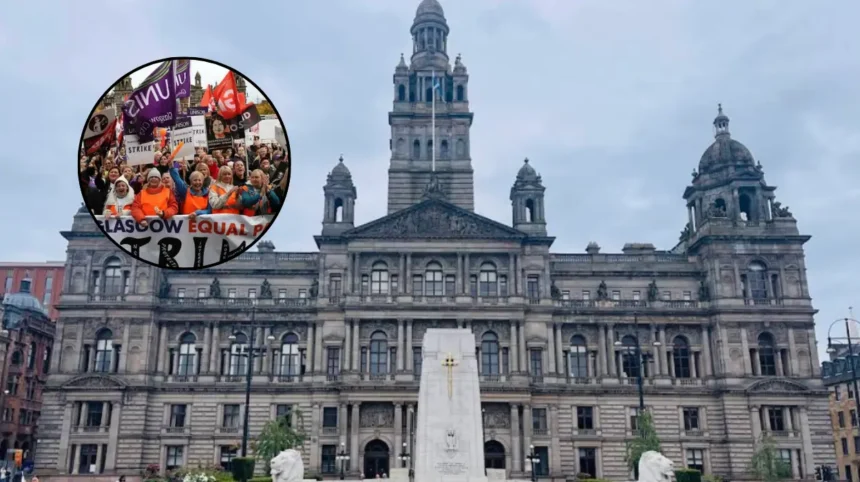
Key Points
- Glasgow City Council has proposed a new job evaluation scheme to bring a final end to its multi-million-pound, long-running equal pay dispute.
- While the majority of the municipal workforce is set to benefit or see pay remain stable under the new structure, hundreds of staff face significant earnings reductions.
- Trade unions representing the workforce warn that some individual employees could see their annual salaries slashed by as much as £10,000.
- The local authority has previously paid out approximately £770 million in compensation to thousands of mostly female workers who were systematically underpaid compared to male peers in equivalent roles.
- Former pay discrimination affected workers in traditionally female-dominated roles—such as catering, home care, and cleaning—who received up to £3 an hour less than colleagues in male-dominated roles like refuse collection and street sweeping.
- The proposed changes aim to introduce a fully non-discriminatory pay and grading system, but trade union representatives are raising strong concerns over the severe impact of pay losses on affected staff amidst ongoing living cost pressures.
Glasgow Council (Glasgow Express) August 17, 2026 – Hundreds of Glasgow City Council employees are facing substantial pay cuts under a newly proposed settlement structure designed to resolve the local authority’s long-running equal pay dispute once and for all. While official evaluations indicate that the majority of the council’s thousands-strong workforce will either receive a pay rise or experience no change in earnings, trade union representatives have highlighted that a significant minority of staff face severe wage reductions. According to statements from union officials, certain individuals could see their annual income slashed by up to £10,000 as the council implements a revised job grading framework aimed at ensuring pay parity across all municipal departments.
The overhaul comes after Glasgow City Council previously paid out approximately £770 million in back-pay and compensation packages to settle historic equal pay claims.
That earlier dispute established that female workers in female-dominated sectors—including catering, school cleaning, and home care—had for decades been systematically underpaid by up to £3 an hour compared to employees in male-dominated roles, such as refuse collection, graveyard maintenance, and street cleaning.
The new job evaluation scheme was commissioned to eliminate these historic disparities and ensure that every council post is graded strictly according to workload, responsibility, and operational conditions without gender bias.
However, the practical application of the updated evaluation criteria has resulted in lower grade placements for several specific operational posts across the authority.
Trade unions representing Glasgow City Council staff have raised serious concerns regarding the scale of the proposed income reductions. Union representatives have emphasized that while the overarching objective of achieving equal pay is universally supported, asking workers to absorb salary losses amounting to thousands of pounds per year during a period of sustained economic strain creates severe financial hardship for affected households.
Negotiations between council leadership and union leaders remain ongoing as both sides address the details of the proposed pay matrix.
Explore More Glasgow Council News
Glasgow City Council Proposes Pay Deal to End Dispute: Glasgow 2026
Glasgow City Council Staff Face Wage Cuts In Equal Pay Deal Glasgow 2026
What is the background to Glasgow City Council’s equal pay dispute?
The equal pay dispute within Glasgow City Council traces its roots back several decades, centered on the implementation of the 1999 “Single Status” agreement. Designed to establish a uniform, fair pay scale for all UK local government employees, the agreement was intended to evaluate jobs objectively and eradicate gender-based wage disparities.
When Glasgow City Council introduced its Workforce Pay and Governance Structure (WPGS) in 2006, the scheme failed to achieve these goals. Instead, it incorporated a system of bonuses and allowances that predominantly benefited male-dominated job roles, such as refuse collectors and grounds maintenance staff, while excluding female-dominated roles like catering staff, home carers, and cleaners.
In response, thousands of female workers, supported by trade unions including GMB, UNISON, and Unite, alongside independent legal representatives, launched legal challenges asserting that their work was of equal value to that of higher-paid male colleagues. For over a decade, the council contested these claims through employment tribunals and higher courts.
The legal tide turned decisively in 2017, when the Court of Session in Edinburgh ruled that the council’s WPGS framework was inherently discriminatory and lacked objective justification. Following a change in political leadership at the council, the local authority formally abandoned its legal resistance and committed to negotiating settlements.
To address the historic underpayment, Glasgow City Council negotiated a major compensation agreement in 2019, resulting in an initial settlement payout of over £500 million to around 14,000 current and former staff members. To fund this historic agreement, the council was required to mortgage several high-profile municipal assets, including the Emirates Arena, the Riverside Museum, and Kelvingrove Art Gallery and Museum.
A secondary wave of interim settlements was agreed in late 2022, bringing the total sum paid out by the local authority to approximately £770 million.
These interim payments were designed to cover ongoing claims until a completely new, non-discriminatory job evaluation system could be fully designed, audited, and implemented across the entire council workforce.
How will this development affect Glasgow City Council workers and the local authority?
The implementation of the revised pay scheme and its associated wage reductions will directly affect several key groups across the local authority, shaping both the municipal workforce and the council’s broader operations.
- Impact on Affected Council Employees: For the hundreds of staff whose positions face downgrading, the financial consequences are immediate and severe. A reduction in salary of up to £10,000 per year represents a fundamental shift in household finances, directly affecting living standards, mortgage or rent affordability, and pension contributions. Even with potential temporary pay protection arrangements—often used by local authorities to cushion income drops over a set period—these workers face a permanent reduction in their future earning capacity.
- Impact on Broader Municipal Workforce and Union Relations: The presence of significant salary cuts within the final settlement package risks fueling workplace friction and damaging morale across public services. While the majority of employees will gain or maintain their earnings, the severe losses suffered by hundreds of colleagues create complex dynamics within trade union memberships. Unions face the challenge of balancing overall progress on gender pay parity against the immediate harm experienced by individual members facing pay cuts, potentially leading to targeted industrial disputes, ballot actions, or further legal appeals regarding job protection.
- Impact on Glasgow City Council and Local Taxpayers: For Glasgow City Council, finalizing a fully compliant, non-discriminatory job evaluation system is an essential step toward achieving long-term financial stability and legal compliance. Successfully resolving the equal pay issue halts the endless accumulation of back-pay liabilities that have burdened the municipal budget for nearly two decades. However, the council must manage these structural changes while maintaining core public services and operating within tight financial constraints. The operational challenge will be retaining experienced staff in downgraded roles while managing the wider public and political reaction to wage reductions within the municipal workforce.