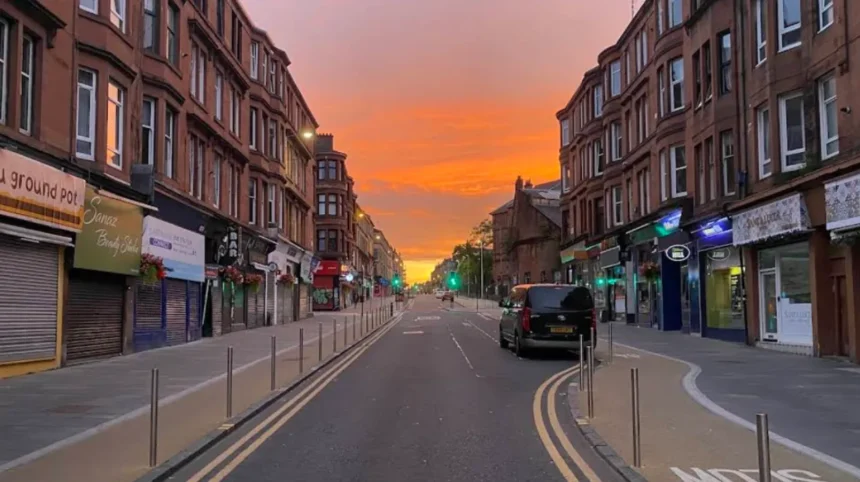
Raising children in Glasgow’s West End means higher housing costs, top-rated schools, and dense cultural amenities, while the Southside offers more space, lower rents, larger parks, and a stronger community feel for families. Both areas sit within Glasgow City Council, Scotland’s largest city by population, and provide distinct environments for family life. The West End centres on Byres Road, Hillhead, and Hyndland near the University of Glasgow. The Southside spans Shawlands, Pollokshields, Queen’s Park, and Pollok. Each district delivers different trade-offs in affordability, school access, green space, and daily logistics for parents.
- What are the West End and Southside of Glasgow?
- How do housing costs and types differ for families?
- Which area offers better primary and secondary schools?
- What parks and outdoor spaces are available for children?
- How do safety and crime rates compare for families?
- What childcare and family services exist in each area?
- How do transport links affect daily family routines?
- What cultural and community activities support child development?
- What are the long-term implications for family life and education outcomes?
- Which area suits different family profiles and priorities?
What are the West End and Southside of Glasgow?
The West End and Southside are two of Glasgow’s most prominent residential districts, defined by geography, housing stock, transport links, and community identity. The West End lies west of the city centre, bounded roughly by the River Kelvin, Great Western Road, and the M8 motorway. The Southside sits south of the River Clyde, stretching from Govanhill and Queen’s Park to Pollok and Shawlands. Both areas function as self-contained neighbourhoods with high streets, schools, parks, and leisure infrastructure that shape everyday family routines.
The West End is an affluent, densely built district known for Victorian and Edwardian tenements, independent shops, and cultural institutions like the University of Glasgow and Kelvingrove Art Gallery and Museum. Its population includes professionals, academics, and long-term residents, with a high concentration of private renters and homeowners. The Southside is more diverse in housing and demographics, mixing mid-20th century semi-detached homes, tenements, and newer builds. It includes both affluent pockets like Battlefield and Pollokshields and more deprived areas such as parts of Govanhill, according to Glasgow City Council demographic profiles.
How do housing costs and types differ for families?
West End housing costs significantly more than the Southside, with typical rents for family-sized flats 20–40% higher and purchase prices reflecting premium demand near schools and transport. As of 2026, average monthly rents in the West End range from £1,100 to £1,300 for a two-bedroom flat and £1,400 to £1,700 for a three-bedroom property. In the Southside, comparable rents run from £990 to £1,250 for two bedrooms and £1,150 to £1,600 for three bedrooms, with wider variation by postcode (G41, G42, G5).
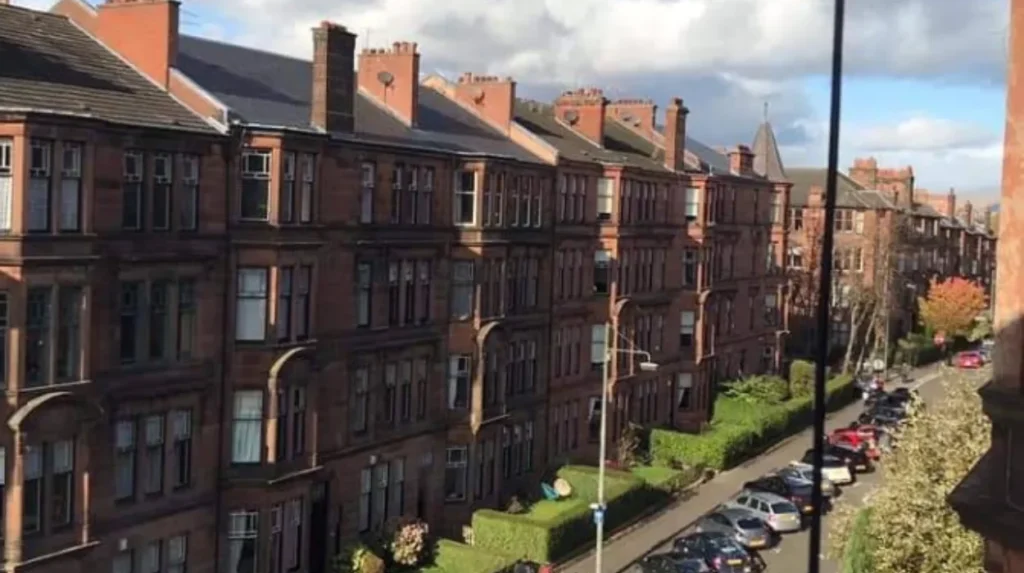
West End housing stock consists predominantly of tenement flats, often with high ceilings, period features, and shared entrances. Detached or semi-detached homes are rare and command premium prices. Families frequently live in converted flats or larger tenement apartments, sometimes with shared gardens or private courtyards. The Southside offers a broader mix: tenements in areas like Shawlands and Queen’s Park, plus substantial numbers of terraced and semi-detached houses with gardens in Pollokshields, Newlands, and Cathcart. This gives Southside families more options for outdoor space and quieter streets.
Purchase prices follow the same pattern. West End properties near Hyndland, Hillhead, and Kelvinside regularly exceed £300,000 for two-bedroom flats and surpass £500,000 for larger homes. Southside family homes in sought-after catchments like Pollokshields or Battlefield often range from £250,000 to £400,000, with more affordable options in Govanhill or Pollok. Council tax bands align with property values, meaning West End households typically pay higher annual charges.
Which area offers better primary and secondary schools?
Both the West End and Southside contain highly rated primary and secondary schools, but the West End has a denser concentration of top-performing primaries within walking distance, while the Southside offers strong options with larger catchments and more varied intake. Glasgow City Council operates a catchment-based school admission system, where children attend the local primary and secondary serving their postcode. Parents can request placements outside catchment, subject to capacity.
West End primaries include Hillhead Primary, Hyndland Primary, and Dowanhill Primary, all consistently rated highly by Education Scotland for attainment and pupil support. These schools serve compact, affluent catchments with high levels of parental engagement and stable enrolment. Secondary education centres on schools like Hillhead High School (serving much of the West End) and nearby independents such as The Glasgow Academy and Kelvinside Academy, which draw families seeking private options.
Southside primaries feature Shawlands Primary, Pollokshields Primary, and Queen’s Park Primary, each with strong community links and solid performance metrics. Some Southside primaries, particularly in Govanhill, serve more diverse and transient populations, which can affect attainment profiles but also enrich cultural exposure. Secondary schools include Shawlands Academy, one of Glasgow’s largest comprehensives, and St. Andrew’s Secondary in Pollokshields. Parents in the Southside also access private schools like St. Aloysius’ College or apply to city-wide options.
Transport to schools differs markedly. West End children often walk or cycle to school due to dense neighbourhood design and short distances. Southside families more frequently rely on buses, trains, or cars, especially where homes sit further from school gates. Glasgow City Council publishes interactive catchment maps showing exact boundaries for every nursery, primary, and secondary, enabling precise comparison before moving.
What parks and outdoor spaces are available for children?
The Southside provides larger, more varied parks with extensive playgrounds and sports facilities, while the West End offers smaller, centrally located green spaces integrated into dense urban fabric. Pollok Country Park, Queen’s Park, and Linn Park anchor the Southside, together covering hundreds of hectares with woodland walks, duck ponds, adventure playgrounds, and cycling paths. Pollok Park alone spans over 500 acres, hosting Highland cattle, the Burrell Collection museum, and multiple play areas suitable for all ages.
West End green space centres on Kelvingrove Park, Kelvinside Gardens, and the Botanic Gardens. Kelvingrove features a well-equipped playground, skate park, river views, and open lawns for ball games, all within walking distance of most West End homes. The Botanic Gardens offer glasshouses, themed gardens, and child-friendly events, though they lack large-scale play equipment. Dowanhill Park and Victoria Park provide additional neighbourhood options with swings, slides, and seating for parents.
Accessibility shapes daily use. West End parents can reach a park in under ten minutes on foot from most addresses, supporting spontaneous play and after-school routines. Southside families often drive or take buses to reach major parks, though neighbourhood parks like Holmlea Park or Bellahouston Park sit closer to residential streets. Both areas benefit from Glasgow’s “Green Network” strategy, which maintains paths, lighting, and safety features across public parks.
How do safety and crime rates compare for families?
Both the West End and Southside are generally safe for families, with low rates of serious violent crime, though the Southside shows higher recorded incidents of anti-social behaviour and property crime in specific postcodes. Glasgow City Police publish neighbourhood-level crime statistics showing that the West End records fewer total crimes per 1,000 residents than parts of the Southside, particularly in Govanhill and Pollok. However, perceived safety remains high in both areas, with parents reporting comfortable walking conditions during daylight and early evening hours.
West End streets benefit from high foot traffic, active shopfronts, and visible policing around universities and transport hubs, deterring opportunistic crime. Incidents tend to cluster around nightlife zones on weekend evenings, with minimal impact on residential blocks. Southside safety varies by street: Shawlands, Battlefield, and Pollokshields experience low crime levels, while parts of Govanhill and Pollok face challenges with drug-related activity and vehicle break-ins. Community policing initiatives and neighbourhood watch groups operate actively across both districts.
Road safety presents a different picture. The West End’s narrow, busy streets and high cyclist/pedestrian volumes require careful supervision near schools and shops. The Southside features wider roads and more cul-de-sacs in residential zones, reducing through-traffic but increasing car dependency. Glasgow City Council maintains 20 mph zones around all primary schools and has expanded traffic-calming measures in both areas since 2020.
What childcare and family services exist in each area?
Both the West End and Southside offer extensive childcare options, including council-run nurseries, private day-care centres, and community toddler groups, with the West End having higher density and the Southside offering more space and lower fees. Glasgow City Council provides 600 hours of funded early learning and childcare annually for all three- and four-year-olds, plus eligible two-year-olds, across both districts. Private nurseries operate in every major neighbourhood, with waiting lists common in high-demand West End catchments.
West End childcare includes established providers like West End Nursery, Little Scholars, and university-affiliated crèches serving academic staff. Soft play centres such as Go Bananas in Partick and indoor activity hubs cluster near Byres Road and Dumbarton Road. Parent-and-toddler groups meet in community halls, churches, and parks, often organised through local Facebook groups or Glasgow Family Info. The concentration of services supports working parents but increases competition for places.
Southside childcare spans Shawlands, Pollokshields, and Queen’s Park, with providers like See Saw Cafe, Bubbles Soft Play, and Glasgow Club leisure centres offering subsidized sessions. Fun Street at Silverburn Shopping Centre in Pollok ranks among the city’s largest indoor play venues, with free parking and extended hours. Community centres in Cathcart and Newlands host regular family sessions, often at lower cost than West End equivalents. The Southside’s larger venues accommodate bigger groups and birthday parties more easily.
How do transport links affect daily family routines?
The West End benefits from dense public transport coverage with subway, bus, and rail options within walking distance, while the Southside relies more on buses and trains with fewer subway connections, increasing car use for some families. Glasgow’s Subway serves the West End via Hillhead, Kelvinbridge, and Partick stations, connecting directly to the city centre in under fifteen minutes. Frequent bus routes run along Byres Road, Great Western Road, and Dumbarton Road, providing access to schools, shops, and hospitals without needing a car.
Southside transport centres on Shawlands, Pollokshaws, and Cathcart rail stations, linking to Glasgow Central and beyond via the Argyle and Cathcart Circle lines. Bus services cover major arteries like Pollokshaws Road and Victoria Road, though frequencies drop in evenings and weekends. The absence of subway coverage means longer journey times to the city centre for some Southside families, particularly those in Pollok or Govanhill. Car ownership rates are higher in the Southside, reflecting this gap.
Active travel differs by design. The West End’s compact layout supports walking and cycling to school, shops, and parks, with dedicated cycle lanes along key corridors. The Southside features wider roads and more greenway paths, such as the Pollok Country Park trails and the Clyde Walkway, but distances between destinations often require motorised transport. Glasgow City Council’s “20 Minute Neighbourhood” plan aims to improve local access in both areas by 2030.
What cultural and community activities support child development?
Both areas provide rich cultural experiences, with the West End offering museums, galleries, and university-led events, and the Southside delivering community festivals, sports clubs, and inclusive family programmes. The West End hosts Kelvingrove Art Gallery and Museum, Hunterian Museum, and Glasgow Science Centre, all within walking distance and offering free or low-cost family days. The University of Glasgow runs public lectures, music recitals, and children’s workshops that integrate families into academic life.
Southside culture emphasises community participation through events like the annual Shawlands Festival, Pollokshields Mela, and Queen’s Park summer fairs. Sports clubs flourish in local parks, with football, rugby, and athletics groups operating year-round. The Burrell Collection in Pollok Country Park provides art education in a parkland setting, while Glasgow Club leisure centres deliver affordable swimming, gymnastics, and dance classes across multiple Southside locations.
Community cohesion shapes experiences. West End families often engage through school networks, parent associations, and cultural institutions, creating tight-knit but sometimes transient circles due to student and professional turnover. Southside families build longer-term relationships through neighbourhood groups, faith communities, and local businesses, fostering stability and intergenerational support. Both models offer distinct advantages for child socialisation and parental well-being.
Explore More Area Guide
Is East Renfrewshire the Best Council Area for Glasgow Families?
How Do Glasgow School Catchment Areas Work and Why Do They Matter?
What are the long-term implications for family life and education outcomes?
Families in the West End typically benefit from higher academic attainment, greater access to cultural capital, and stronger university pathways, while Southside families gain from larger living spaces, lower financial stress, and deeper community roots. Research by the Scottish Government and Education Scotland links school performance to neighbourhood deprivation indices, with West End catchments consistently scoring higher on attainment metrics. However, Southside schools demonstrate strong value-added progress, particularly in diverse, multilingual settings.
Housing stability affects educational continuity. West End’s high costs can force families to move further out as children age, disrupting school placements and social networks. Southside affordability enables longer-term residence in the same catchment, supporting consistent friendships and parental involvement in school life. Both patterns influence GCSE and A-level choices, with West End students more likely to pursue academic routes and Southside students accessing vocational and creative pathways.
Social mobility operates differently across the two areas. West End children grow up surrounded by professionals, academics, and cultural institutions, normalising higher education and career aspirations. Southside children experience greater socioeconomic diversity, building resilience and adaptability in mixed environments. Glasgow City Council’s “Opportunity Areas” programme targets investment in both districts to narrow gaps in health, education, and employment by 2030.
Which area suits different family profiles and priorities?
The West End best fits families prioritising school proximity, cultural access, and car-free living, while the Southside suits those seeking space, affordability, and community-oriented lifestyles. Dual-income professional households with young children often choose the West End for its walkable schools, nurseries, and amenities, accepting higher costs for convenience. Families with older children, multiple kids, or budget constraints frequently prefer the Southside for larger homes, gardens, and lower monthly outlays.
Single parents and caregivers may find the Southside’s lower rents and community support networks more sustainable, especially where extended family live nearby. International families and academics gravitate to the West End for its global vibe, university links, and short commutes. Retired grandparents involved in childcare often favour the Southside for its quieter streets, parks, and slower pace compared to the West End’s bustling high streets.
Ultimately, both areas deliver high quality of life for children, with trade-offs rather than deficiencies. The West End excels in density, prestige, and cultural richness; the Southside leads in space, value, and community depth. Families should weigh school catchments, transport needs, housing budgets, and lifestyle preferences before choosing, using Glasgow City Council’s interactive maps and school reports to inform decisions.
Is Glasgow’s West End or Southside better for families?
It depends on your priorities. The West End offers highly rated schools, walkable neighbourhoods, and cultural attractions, while the Southside provides larger homes, lower housing costs, bigger parks, and a stronger community atmosphere.