Key Points
- Application Withdrawn: The owners of Tartan Lodge, Galsey Enterprises, have officially withdrawn their planning application to construct a multi-storey extension that would have doubled the capacity of the hostel on Alexandra Parade.
- Mass Objections: The proposal faced at least 53 official objections lodged with Glasgow City Council, including formal submissions from local politicians, the area’s community council, and surrounding residents.
- Police Interventions: Opponents disclosed that Police Scotland received 258 call-outs to the premises over a two-year period due to ongoing incidents of disorder, public drinking, aggressive behaviour, and suspected drug activity.
- Dual-Use Concerns: Whilst marketed online as a “boutique” venue for budget tourists, objectors noted that the property predominantly functions as temporary accommodation for homeless individuals.
- Heritage & Design Criticisms: Opponents slammed the proposed multi-storey extension for using red brick rather than matching red sandstone, arguing it compromised the historic character of the former 19th-century church and Masonic lodge.
Glasgow (Glasgow Express) July 30, 2026 – Plans to construct a substantial extension to a commercial hostel in the Dennistoun district of Glasgow have been formally withdrawn following widespread community opposition regarding rising anti-social behaviour, historic heritage concerns, and hundreds of emergency service call-outs.
- Key Points
- Why were the expansion plans for Tartan Lodge withdrawn by the developers?
- What concerns were raised by local politicians and Police Scotland call-out records?
- How did the community council and developers frame the proposal?
- Background of the particular development after the news
- Prediction: How this development can affect the local community, homeless services, and planning policies
Why were the expansion plans for Tartan Lodge withdrawn by the developers?
The owners of Tartan Lodge, trading under Galsey Enterprises, submitted a planning application to Glasgow City Council seeking permission to erect a multi-storey extension.
The proposed expansion aimed to add 16 new rooms, effectively doubling the existing guest capacity at the 235 Alexandra Parade address.
However, the council updated its online planning portal to confirm that the application had been officially withdrawn after facing an overwhelming wave of public and political resistance.
As reported by Drew Sandelands, Local Democracy Reporter for The Herald, and coverage published by the Glasgow Times, the withdrawal followed the submission of at least 53 formal objections from local residents, community groups, and elected representatives.
Objectors expressed serious apprehension that doubling the capacity of the site would exacerbate severe amenity issues in the surrounding residential streets.
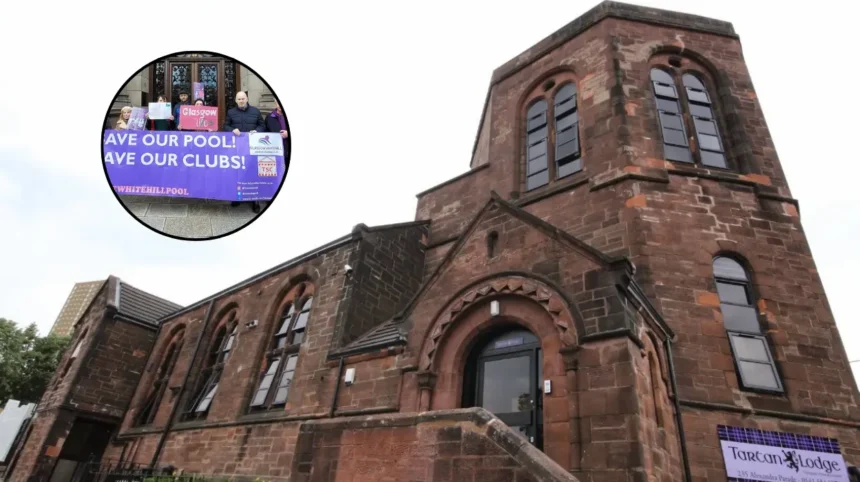
The hostel operates out of a converted 19th-century church and former Masonic Lodge, offering private en-suite double and twin rooms alongside shared dormitories. On its official website, Tartan Lodge describes its business as a “boutique hotel” and affordable option for budget and business travellers.
However, objectors highlighted that the premises predominantly function as emergency temporary accommodation for vulnerable homeless individuals managed in coordination with local authority services.
What concerns were raised by local politicians and Police Scotland call-out records?
Opponents of the application compiled evidence regarding the operational track record of the facility, revealing significant demands placed on local law enforcement.
As reported by Drew Sandelands of The Herald and local reporting in the Glasgow Times, Paul Sweeney, Scottish Labour MSP for Glasgow, submitted a comprehensive objection on behalf of a substantial number of his constituents. In his formal submission, Sweeney revealed that emergency services had been summoned to the property at an unprecedented rate.
As stated by Paul Sweeney MSP in his planning objection:
“Everyone deserves the opportunity to rebuild their lives in a safe, dignified environment. However, this application concerns the suitability of this specific site expansion, the capability of the operator to manage it, and the architectural impact of the proposal.”
Sweeney further detailed the extent of the disruption faced by the surrounding community:
“The existing operation has generated an unacceptable level of distress for neighbouring residents, culminating in a staggering 258 call-outs to Police Scotland. Residents regularly endure shouting, disorder, aggressive behaviour, public drinking, suspected drug-related activity, and constant loitering at all hours. The sheer volume of police interventions and the daily disruption faced by families and elderly residents conclusively prove that this site is currently neither safe nor pleasant.”
In addition to operational concerns, Sweeney criticised the architectural suitability of the extension. He noted that the plans proposed finishing the multi-storey extension in standard red brick rather than red sandstone, which failed to respect the historic character of the original Victorian structure. In a statement shared on social media following the portal update, Sweeney expressed relief that the decision had been taken to withdraw the extension plans.
Local government representatives responsible for social care policy also raised objections regarding management capacity.
As reported in The Herald, Councillor Allan Casey, Scottish National Party (SNP) representative for Dennistoun and Glasgow City Council’s city convener for homelessness, confirmed that neighbouring households had suffered severe loss of residential amenity.
Councillor Allan Casey stated in his formal representation:
“In their view, the cumulative impact of increasing activity at the site has the potential to further affect the character of the area.”
Casey noted that residents had repeatedly questioned the “effectiveness of the site’s current management” and voiced skepticism over whether an expanded facility would intensify longstanding community friction.
Additional objections were submitted by local Labour representatives Councillor Elaine McDougall and Bailie Ann Jenkins, who emphasized that families with young children and elderly residents felt their security and quality of life were directly compromised.
How did the community council and developers frame the proposal?
The local civic body, Dennistoun Community Council, lodged a formal objection asserting that the extension violated key local planning standards.
As quoted in the Glasgow Times, a spokesperson for Dennistoun Community Council stated:
“We object to the application on the grounds of unacceptable impact on residential amenity, local businesses, public safety, the character of the surrounding area, and increasing the existing use of the premises. The proposed flat-roofed extension is inappropriate in terms of scale, design, appearance and impact on the architectural and historical character of the existing building.”
The community council expressed further concern that expanding guest capacity without addressing existing operational management failures would compound difficulties for adjacent trade owners and households.
Conversely, the planning documents submitted by agents on behalf of the applicant, Galsey Enterprises, defended the project as an appropriate urban density enhancement.
According to the official application statement prepared for Galsey Enterprises, as cited by The Herald:
The proposal “represents a logical and sustainable development on an existing urban site.”
Despite the applicant’s position that the development aligned with sustainable urban infill principles, the accumulation of 53 statutory objections, adverse representations from homelessness conveners, and documented police intervention data led to the application being pulled prior to consideration by Glasgow City Council’s Planning Applications Committee.
Background of the particular development after the news
The withdrawal of the Tartan Lodge extension application takes place against the backdrop of an ongoing statutory homelessness crisis across Scotland, particularly within the local authority area of Glasgow City Council.
In recent years, severe shortages in social housing stock have forced local councils to rely heavily on private sector providers, commercial hostels, and budget hotels to fulfill their statutory duty to provide temporary emergency shelter to individuals and families facing homelessness.
Tartan Lodge, situated at 235 Alexandra Parade, occupies a prominent historic plot within the Dennistoun conservation area, originally designed as a 19th-century church and subsequently utilized as a Masonic Lodge.
While private hostel operators rely on commercial tourist bookings during peak seasons, long-term block bookings from municipal social work departments have become a primary revenue stream for private accommodation providers across urban centers.
This dual-use model—combining commercial tourist hostel marketing with unassisted, high-density temporary housing—has increasingly come under regulatory scrutiny across Glasgow.
Community groups and elected representatives have consistently argued that converting residential properties and boutique hostels into high-turnover temporary accommodation without specialized support services leads to management strain, increased emergency service call-outs, and significant friction with permanent neighbourhood populations.
Prediction: How this development can affect the local community, homeless services, and planning policies
The withdrawal of the Tartan Lodge expansion plan will directly impact three primary audiences: Dennistoun residents, local authority housing procurement teams, and commercial accommodation operators.
For the local residents and business owners of Dennistoun, the withdrawal represents an immediate halt to potential intensification of anti-social behaviour and overcrowding on Alexandra Parade. Neighborhood stability and residential amenity will remain at current baseline levels, avoiding the introduction of an additional 16 high-turnover rooms.
Furthermore, the outcome reinforces community council involvement in local planning decisions, establishing a clear precedent that historic architectural preservation and documented police call-out records carry substantial weight against unsuitable urban expansions.
For Glasgow City Council and homelessness support networks, the decision underscores an intensifying policy challenge.
As local authorities face mounting obligations to house vulnerable populations, the loss of potential expansion bed spaces at private sites restricts available temporary accommodation capacity within the city boundary.
This will likely push municipal authorities to seek alternative, purpose-built temporary facilities or rely on supported accommodation models that incorporate dedicated on-site healthcare and social work management, rather than unassisted private hostel environments.
For commercial hostel operators and private developers, this case signals a stricter application of National Planning Framework guidelines regarding residential amenity and building heritage.
Planning authorities are likely to exercise heightened scrutiny over applications seeking to expand temporary accommodation facilities within dense urban neighborhoods.
Developers will increasingly be required to demonstrate robust management plans, security strategies, and sympathetic architectural design before attempting to scale up capacity in mixed-use residential areas.