Key Points
- Union Street in Glasgow has fully reopened to pedestrians and vehicles after being closed for months following a major fire.
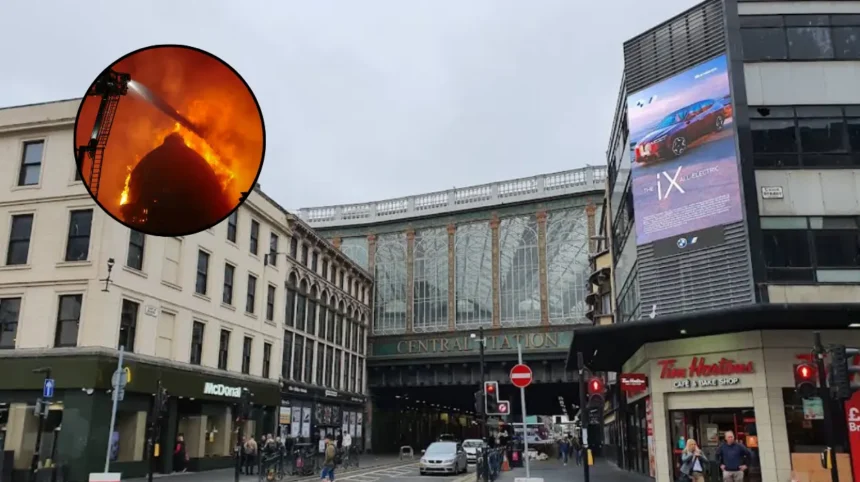
- The closure began after a fire on 8 March damaged a B-listed Victorian building at the junction of Union Street and Gordon Street.
- The reopening also includes the Union Street and Gordon Street entrances to Glasgow Central Station.
- The street is a major bus route in Glasgow city centre, so the reopening is significant for transport and access.
- The timing comes just ahead of the Commonwealth Games, which begin on 23 July.
- Deputy First Minister Jenny Gilruth said the fire had affected local businesses and operations at Glasgow Central Station.
- ScotRail managing director Joanne Maguire said the reopening was a “great day for staff and passengers”.
Glasgow (Glasgow Express) July 17, 2026 – Union Street has reopened fully after months of disruption caused by a fire that badly damaged a neighbouring B-listed Victorian building earlier this year.
As reported by BBC News, the road had been blocked off since the blaze on 8 March, with the closure affecting both everyday city-centre travel and access around Glasgow Central Station.
The reopening took place at 13:00 on Friday 17 July, with pedestrians and vehicles able to use the street again.
What did the fire do to the area?
The fire destroyed a historic building at the corner of Union Street and Gordon Street, leaving a long period of restriction around one of Glasgow’s busiest transport corridors.
BBC News reported that Union Street is a major bus route, so the closure had wider effects than a single roadblock, especially for commuters and station users.
The disruption also affected the entrances to Glasgow Central Station, which is Scotland’s busiest railway station, and forced a staged reopening process over several months.
How did the reopening happen?
The reopening of Union Street followed earlier partial returns to normal at Glasgow Central Station after the fire forced access changes and temporary restrictions.
Network Rail said the station’s full concourse reopened before the main street closure ended, while the Union Street and Gordon Street entrances were held back until the site was safe.
This phased approach reflected the need for demolition, safety checks and site clearance around the damaged building, which had been a live concern since March.
What did officials say?
Deputy First Minister Jenny Gilruth said the fire had “really impacted on a number of local businesses” and on the operations of Glasgow Central Station.
She added that the area now looked “dramatically different” from earlier in the year and said the reopening was happening as the city geared up for the Commonwealth Games.
Joanne Maguire, managing director of ScotRail, described it as a “great day for staff and passengers” and praised the work of Glasgow City Council, Network Rail Scotland and ScotRail colleagues.
Why does this matter for Glasgow?
The reopening restores a major bus corridor in the city centre and removes one of the most visible reminders of the March fire.
It also improves access to Glasgow Central Station for rail passengers, station staff and people using the surrounding streets for work, shopping or onward travel.
With the Commonwealth Games beginning on 23 July, the timing reduces pressure on local transport and helps the city present a more normal travel environment to visitors and residents.
What happened before this stage?
The fire on 8 March led to a major emergency response and a prolonged closure around the site as the damaged Victorian building was made safe.
BBC News reported that Glasgow Central initially reopened in stages, with some platforms and services returning before the main entrances and surrounding roads were restored.
By May, parts of the surrounding area had already begun reopening, showing a gradual return to normal before the final full reopening of Union Street in July.
What could this mean next?
For commuters, the reopening should mean easier bus movements, more direct station access and fewer detours through nearby streets.
For businesses in the area, the removal of barriers may help footfall recover after months of restricted access and reduced visibility.
For Commonwealth Games visitors and local residents, the change should make the city centre more navigable at a time when transport demand is likely to increase.
Background of this development
The key background is the fire that broke out on 8 March and damaged the building at Union Street and Gordon Street, triggering a chain of closures, repairs and safety checks.
That incident affected one of Glasgow’s most important transport locations, because the street sits beside Glasgow Central Station and serves as a main bus route through the city centre.
The reopening on 17 July marks the end of the most visible phase of disruption, although the broader recovery around the site followed a gradual, step-by-step process.
Prediction
This reopening is likely to ease pressure on Glasgow city centre traffic, improve passenger flow at Glasgow Central Station and support nearby businesses as the Games approach.
For regular commuters and station users, the biggest practical effect should be shorter and simpler journeys through the area, with fewer temporary route changes.
For the wider public, the event may also be seen as a sign that the city is returning to normal after a serious fire that disrupted both transport and local commerce.