
Key Points
- Full Reopening Date Confirmed: Glasgow Central station is scheduled to fully reopen all platforms on Wednesday, 25 March, following a partial closure lasting over two weeks.
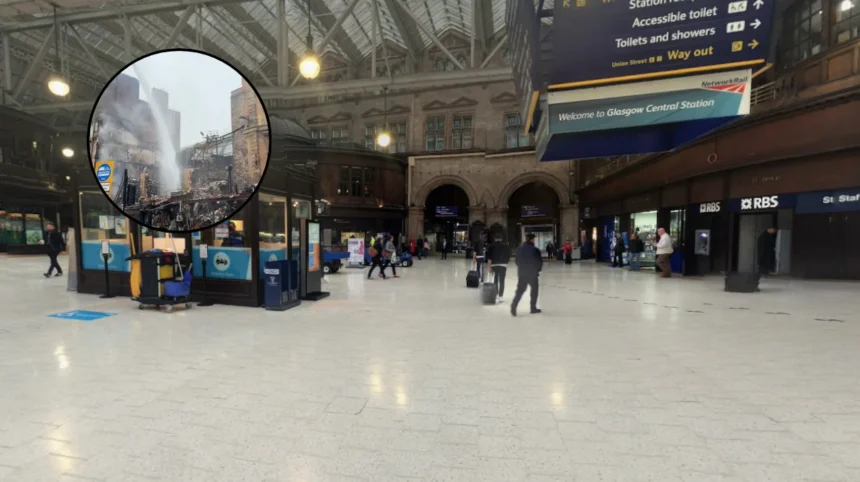
- The Incident: A major fire broke out in a vape shop on Union Street on Sunday, 8 March, spreading through the building and leaving only the Victorian facade standing at the Gordon Street junction.
- Phased Recovery: The low-level station reopened on 11 March. High-level platforms seven to 15 were reinstated on 18 March, while platforms one to six remained shut due to ongoing demolition work.
- Exclusion Zone Reduced: Significant progress by demolition teams has allowed officials to shrink the safety exclusion zone, clearing the way for full rail operations.
- All Operators Resuming: Services from ScotRail, Avanti West Coast, TransPennine Express, CrossCountry, and the Caledonian Sleeper will return to standard schedules at the hub.
Glasgow (Glasgow Express) July 9, 2026 – Scotland’s busiest railway hub will fully return to service this week after a disruptive, multi-week partial closure triggered by a catastrophic fire in an adjacent commercial building. Network Rail Scotland officially confirmed that all remaining high-level platforms are poised to reopen on Wednesday, 25 March, effectively restoring full capacity to the transport network more than a fortnight after the initial incident.
- Key Points
- What Caused the Interruption at Glasgow Central Station?
- How Was the Phased Reopening Strategy Managed by Network Rail?
- Which Train Operators and Passenger Services Are Affected by the Full Reopening?
- What Have Transport Officials Said About the Recovery Efforts?
- Background of the Glasgow Central Infrastructure and Union Street Commercial Zone
- Prediction: How the Full Reopening Will Affect Daily Commuters and the Regional Economy
The disruption began on Sunday, 8 March, when a major blaze erupted inside a vape shop located on Union Street. The fire quickly intensified, spreading extensively through the block and compromising the structural integrity of a prominent Victorian building at the junction with Gordon Street.
Because of the immediate collapse risk posed to the station’s immediate surroundings, transit authorities were forced to close off a significant section of the high-level concourse and establish a strict safety exclusion zone, which heavily impacted daily commuters and cross-border rail lines.
Over the last fortnight, engineering and demolition teams have worked continuously to dismantle the fire-ravaged wreckage while preserving public safety.
The phased recovery reached its first milestone on Wednesday, 11 March, when the low-level station reopened for local services.
One week later, on Wednesday, 18 March, engineers safely reinstated high-level platforms seven to 15. The final phase of the recovery plan will see the remaining platforms, numbered one to six, brought back into passenger service this Wednesday, marking the formal end of the emergency operational restrictions.
What Caused the Interruption at Glasgow Central Station?
The extensive disruption at the prominent terminal stems directly from the emergency response and subsequent structural complications caused by the 8 March commercial fire.
According to local emergency service logs, the fire originated within a retail vape outlet on Union Street before rapidly taking hold of the surrounding multi-storey property.
The fire spread around the corner of the block, gutting the interior of the historic Victorian building. The intensity of the flames destroyed the upper floors and roof system, leaving only the external masonry facade standing at the critical junction of Union Street and Gordon Street.
Because this unstable facade directly flanked the main pedestrian and rail approaches to Glasgow Central, structural engineers declared the immediate vicinity unsafe, necessitating the enforcement of a large exclusion zone that blocked access to platforms one through six.
How Was the Phased Reopening Strategy Managed by Network Rail?
To mitigate the impact on Scotland’s transport architecture, Network Rail Scotland implemented a tiered strategy to restore track access as quickly as demolition safety permitted.
The low-level lines, which run completely beneath the main high-level concourse and were shielded from the overhead structural hazards, were cleared to resume operations on Wednesday, 11 March, just three days after the fire.
Reopening the high-level platforms required a more cautious approach, dictated entirely by the progress of the demolition contractors working on the exterior Victorian shell.
By Wednesday, 18 March, workers had successfully stabilised enough of the surrounding area to allow platforms seven through 15 to safely accept trains.
Over the past several days, demolition teams achieved sufficient progress on the upper sections of the damaged building to warrant a further reduction of the exclusion zone perimeter. This definitive reduction has cleared the path for platforms one to six to follow suit exactly one week later.
Which Train Operators and Passenger Services Are Affected by the Full Reopening?
The successful reclamation of platforms one to six ensures that all major rail operators utilizing Glasgow Central can restore their standard timetables.
The partial closure forced operators to either cancel services, terminate journeys early at outer stations, or heavily consolidate schedules on the remaining open platforms.
Beginning Wednesday, 25 March, the fully cleared station will accommodate the complete resumption of normal services across the following operators:
- ScotRail: Restoring full capacity to regional commuter routes across west-central Scotland and links to Edinburgh.
- Avanti West Coast: Resuming standard arrivals and departures for long-distance services connecting Glasgow to London Euston via the West Coast Main Line.
- TransPennine Express: Re-establishing complete routes between western Scotland and destinations across the North of England.
- CrossCountry: Restoring long-distance cross-border connections extending through the Midlands to the South Coast of England.
- Caledonian Sleeper: Bringing overnight sleeper services back to their traditional departure platforms.
What Have Transport Officials Said About the Recovery Efforts?
As reported by transport correspondents covering the regional infrastructure recovery, officials have expressed gratitude for public cooperation during what has been a logistically complex emergency response.
Ross Moran, the route director for Network Rail Scotland, emphasized the strategic importance of the terminal and the intense focus required to bring it back to full capacity. In an official organizational statement, Moran noted:
“Glasgow Central is at the heart of the city and is Scotland’s busiest station, and we’ve been fully focused on getting everyone back safely. The aftermath of the fire has been a significant challenge for everyone involved, but our teams have been working tirelessly to restore the station and support our passengers, train operators and retailers.”
Moran further acknowledged the disruptions faced by the public over the seventeen-day ordeal, stating:
“I’d like to thank everyone for their patience and understanding. Their co-operation has made a difficult situation easier and we’re grateful for the support shown. Our priority now is to keep people moving safely and give everyone who relies on this station a smooth and welcoming experience on Wednesday.”
Background of the Glasgow Central Infrastructure and Union Street Commercial Zone
Glasgow Central station is a Category A listed architectural structure that originally opened to the public in 1879 under the Caledonian Railway company.
As the northern terminus of the West Coast Main Line, it serves as a critical artery for both Scottish domestic transport and UK-wide cross-border commerce, handling over thirty million passengers annually under normal operating conditions.
The station is integrated into Glasgow’s dense city centre, bounded tightly by Union Street, Gordon Street, and Hope Street.
The buildings lining these corridors are predominantly late-Victorian and Edwardian tenements and commercial properties, characterized by traditional sandstone facades and complex timber-framed internal configurations.
Over the past two decades, urban planners and fire safety experts have frequently highlighted the challenges of managing fire risks within these historic city blocks.
Because many of these buildings share contiguous party walls and roof spaces, localized fires can easily bypass modern containment measures if they breach the ceiling voids.
The specific building affected by the 8 March fire is typical of this urban layout, where ground-floor retail units operate beneath historic upper stories, creating intricate structural interdependencies with the adjacent railway infrastructure.
Prediction: How the Full Reopening Will Affect Daily Commuters and the Regional Economy
The transition back to a fully operational terminal on 25 March will immediately alleviate the severe logistical pressures experienced by roughly one hundred thousand daily commuters, business travellers, and regional retailers.
For the daily commuting public, the reopening eliminates the bottleneck of platform sharing that has caused cascading delays across the ScotRail network over the last two weeks. Passengers will no longer need to navigate modified timetables, short-noticed platform changes, or overcrowded substitute bus links.
Long-distance passengers traveling to England via Avanti or CrossCountry will experience fewer cancellations and a return to reliable, direct journey times, removing the necessity of transferring at peripheral stations.
For city-centre business owners, particularly retail operators located inside the Glasgow Central concourse and along the Gordon Street entrance, the full reopening represents a return to normal footfall.
The station’s retail tenants have reported sharp drops in revenue during the partial shutdown due to restricted pedestrian access and redirected passenger flows.
Furthermore, restoring full rail connectivity ensures that Glasgow’s central business district can recover its normal economic momentum, as workers and shoppers regain unrestricted access to the city’s primary transit gateway.