
Key Points
- Incident and Response: A crowd of local residents blocked Royston Road near the M8 on-slip in Glasgow for approximately 30 minutes on Friday evening.
- Catalyst for Protest: The demonstration was organized via social media following the arrest of a man in connection with an alleged sexual assault in the area.
- Community Demands: Organizers described the gathering as a peaceful protest meant to vocalize deep-seated concerns regarding the safety of women and children in the community, with residents chanting “enough is enough.”
- Police Intervention: Police Scotland officers negotiated with the demonstrators to relocate the protest further along the road, allowing vehicles to resume regular movement shortly after 7:00 pm.
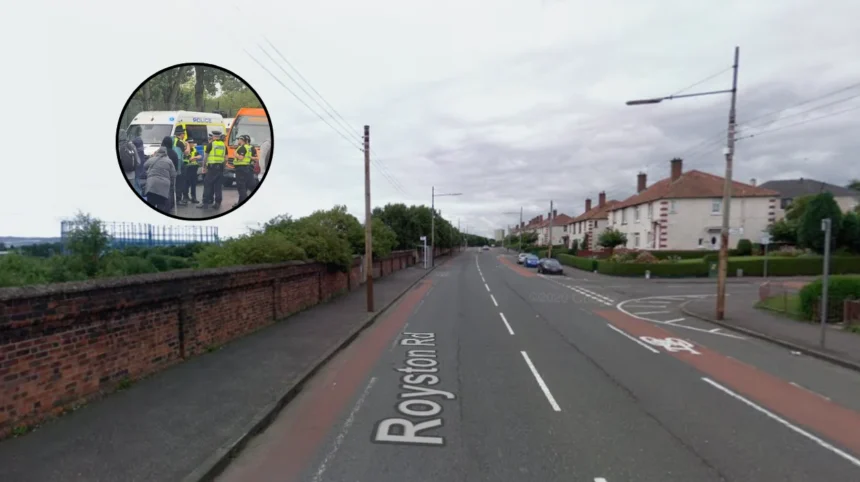
Glasgow (Glasgow Express) July 4, 2026 – A large group of angry protestors blocked a major Glasgow thoroughfare on Friday evening following the police arrest of a male suspect in connection with an alleged sexual assault in the local area. The demonstration, which saw residents march through the streets chanting “enough is enough,” forced the closure of Royston Road near the M8 motorway slip road, causing traffic disruption before police officers successfully negotiated a relocation of the crowd.
What Happened on Royston Road During the Glasgow Protest?
The public gathering formed rapidly on Friday afternoon after calls for collective action circulated widely across various social media platforms.
According to reports published by the Daily Record, the crowd initially assembled outside the Royston Library before launching a march toward Royston Road.
The sheer volume of demonstrators effectively halted the flow of local traffic, completely blocking the busy route for roughly 30 minutes.
Because the blockade occurred near the M8 on-slip, a vital junction for commuter traffic, police units were deployed to the scene to manage the disruption. Officers quickly established diversions for affected vehicles while the road remained closed to the public.
As the gridlock intensified, Police Scotland officers on the ground initiated direct dialogue with the protest organisers.
Through active negotiation, authorities managed to persuade the demonstrators to move their gathering further down the road, away from the critical motorway junction.
Following the successful relocation of the crowd, the road was declared safe for use, and regular traffic conditions resumed shortly after 7:00 pm.
No injuries or secondary arrests were immediately reported during the dispersal or subsequent relocation of the assembly.
Why Did the Royston Community Decide to Take to the Streets?
The demonstration was explicitly framed by its organisers as a peaceful protest born out of immediate panic and frustration regarding community safety. Local residents expressed an overwhelming sentiment that public spaces have become unsafe for vulnerable groups.
A social media post detailing the community’s collective stance stated:
“The Royston community took to the streets to say enough is enough as they expressed their concerns about the safety of women and children.”
Videos captured at the scene and shared across social networks verified the tense atmosphere, showing groups of residents standing in the path of oncoming traffic while shouting slogans to highlight their demands for increased protection and systemic accountability.
Background of the Royston Road Development
The spontaneous mobilization in Royston highlights an increasing reliance on neighborhood-centric social media networks to coordinate rapid-response public demonstrations in the United Kingdom.
Over the last several years, localized groups on platforms like Facebook, Nextdoor, and WhatsApp have changed how communities react to local criminal investigations.
Rather than waiting for formal updates from law enforcement or traditional media outlets, neighborhood factions frequently share real-time information—and occasionally unverified speculation—regarding ongoing police incidents.
Historically, public demonstrations concerning women’s safety in major Scottish urban centers like Glasgow and Edinburgh have been organized by established advocacy groups or student organizations, typically featuring planned routes and pre-approved council permits.
The shift toward flash-mob style blockades in residential neighborhoods represents a distinct tactical change.
This development emphasizes a growing impatience among local populations who feel that standard institutional responses to sexual offenses and neighborhood policing are moving too slowly to address immediate risks.
Prediction: How This Development Can Affect Local Residents and Commuters
This incident is highly likely to alter both community dynamics and daily logistics within the Royston area and the wider Glasgow district in several distinct ways:
- For Local Commuters: The targeting of the M8 motorway on-slip demonstrates that protestors recognize the strategic value of blocking vital transport arteries to maximize visibility. Commuters should prepare for unpredictable travel delays in the future, as secondary or copycat demonstrations regarding local grievances may use similar tactics to disrupt major transit corridors during peak evening hours.
- For the Local Neighborhood and Residents: The successful mobilization will likely embolden the Royston community to keep using public assembly as a tool for leverage. Residents can expect a heightened, more visible police presence in the coming weeks as authorities attempt to reassure the public and deter further civil disruption. However, if structural demands regarding street lighting, surveillance, and faster judicial processing are not visibly addressed, friction between local civilian groups and Police Scotland could intensify.
- For Local Advocacy Groups: This event establishes a precedent for rapid, decentralized organizing in Glasgow’s residential zones. It will likely force localized safety campaigns to pivot away from traditional town hall meetings and toward immediate, direct-action street protests to force quick responses from local council representatives.