Key Points
- Proposed Redevelopment: A planning application has been submitted to demolish existing commercial buildings at 93 to 113 St George’s Road in Glasgow to clear the path for a brand-new student housing complex.
- Current Site Occupiers: The targeted plot currently accommodates the Q Club Snooker Club, a Pure Gym branch, multiple office units, and separate local business entities.
- Facade Conservation: Plans dictate that the historical facade of St George’s Studios will be carefully retained and integrated into the new architectural structure.
- Project Specifications: The proposed development intends to deliver 314 student bedrooms alongside extensive communal amenities, including a yoga studio, standard gym, lounges, a lobby, and dedicated study zones.
- Living Space Dimensions: Architectural design documents outline that a typical studio flat will measure 18.5 square metres, fully equipped with a double bed, kitchenette, en suite bathroom, wardrobe storage, and a study desk or sofa area.
- Out-of-Term Strategy: The operational plan indicates that the accommodation will be repurposed for short-term lets and tourist stays during university holiday periods.
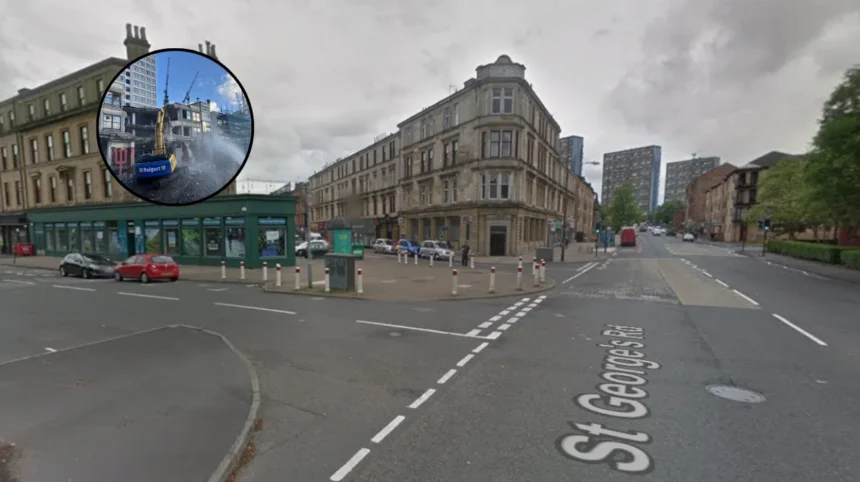
Glasgow (Glasgow Express) July 4, 2026 – A major planning application has been submitted to the Glasgow City Council detailing the partial demolition and sweeping redevelopment of a prominent commercial site directly overlooking the M8 motorway near Charing Cross. The proposal outlines the transformation of 93 to 113 St George’s Road into a high-density, purpose-built student accommodation complex capable of housing hundreds of university students.
- Key Points
- Will the Demolition of St George’s Road Buildings Solve Glasgow’s Student Housing Crisis?
- Which Iconic Businesses and Structures Face Demolition Under the New Charing Cross Masterplan?
- Background of the St George’s Road Development
- Predictions: How This Development Can Affect Local Residents and Businesses
The site, which currently acts as a bustling commercial footprint on the edge of the city centre, accommodates a variety of operating leisure and professional premises. Under the current structural roadmap, the existing buildings housing the popular Q Club Snooker Club, a Pure Gym fitness centre, and a selection of operational offices and local businesses will be torn down to facilitate the modern multi-storey construction.
Architectural blueprints submitted to the local authority reveal a design strategy that attempts to balance contemporary urban expansion with heritage conservation.
While the modern extensions and interior structures of the plot are earmarked for full demolition, the historic front facade of St George’s Studios is scheduled to be meticulously preserved and woven into the fabric of the new development.
This specific block will serve as the architectural anchor for the project, ensuring that the visual streetscape along St George’s Road retains its established character while the rear and adjacent sections undergo full modern adaptation.
The project intends to supply 314 self-contained student bedrooms to meet the city’s ongoing demand for higher education housing.
Beyond the individual living spaces, the development is designed as a full-service residential community. The internal layout maps out substantial floorspace dedicated to student welfare, health, and academic productivity.
According to the design specifications, the complex will feature an entrance lobby, a fully equipped modern gym, a separate yoga studio for wellness activities, communal resident lounges for social interaction, and quiet study rooms intended for individual and group university coursework.
Furthermore, the developers have outlined a commercial strategy extending beyond the traditional academic year, stating that all residential units will be made available for short-term stays, corporate bookings, and general tourist accommodation during the summer and winter term breaks.
Will the Demolition of St George’s Road Buildings Solve Glasgow’s Student Housing Crisis?
As detailed within the comprehensive design statement prepared by the project’s architectural team, the proposals involve the total
“redevelopment of land on St George’s Road, containing three existing buildings; an office building, a snooker hall and a gym.”
The documentation underscores an intentional pivot away from traditional commercial and recreational land use toward high-density residential spaces tailored specifically for the city’s expanding student demographic.
The documents submitted to the planning portal confirm that the typical studio configuration within the building will measure exactly 18.5 square metres.
Within this footprint, developers intend to maximise spatial efficiency by installing a double bed, a functional kitchenette for independent catering, an en suite shower and bathroom module, dedicated cupboard and wardrobe space, and a flexible zone accommodating either a study desk or a small sofa setup.
The planning layout asserts that these rooms are engineered to meet modern student expectations, focusing on self-sufficiency within a urban environment.
Which Iconic Businesses and Structures Face Demolition Under the New Charing Cross Masterplan?
The physical footprint of the proposed development encompasses a well-known stretch of real estate positioned right at the frontier of Glasgow’s city centre and the West End.
The loss of the Q Club Snooker Club will mark the closure of a long-standing recreational hub in the area, whilst the departure of Pure Gym will require local fitness members to seek alternative facilities.
The planning applications clarify that the demolition process will be highly selective to safeguard the most historically significant element of the plot.
The preservation of the St George’s Studios facade represents a critical compromise within the developer’s framework.
According to conservation statements embedded in the application, retaining the stone facade prevents the complete erasure of the area’s Victorian and early 20th-century architectural lineage.
By gutting the interior and clearing the less architecturally significant adjacent blocks—specifically the modern components housing the gym and office suites—the construction teams will have the clearance required to erect the 314-bed facility without completely breaking the visual continuity of the historic street wall.
Background of the St George’s Road Development
The proposed transition of the St George’s Road site from a commercial and leisure hub into a concentrated student residential block reflects a long-term shift in Glasgow’s urban planning priorities over the past decade.
The Charing Cross and M8 corridor has traditionally served as a buffer zone separating the commercial core of the city centre from the residential and academic sectors of the West End, home to the University of Glasgow. Historically, this sector accommodated low-to-medium-rise office spaces, local sports venues, and light commercial properties.
However, a sustained surge in international and domestic student enrolments at Glasgow’s major higher education institutions—including the University of Glasgow, Strathclyde University, and Glasgow Caledonian University—has placed unprecedented pressure on the city’s housing market.
Over the last ten years, local planning authorities have increasingly favoured Purpose-Built Student Accommodation (PBSA) over traditional commercial spaces to prevent students from saturating the private rental market, which has faced severe supply shortages.
The site at 93 to 113 St George’s Road became a prime target for redevelopment due to its immediate proximity to public transport links, such as the Charing Cross railway station and St George’s Cross Subway station, making it highly attractive to developers seeking to capitalise on student mobility.
Explore More Local Glasgow News
New Glasgow Traffic Stop Leads to Drug Charges, Weapons Case 2026
GCU Staff Strike Over Job Cuts in Glasgow 2026
Predictions: How This Development Can Affect Local Residents and Businesses
Should Glasgow City Council grant full planning permission for this project, the development will significantly alter the socio-economic dynamics of the St George’s Road and Charing Cross neighbourhoods.
For the local resident population, the introduction of 314 student bedrooms will dramatically alter the local demographic makeup, shifting the area toward a transient, youth-dominated populace.
The immediate benefit for permanent residents could be a stabilization of private rental prices in the surrounding West End and city centre tenement flats, as hundreds of students are redirected into dedicated institutional housing rather than competing for traditional flats.
Conversely, the increased density may lead to heightened pressure on local public amenities, waste management services, and pedestrian infrastructure, particularly along the narrow corridors spanning the M8 overpasses.
For the business community, the effects will be sharply divided:
- Recreational and Office Sectors: The immediate loss of the Q Club Snooker Club and Pure Gym removes footfall driven by local sports and fitness enthusiasts. Small businesses that relied on office workers from the current complex during daytime hours will experience a notable drop in weekday commercial activity.
- Retail and Hospitality Sectors: Conversely, the influx of over 300 full-time residents with disposable income will provide a major economic boost to local convenience stores, supermarkets, pubs, and casual dining outlets.
- The Tourism and Hospitality Market: The provision for out-of-term short-term lets will introduce a steady stream of seasonal tourists and short-stay visitors during summer months, directly competing with local budget hotels and established guest houses along the Charing Cross periphery.