
Yes, Glasgow is a highly viable and expanding hub for technology employment in 2026, offering robust job opportunities across software engineering, data analytics, and advanced manufacturing. The city balances competitive tech salaries with a significantly lower cost of living than London.
- How does the historical development of Glasgow and Edinburgh shape their tech sectors today?
- What are the primary technology sub-sectors driving job growth in Glasgow?
- What are the primary technology sub-sectors driving job growth in Edinburgh?
- How do technology salaries compare between Glasgow and Edinburgh in 2026?
- What is the difference in the cost of living and disposable income between both cities?
- Which city possesses the stronger technology startup ecosystem and funding network?
- How do the university systems in Glasgow and Edinburgh impact local tech job opportunities?
- What are the remote work and commuting dynamics between Glasgow and Edinburgh in 2026?
- How will government policies and future investments shape both tech hubs over the next decade?
Glasgow has successfully transitioned from its historical industrial identity into a modern, digitally driven economy. According to data from ScotlandIS, the trade body for Scotland’s digital technology industry, the technology sector across Scotland employs approximately 87,700 people across 10,395 registered businesses. Glasgow and Edinburgh jointly account for more than 52% of these active technology operations. This concentration forms a highly dense regional economic landscape known as the Central Belt tech corridor.
The structural foundation of the Glasgow technology sector relies on three distinct pillars: academic research pipelines, multinational engineering centers, and homegrown startup ecosystems. Institutions like the University of Glasgow and the University of Strathclyde produce over 3,000 computing and data science graduates annually. This continuous supply of entry-level professionals attracts major international employers.
Financially, technology professionals in Glasgow experience strong purchasing power. While the average technology salary in the United Kingdom ranges between £45,000 and £65,000 depending on specialism, Glasgow offers a median technology salary of approximately £52,500. When adjusted for local housing costs, which remain roughly 30% lower than in Edinburgh and 60% lower than in London, the real value of disposable income for workers in Glasgow is among the highest in the United Kingdom.
How does the historical development of Glasgow and Edinburgh shape their tech sectors today?
Glasgow evolved as an industrial, engineering, and manufacturing center, whereas Edinburgh developed as an administrative, financial, and legal capital. These distinct historical paths directly dictate that Glasgow dominates industrial technology and engineering, while Edinburgh leads in financial technology and commercial enterprise software.
During the nineteenth and early twentieth centuries, Glasgow served as a global center for heavy engineering and shipbuilding along the River Clyde. This legacy established a deeply ingrained culture of physical product design, complex systems architecture, and mechanical engineering. In contrast, Edinburgh functioned as the seat of the Scottish judiciary, major banking institutions, and insurance companies, including the Royal Bank of Scotland and Standard Life.
When the digital economy emerged in the late twentieth century, these legacy industries determined how computing resources were deployed in each city. Glasgow adapted its engineering expertise to focus on systems integration, space technology, defense electronics, and advanced informatics. Edinburgh applied its financial infrastructure to pioneer electronic trading, database management, and eventually financial technology, commonly abbreviated as fintech.
In 2026, this historical division remains visible across both cities. Glasgow hosts specialized clusters focused on satellite manufacturing and internet-of-things applications, such as tracking devices and smart sensors. Edinburgh leverages its academic heritage, particularly the University of Edinburgh’s School of Informatics established in 1998, to anchor high-valuation software-as-a-service enterprises and artificial intelligence research labs.
What are the primary technology sub-sectors driving job growth in Glasgow?
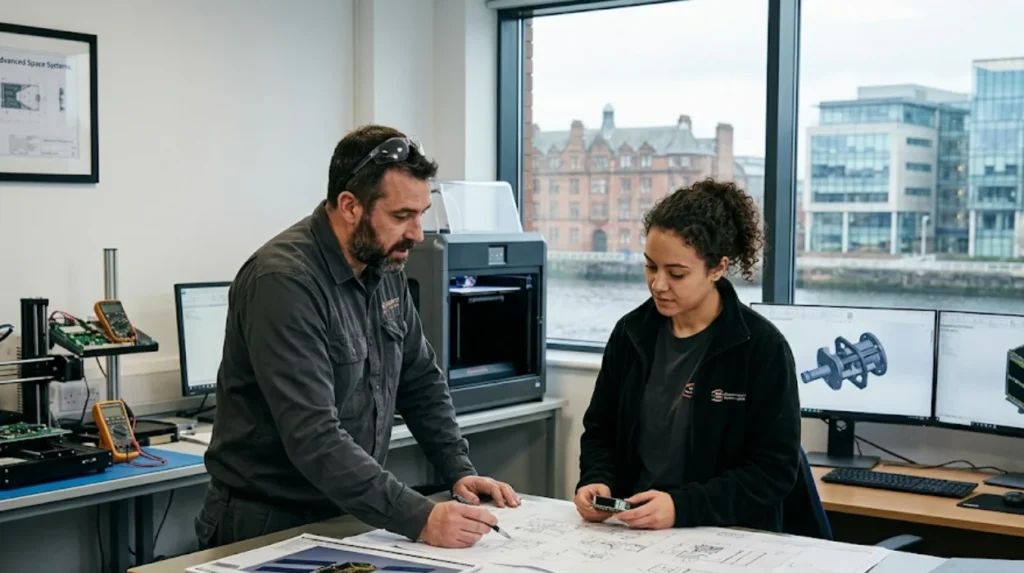
The primary technology sub-sectors driving job growth in Glasgow are space technology, health informatics, defense systems engineering, and enterprise public sector software. These industries leverage Glasgow’s traditional engineering expertise to build physical hardware integrated with complex cloud-based software platforms.
Space technology represents one of Glasgow’s fastest-growing specialisms. The city manufactures more satellites than any other urban center outside of the United States. Organizations like AAC Clyde Space design, build, and operate nanosatellites that weigh less than 10 kilograms. This industry creates constant demand for specific technical roles, including embedded systems software engineers, telemetry data analysts, and radio frequency hardware engineers.
Health informatics is another critical driver, accelerated by the Queen Elizabeth University Hospital campus, which is one of the largest acute medical facilities in Western Europe. The integration of clinical data platforms requires specialists in health data science, secure medical database administration, and predictive machine learning models. These professionals build tools that analyze patient diagnostics and streamline operational workflows for National Health Service Scotland.
Defense and marine electronics companies utilize Glasgow’s historic maritime geography to develop advanced sensor arrays and communications systems. Firms such as Thales and BAE Systems maintain large engineering facilities along the Clyde, employing hundreds of software assurance engineers, cyber-physical systems security experts, and real-time operating systems developers. These teams build navigation and radar software used in international defense applications.
What are the primary technology sub-sectors driving job growth in Edinburgh?
The primary technology sub-sectors driving job growth in Edinburgh are financial technology, artificial intelligence development, data science, and business-to-business software-as-a-service platforms. These fields rely heavily on advanced algorithms, cloud infrastructure, and Venture Capital investments.
Financial technology, or fintech, forms the core of Edinburgh’s digital economy. The city is officially designated as a top-global fintech hub, supported by FinTech Scotland, an independent cluster management organization. The presence of corporate financial institutions creates a large market for consumer banking applications, automated compliance systems, and algorithmic trading infrastructure. This ecosystem requires data engineers, cloud architects, and full-stack JavaScript developers.
Artificial intelligence and machine learning research have achieved significant commercial scale in Edinburgh, driven by decades of academic research at local institutions. The first report of Scotland’s Technology Council, published in March 2026, emphasizes that artificial intelligence jobs command a 21% salary premium across the nation. Edinburgh hosts numerous artificial intelligence startups and multinational research centers focusing on natural language processing, computer vision, and predictive analytics.
Business-to-business software-as-a-service operations utilize Edinburgh’s abundant venture capital networks to scale their corporate footprints. Companies specializing in travel technology, data governance, and human resources management platforms maintain large headquarters in the city center. These firms drive high job volumes for product managers, user experience designers, and site reliability engineers tasked with maintaining continuous cloud operations.
How do technology salaries compare between Glasgow and Edinburgh in 2026?
Technology salaries in Edinburgh are generally 5% to 10% higher than equivalent roles in Glasgow across senior and specialized positions. However, entry-level compensation remains highly competitive and nearly identical across both municipal areas.
According to the Eden Scott Tech Salary Guide Scotland, compensation models vary directly by specialism, seniority, and location. In Edinburgh, the high concentration of well-capitalized financial entities and venture-backed startups inflates the market rate for elite technical talent. In Glasgow, compensation aligns closely with industrial engineering scales and public sector frameworks.
| Technical Role | Glasgow Salary Range (2026) | Edinburgh Salary Range (2026) |
| Junior Software Developer | £30,000 – £40,000 | £32,000 – £42,000 |
| Mid-Level DevOps Engineer | £50,000 – £68,000 | £55,000 – £75,000 |
| Senior Cloud Architect | £80,000 – £105,000 | £85,000 – £115,000 |
| Senior AI / ML Engineer | £85,000 – £110,000 | £90,000 – £125,000 |
| Data Scientist | £50,000 – £70,000 | £55,000 – £78,000 |
Senior leadership positions, including Chief Technology Officers and Vice Presidents of Engineering, show wider disparities. An executive position in an Edinburgh fintech corporation frequently yields base salaries exceeding £140,000, accompanied by equity incentives. A comparable technology leadership role in a Glasgow engineering firm typically maxes out at £120,000 base salary, though it often provides superior pension contributions and health benefits.
The salary gap narrows significantly within specialized fields like artificial intelligence and machine learning. Because competent Python and PyTorch developers are in short supply globally, employers in both Glasgow and Edinburgh must match national UK benchmarks to prevent talent from migrating to London. Consequently, a machine learning engineer with four years of experience can command at least £75,000 in either city.
What is the difference in the cost of living and disposable income between both cities?
Glasgow offers a significantly lower cost of living than Edinburgh, resulting in higher net disposable income for technology workers earning similar nominal salaries. The primary differentiator is the cost of residential housing, including both property purchases and monthly rentals.
Data from the Office for National Statistics indicates that residential rent prices in Edinburgh are approximately 35% higher than those in Glasgow. A standard two-bedroom apartment in central Edinburgh costs an average of £1,600 per month, whereas a comparable property in the West End or City Centre of Glasgow averages £1,150 per month. This difference directly preserves £5,400 in post-tax income annually for workers residing in Glasgow.
Property purchase prices show an even larger divergence. The average cost per square meter for residential real estate in Edinburgh sits at roughly £4,200, driven by strict historic preservation laws and geographic constraints that limit new housing developments. Glasgow features a wider geographic footprint and a larger volume of post-industrial brownfield conversions, keeping the average cost per square meter at approximately £2,600.
Daily living expenditures, including local public transportation, municipal council taxes, child care, and leisure activities, are roughly 8% cheaper in Glasgow. A technology professional earning £60,000 in Glasgow will retain a higher percentage of net income after essential expenditures than an identical professional earning £65,000 in Edinburgh. This economic reality makes Glasgow highly attractive to mid-career developers establishing families.
Which city possesses the stronger technology startup ecosystem and funding network?
Edinburgh possesses a larger, more mature technology startup ecosystem and a significantly stronger venture capital funding network than Glasgow. The capital city attracts the majority of Scottish technology investments, angel networks, and institutional startup accelerators.
Edinburgh’s startup dominance is anchored by CodeBase, which is the largest technology incubator in the United Kingdom. CodeBase houses over 100 technology companies and serves as the central hub for the Scottish Government’s Techscaler program, an initiative designed to deliver run-time entrepreneurial education and mentorship. Edinburgh has successfully produced multiple technology unicorns, companies valued over 1 billion dollars, including Skyscanner and FanDuel.
Investment infrastructure is heavily concentrated in the capital. Angel investment syndicates, such as Archangels and Par Equity, are headquartered in Edinburgh and actively deploy capital into early-stage software and life sciences companies. Corporate venture arms from major financial institutions also maintain their investment committees within the city, providing local startups with direct routes to Series A and Series B funding rounds.
Glasgow’s startup ecosystem is smaller but growing around specialized university innovation zones, such as the Glasgow City Innovation District located in the Merchant City area. Funding in Glasgow leans toward public sector grants, Innovate UK funding, and corporate partnerships with engineering conglomerates rather than equity-based venture capital. This structure favors capital-intensive hardware and deep-tech startups that require longer development cycles before commercialization.
Explore More Area Guide
What Is the Average Salary in Glasgow and Is It Enough to Get By?
Is Maryhill Worth Living in or Should You Look Elsewhere in Glasgow?
How do the university systems in Glasgow and Edinburgh impact local tech job opportunities?
The university systems in both cities provide world-class talent pipelines, but they feed different sectors of the digital economy. Edinburgh universities focus on theoretical computer science and artificial intelligence, while Glasgow institutions emphasize applied engineering and collaborative industrial research.
The University of Edinburgh is a global leader in computing research, ranking among the top institutions globally for computer science and informatics. Its data science graduates are routinely recruited by international tech giants, including Amazon, Microsoft, and Google, all of which maintain engineering offices in Edinburgh to harvest this specific talent pool. The institution’s research focus accelerates local hiring in advanced software sectors.
Glasgow benefits from a dual-university structure that provides a broader spectrum of technical competencies. The University of Glasgow is a major center for computing science, human-computer interaction, and quantum computing hardware. The University of Strathclyde excels in electrical engineering, data-driven manufacturing, and satellite systems, operating the Technology and Innovation Centre to facilitate direct knowledge transfers to commercial businesses.
These academic networks actively lower recruitment frictions for local businesses. Through programs like the Knowledge Transfer Partnership, a government-funded graduate placement scheme, technology companies in Glasgow can embed postgraduate researchers directly into their engineering teams. This structural link ensures that local businesses remain aligned with contemporary technological developments.
What are the remote work and commuting dynamics between Glasgow and Edinburgh in 2026?
The short geographic distance between Glasgow and Edinburgh creates a highly integrated, fluid job market connected by rapid rail links. A significant percentage of technology professionals reside in Glasgow to capitalize on cheaper housing while working hybrid roles for companies based in Edinburgh.
The physical distance between Glasgow Queen Street station and Edinburgh Waverley station is 47 miles. ScotRail operates express train services every 15 minutes during peak hours, with an average transit time of 42 minutes. This infrastructure enables seamless inter-city commuting, effectively transforming the Scottish Central Belt into a single, unified technology labor market.
In 2026, hybrid working models dominate the technology landscape across Scotland, with standard corporate policies requiring two days of in-office attendance per week. This policy shift directly benefits Glasgow’s residential economy. Technology workers can accept higher-paying positions in Edinburgh’s fintech or software-as-a-service sectors without incurring the high cost of living associated with relocating to the capital.
Co-working spaces have expanded in Glasgow to support this distributed workforce. Facilities like Clockwise and Spaces provide enterprise-grade internet connectivity, meeting rooms, and hot-desking facilities for remote workers. This decentralized setup allows distributed teams to collaborate effectively without requiring dedicated corporate real estate, lowering overhead costs for employers and employees alike.

How will government policies and future investments shape both tech hubs over the next decade?
Government policies and investments are structured to reinforce the specific strengths of each city, funding artificial intelligence infrastructure in Edinburgh and advanced manufacturing and green technologies in Glasgow. These long-term initiatives ensure both cities remain globally competitive.
The Scottish Government’s “Vision 2035: Scotland’s Next Horizon” report positions the technology sector as a core driver of national gross domestic product. A key component of this policy is the continuous funding of the Techscaler network, which provides foundational infrastructure, digital training platforms, and international hub access across both municipal areas to stimulate commercial software creation.
In Glasgow, public investment targets the Clyde Climate Valley initiative, a regional development plan focused on clean technology, renewable energy software, and smart-grid integration. The Advanced Manufacturing Innovation District Scotland, located near Glasgow Airport, receives substantial funding to integrate internet-of-things sensors, robotics, and automation software into traditional manufacturing supply chains, creating long-term roles for automation engineers.
Edinburgh benefits from sustained investment through the Edinburgh and South East Scotland City Region Deal, which funds the Data-Driven Innovation program. This initiative anchors the Edinburgh Futures Institute, a major facility dedicated to examining the ethical, commercial, and technical implementations of data science and artificial intelligence. These investments guarantee that Edinburgh retains its status as a premier location for high-level data processing and algorithmic development.
Is Glasgow a good city for technology jobs in 2026?
Yes, Glasgow is one of Scotland’s leading technology hubs, offering strong career opportunities in software engineering, cybersecurity, data science, health technology, and advanced manufacturing.