

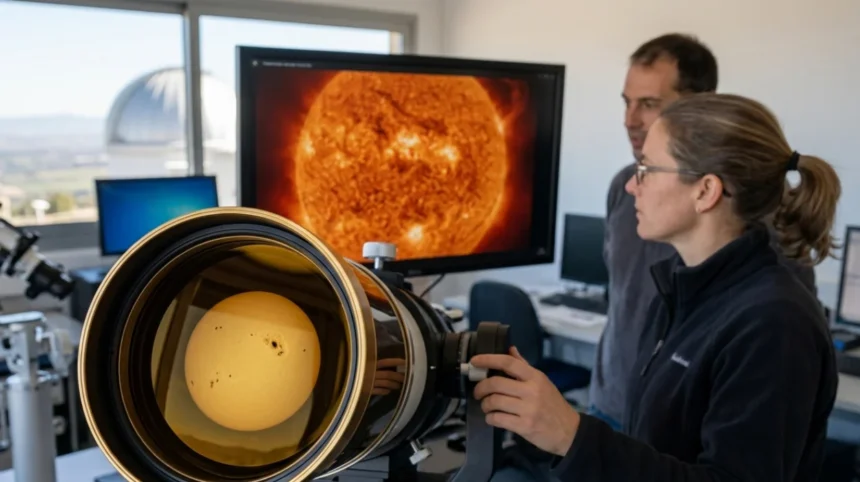
The Sun is a luminous, nearly perfect sphere of hot plasma at the center of the Solar System, composed of 74.9% hydrogen and 23.8% helium. It functions as a main-sequence star, generating light and heat through nuclear fusion.
- What Is the Internal Structure of the Sun?
- How Does the Sun Produce and Regulate Its Magnetic Field?
- What Types of Solar Activity Impact the Solar System?
- How Does Solar Radiation and Activity Influence the Environment of Glasgow?
- What Is the Lifecycfle of the Sun and Its Future Path?
- How Do Scientists Observe and Measure the Sun?
- What Role Does the Sun Play in the Energy Systems of Earth?
The Sun is classified as a G2V star, commonly referred to as a yellow dwarf. It formed approximately 4.6 billion years ago from the gravitational collapse of a matter cloud within a large molecular cloud. The Sun contains 99.86% of the total mass of the entire Solar System. Its mass is approximately $1.989 \times 10^{30}$ kilograms, which is roughly 333,000 times the mass of Earth. The structural diameter of the Sun measures 1.39 million kilometers, making it 109 times wider than Earth.
The primary mechanism driving the Sun is nuclear fusion, which occurs exclusively within its core. In this zone, temperatures exceed 15 million degrees Celsius ($1.5 \times 10^7 \text{°C}$) and the pressure reaches 250 billion atmospheres. These extreme conditions force hydrogen nuclei to fuse into helium nuclei via a process called the proton-proton chain reaction. Every single second, the Sun fuses approximately 600 million metric tons of hydrogen into 596 million metric tons of helium. The remaining 4 million metric tons of matter are converted directly into energy, as dictated by the mass-energy equivalence equation ($E=mc^2$). This energy takes between 10,000 and 170,000 years to escape the dense solar interior to reach the surface, from where it radiates into space as electromagnetic radiation, including visible light, ultraviolet light, and infrared radiation.
What Is the Internal Structure of the Sun?
The internal structure of the Sun consists of three distinct interior zones—the core, the radiative zone, and the convection zone—surrounded by three atmospheric layers, which are the photosphere, the chromosphere, and the outermost corona.
The structural profile of the Sun is divided by density, temperature, and energy transport mechanisms. The core extends from the center of the Sun to approximately 20% to 25% of the solar radius. It is the only region that produces significant heat through nuclear fusion. Surrounding the core is the radiative zone, which extends out to about 70% of the solar radius. In this zone, the plasma is dense enough that thermal radiation is the primary mechanism for energy transfer. Photons repeatedly bounce off charged particles, traveling through a process known as a “random walk,” which drastically slows their outward progress.
The final interior layer is the convection zone, which occupies the outer 30% of the solar radius. Here, the temperature drops below 2 million degrees Celsius, making the plasma less dense and opaque enough to trap heat. Energy transport changes from radiation to thermal convection. Giant bubbles of hot plasma rise toward the surface, cool down, and sink back toward the interior. This movement creates boiling patterns visible on the solar surface called granules. Above the convection zone lies the solar atmosphere. The first layer is the photosphere, which is the visible surface of the Sun. It is approximately 100 kilometers thick, with temperatures ranging between 4,500 and 6,000 degrees Celsius. Above the photosphere is the chromosphere, a reddish layer roughly 2,000 kilometers deep. The outermost layer is the corona, an extended plasma atmosphere that reaches millions of kilometers into space.

How Does the Sun Produce and Regulate Its Magnetic Field?
The Sun produces and regulates its magnetic field through an internal solar dynamo, a physical process driven by the differential rotation of plasma and convective fluid motions inside the outer third of the stellar interior.
The solar magnetic field is generated at a specific boundary layer known as the tachocline, which sits precisely between the radiative zone and the convection zone. Unlike solid planetary bodies, the Sun exhibits differential rotation. The solar equator rotates completely once every 25 days, whereas the solar polar regions require up to 35 days to complete a single rotation. This variance in rotational velocity stretches and twists the internal magnetic field lines along the longitudinal axis, a phenomenon solar physicists define as the Omega effect.
Convective updrafts within the outer solar interior further manipulate these field lines by twisting them along the latitudinal axis, a process termed the Alpha effect. Together, these mechanisms amplify the global magnetic field strength. The solar magnetic field fluctuates across an average 11-year cycle called the solar cycle. During this timeframe, the magnetic poles of the Sun completely swap places. This activity cycle is monitored by tracking the frequency and size of sunspots, which are temporary, dark regions on the photosphere where intense magnetic fields inhibit thermal convection, lowering surface temperatures to roughly 3,500 degrees Celsius. The solar dynamo regulates the release of magnetic energy, which drives solar eruptive events.
What Types of Solar Activity Impact the Solar System?
The Sun exhibits four primary types of solar activity: sunspots, solar flares, coronal mass ejections, and the continuous solar wind. These phenomena project high-energy particles and electromagnetic radiation across space.
Solar activity is a direct consequence of magnetic field reorganization and reconnection events. Sunspots serve as the structural hubs for more volatile activity. When the twisted magnetic field lines above sunspot groups suddenly realign, they release vast quantities of energy. This event is a solar flare, a sudden flash of increased brightness on the solar limb or disk. Solar flares emit radiation across the entire electromagnetic spectrum, from radio waves to X-rays and gamma rays, accelerating local particles to near the speed of light.
A distinct but often simultaneous event is a Coronal Mass Ejection (CME). A CME is a massive burst of solar wind and magnetic fields rising above the solar corona. These events release billions of tons of magnetized plasma, consisting mostly of electrons and protons, traveling at speeds ranging from 250 to 3,000 kilometers per second. While solar flares travel at the speed of light and reach planetary orbits in 8.3 minutes, CMEs take one to five days to traverse the same distance. The entire heliosphere is also continuously filled by the solar wind, a steady stream of ionized plasma escaping the gravitational pull of the Sun through coronal holes. The solar wind travels outward at speeds averaging 400 kilometers per second, maintaining the bubble that defines the outer boundary of the Solar System.
How Does Solar Radiation and Activity Influence the Environment of Glasgow?
Solar radiation directly establishes the seasonal baseline, agricultural photoperiods, and solar energy yields in Glasgow, while solar activity dictates the visibility of the Aurora Borealis and impacts the local high-latitude electrical grid infrastructure.
Glasgow sits at a high northern latitude of 55.86 degrees North. This geographic position causes extreme seasonal variations in the angle of incidence of solar radiation. During the winter solstice, the Sun reaches a maximum altitude of just 10.8 degrees above the local horizon, providing Glasgow with 6 hours and 57 minutes of daylight. During the summer solstice, the solar altitude reaches 57.6 degrees, extending daylight to 17 hours and 36 minutes. This high-latitude location means the total solar irradiance varies from less than 0.5 kilowatt-hours per square meter per day in December to over 4.5 kilowatt-hours per square meter per day in June.
The environmental impact of solar activity is amplified at Glasgow’s latitude due to its proximity to the auroral oval, which expands southward during periods of high solar activity. When coronal mass ejections interact with the magnetosphere of Earth, they trigger geomagnetic storms. These storms redirect charged particles down the planetary magnetic field lines toward the poles, causing the Aurora Borealis to become visible in the skies over Greater Glasgow.
Geomagnetic storms induce ground currents in high-latitude regions. These Geomagnetically Induced Currents (GICs) enter high-voltage power transmission systems, such as the Scottish electrical grid infrastructure operated by SP Energy Networks. GICs saturate the magnetic cores of transformers, causing systemic voltage instability, overheating, and potential hardware damage. Furthermore, solar flare ionization disruptions alter the ionosphere above the United Kingdom, degrading High Frequency (HF) radio communications and decreasing the accuracy of Global Positioning System (GPS) data used by marine and aviation transit networks in the River Clyde corridor.
Explore More uk/area-guide/">Area Guide
What Is the Average Salary in Glasgow and Is It Enough to Get By?
Is Maryhill Worth Living in or Should You Look Elsewhere in Glasgow?
What Is the Lifecycfle of the Sun and Its Future Path?
The lifecycle of the Sun spans roughly 10 to 11 billion years, progressing from its current main-sequence state into a red giant star, before shedding its outer layers to leave a cooling white dwarf.
The Sun is currently 4.6 billion years old and has expended approximately half of the hydrogen core reserves required for nuclear fusion. It resides in a state of hydrostatic equilibrium, where the inward pull of gravity is balanced by the outward thermal pressure generated by fusion reactions. The Sun is slowly increasing in brightness, experiencing a 10% increase in total luminosity every 1.1 billion years as the solar core contracts and increases in temperature.
In approximately 5 billion years, the hydrogen fuel in the core will be entirely exhausted. Hydrostatic equilibrium will break, causing the core to collapse under its own gravity, which will elevate internal temperatures until a shell of hydrogen surrounding the core begins fusion. This process will cause the outer layers of the Sun to expand dramatically, transitioning the star into the red giant phase. During this period, the solar radius will expand beyond 1 astronomical unit, which is 150 million kilometers, completely engulfing the orbits of Mercury, Venus, and potentially Earth. The red giant Sun will sustain itself for approximately 1 billion years, fusing helium into carbon and oxygen within its core. Once helium reserves deplete, the Sun will eject its outer plasma envelopes into space, creating a planetary nebula. The remaining structural remnant will be a white dwarf, a dense, earth-sized carbon-oxygen core that contains no nuclear fuel source, which will slowly radiate its remaining thermal energy into space over trillions of years.
How Do Scientists Observe and Measure the Sun?
Scientists observe and measure the Sun using ground-based solar telescopes equipped with adaptive optics, paired with space-based satellite observatories that capture ultraviolet, X-ray, and coronagraphic imagery outside the atmosphere of Earth.
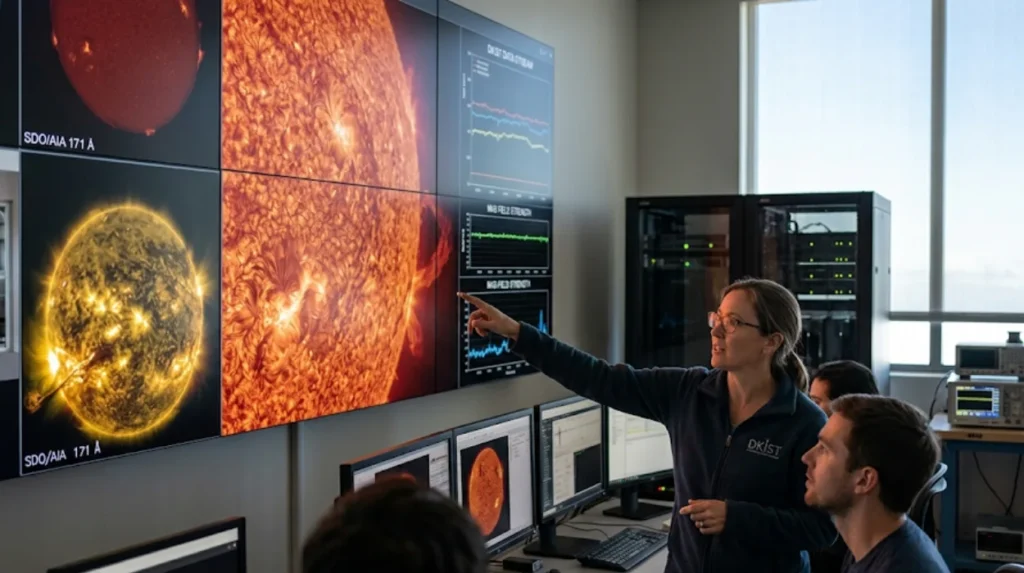
Solar observation requires specialized instruments capable of mitigating extreme thermal energy while resolving fine structural details in the solar atmosphere. Ground-based infrastructure relies on installations like the Daniel K. Inouye Solar Telescope (DKIST) in Hawaii, which utilizes a 4-meter aperture to resolve features as small as 20 kilometers across on the solar surface. Ground observatories use specialized filters, including Hydrogen-alpha (H-alpha) filters centered at a wavelength of 656.3 nanometers, to study the dynamics of the solar chromosphere and prominences.
Space-based assets are required to observe the shortwave radiation blocked by the ozone layer of Earth. The Solar Dynamics Observatory (SDO), launched by NASA in 2010, continuously records the solar atmosphere across 10 distinct wavelengths using its Atmospheric Imaging Assembly. The Solar and Heliospheric Observatory (SOHO), a joint mission between ESA and NASA stationed at the Lagrange Point 1 (L1), uses coronagraphs to block the bright light of the photosphere, allowing continuous tracking of coronal mass ejections.
To measure the solar wind directly, missions like the Parker Solar Probe and Solar Orbiter travel close to the star. The Parker Solar Probe uses a carbon-composite heat shield to withstand temperatures over 1,300 degrees Celsius, diving into the solar corona to measure magnetic field strengths and plasma densities directly, which helps scientists understand how the corona is heated to temperatures hotter than the solar surface.
What Role Does the Sun Play in the Energy Systems of Earth?
The Sun drives the natural atmospheric, hydrological, and biological energy systems of Earth, while simultaneously providing the electromagnetic input harnessed by human infrastructure through photovoltaic and thermal solar technologies.
All planetary energy systems, with the exception of geothermal and nuclear power, are modified forms of solar energy. The Sun delivers a continuous stream of electromagnetic energy to the top of the atmosphere of Earth, a value known as the solar constant, which averages 1,361 watts per square meter. This solar input heats the equator more intensely than the polar regions, driving global atmospheric circulation patterns and oceanic currents. Solar thermal energy drives the hydrological cycle by evaporating approximately 505,000 cubic kilometers of water annually, which powers global weather systems.
Biological energy systems rely on solar inputs through oxygenic photosynthesis, a biochemical process where autotrophic organisms, such as green plants, algae, and cyanobacteria, convert solar photons into chemical energy. This process fixes carbon dioxide into carbohydrates, forming the foundational trophic layer of global food chains. Over geological timescales, buried photosynthetic biomass transformed into fossil fuels, including coal, oil, and natural gas.
In modern infrastructure, solar energy is directly captured via two main technological methods: photovoltaic systems and concentrated solar thermal plants. Photovoltaic cells use semiconductor materials, such as silicon, to convert solar photons directly into electrical energy via the photoelectric effect. Solar thermal systems use mirrors to focus sunlight to heat fluids, which drive turbines to generate utility-scale electricity, integrating solar power into global energy grids.
What is the Sun?
The Sun is a G2V main-sequence star located at the center of the Solar System. It consists primarily of hydrogen and helium and contains approximately 99.86% of the Solar System’s total mass.