

Key Points
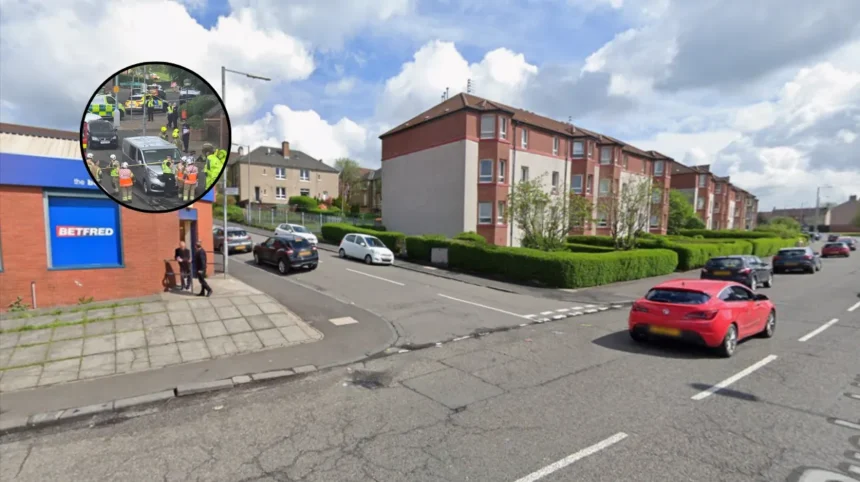
- Incident Location: Emergency services were called to a residential property located on Lenzie Terrace in the Springburn area of North Glasgow.
- Emergency Response: Police Scotland and the Scottish Fire and Rescue Service (SFRS) attended the scene following an emergency call received at approximately 3.30pm on Sunday, May 31, 2026.
- Precautionary Measures: Multiple residential properties in the immediate vicinity were evacuated by authorities, and a strict police cordon was established to block off the street.
- Public Advice: Members of the public were explicitly requested to avoid the area entirely, while individuals requiring assistance were instructed to approach on-scene officers or contact Police Scotland.
- Casualties Unconfirmed: As of late Sunday evening, emergency services remained on the scene, and no official information had been released regarding whether any individuals sustained injuries.
North Glasgow (Glasgow Express) June 1, 2026 – A major emergency response was triggered in a northern district of Glasgow this afternoon after a suspected “chemical incident” inside a residential property prompted a multi-agency operation, widespread evacuations, and the complete closure of a public street.
The emergency response saw Police Scotland officers and crews from the Scottish Fire and Rescue Service deploy to Lenzie Terrace in the Springburn area. Specialist responders established a safety perimeter around the affected site, displacing nearby residents from their homes as a preventative measure while investigators worked to identify the nature of the substance involved.
What Happened During the Lenzie Terrace Chemical Incident?
The incident began unfolding in the mid-afternoon of Sunday, May 31, 2026, when authorities received reports concerning a hazardous substance or dynamic within a property on Lenzie Terrace.
Emergency personnel arrived on the scene shortly after 3.30pm to find a developing situation that required immediate containment.
As reported by Donald Erskine, a news reporter for the Glasgow Times, Police Scotland locked down the residential street completely, sealing off access to both pedestrian and vehicular traffic.
The Scottish Fire and Rescue Service mobilised resources to assist in securing the building and managing the potential environmental and health hazards associated with the unidentified chemical footprint.
How Did Emergency Services Respond to the Scene?
The operational response involved a co-ordinated effort between law enforcement and fire crews to isolate the property while minimizing risk to the wider Springburn community.
Officers established a visual and physical boundary around the location, directing traffic away from the intersection and adjacent corridors.
According to a formal public statement issued by a Police Scotland spokesperson and published across regional media titles, the primary focus of the initial response was safety containment:
“Emergency services are in attendance at a chemical incident at a property on Lenzie Terrace in Glasgow, which was reported around 3.30pm on Sunday, 31 May, 2026. Nearby properties have been evacuated as a precaution, and the public is asked to avoid the area.”
The spokesperson further advised via the Glasgow Times and STV News that any local residents or displaced individuals requiring immediate assistance should
“approach officers at the scene or call Police Scotland on 101, quoting incident number 1991 of 31 May, 2026.”
What Was the Immediate Impact on Local Residents?
For the residents of Lenzie Terrace and the surrounding Springburn neighborhood, the sudden influx of emergency vehicles and the imposition of a containment zone caused significant immediate disruption to their Sunday afternoon.
As detailed in a report by the Daily Record, the enforcement of the safety perimeter meant that some individuals within the exclusion zone were restricted from moving freely outside their doors. One local resident, speaking anonymously to a reporter from the Daily Record, described the scene on the ground:
“The street is completely blocked off and some of us aren’t even allowed to leave the house.”
Displaced families from the evacuated properties were forced to wait behind police lines as specialist teams evaluated the interior of the target premises. No official rest centres or temporary shelters were immediately announced, though officers on the perimeter remained the primary point of contact for vulnerable citizens needing logistical support.
Are There Any Confirmed Casualties or Ongoing Risks?
As the operation extended into the evening hours, details regarding the precise source of the chemical risk, its composition, or the presence of occupants inside the primary property remained strictly controlled by responding agencies.
According to reports published by STV News journalist Matthew Fulton, emergency services were still actively managing the scene at Lenzie Terrace as late as 6.20pm on Sunday.
At that time, it remained entirely unclear whether any residents, occupants, or first responders had suffered injuries or required medical treatment for exposure.
The Scottish Fire and Rescue Service did not immediately clarify whether specialized environmental protection units or hazardous materials (HAZMAT) teams had been required to enter the building to neutralize the threat, keeping the technical details of the containment confidential while operations were active.
Background of the Development
The deployment of multi-agency hazardous materials protocols in Glasgow residential zones follows established standard operating procedures designed to mitigate volatile domestic hazards.
In urban areas like Springburn, which features a mixture of high-density tenement blocks and modern residential terraced housing, chemical incidents typically fall into a few distinct operational categories: accidental household chemical mixtures, industrial agricultural run-off storage failures, or illegal clandestine laboratory activities.
Under the United Kingdom’s Control of Major Accident Hazards (COMAH) regulations and local civil contingency frameworks, Police Scotland and the Scottish Fire and Rescue Service treat any unverified chemical odor or substance report within a multi-family dwelling as a high-priority threat.
This requires an immediate cordon, defensive evacuation of structural neighbors to prevent inhalation risks, and atmospheric testing before residents are permitted back into their homes.
Prior incidents in the wider Glasgow area—such as the notable evacuation of the Silverburn Shopping Centre following a localized chemical scare—demonstrate the strict precautionary stance taken by Scottish emergency services to avoid mass-exposure casualties before the exact toxicity of a substance is determined by scientific analysis.
Prediction
This development is expected to have a multi-layered impact on the local community of Springburn and the broader population of North Glasgow. In the short term, residents living directly on or adjacent to Lenzie Terrace will experience persistent logistical disruptions, including restricted vehicle access, localized parking bans, and potential delays in returning to their homes while environmental health officers conduct mandatory air quality and structural safety clearances.
For the wider community, an incident of this nature typically triggers an increase in localized anxiety and a temporary demand for transparency regarding neighborhood safety. If investigations reveal that the chemical source was linked to hazardous domestic storage or illicit processing, it may prompt Glasgow City Council and housing associations to review tenant inspection protocols and implement stricter guidelines regarding the storage of volatile substances in residential complexes.
Additionally, the disruption to local roads and the visible presence of emergency personnel will likely cause short-term traffic diversions through Springburn, impacting local commuters and delivery services until Police Scotland officially de-escalates the incident number 1991 log and removes the physical barriers on Lenzie Terrace.